
Choosing between the Shure SM7B and the Rode NT1 5th Gen comes down to the fundamental differences between dynamic and condenser microphone architectures. The Shure SM7B is an industry-standard cardioid dynamic microphone revered in broadcast, streaming, and untreated recording spaces for its tight off-axis rejection and warm vocal profile. The Rode NT1 5th Generation is a large-diaphragm studio condenser microphone featuring hybrid XLR and USB-C connectivity, 32-bit float digital recording, onboard digital signal processing, and a record-low 4 dBA self-noise floor.
Updated October 2026: This comparison is really two questions in one: dynamic versus condenser, and untreated room versus treated room. The SM7B forgives a noisy, echoey space; the NT1 rewards a quiet one with detail the dynamic cannot reach. Add the NT1’s USB output and 32-bit float on one side and the SM7B’s famous gain hunger on the other, and the winner is decided by your room and your chain - not by brand. This update adds the disclosure this article was missing, plus that room-first verdict below.
Disclosure: This article contains affiliate links. If you buy through them, HeadphoneEcho may earn a small commission at no extra cost to you. Recommendations are based on research and published specifications, not on commissions.
While both capture high-quality audio, they serve different acoustic environments, workflows, and budgets.
Shure SM7B vs Rode NT1 5th Gen: Which Is Better?
Rode NT1 5th Gen Update Price….
The Rode NT1 5th Gen is the better overall value and more versatile studio tool for most home creators, offering pristine acoustic detail, Dual Connect XLR/USB outputs, and unclippable 32-bit float recording out of the box. However, the Shure SM7B remains the superior choice for spoken-word creators recording in untreated, noisy rooms who want a warm broadcast tone and maximum acoustic isolation.
Winner by Category
| Category | Winner | Key Advantage |
| Acoustic Background Rejection | Shure SM7B | Low dynamic sensitivity rejects room reflections and ambient noise. |
| Acoustic Detail & Highs | Rode NT1 5th Gen | 1-inch condenser capsule delivers fast transient response up to 20 kHz. |
| Self-Noise Floor | Rode NT1 5th Gen | Ultra-quiet 4 dBA active self-noise eliminates audible hiss. |
| Connectivity & Flexibility | Rode NT1 5th Gen | Dual Connect system supports both analog XLR and direct USB-C. |
| Gain & Interface Demands | Rode NT1 5th Gen | High sensitivity (-32 dBV) requires modest preamp gain; USB mode requires none. |
| Hardware Tone Sculpting | Shure SM7B | Rear mechanical switches provide bass roll-off and mid presence boost. |
| DSP & Software Features | Rode NT1 5th Gen | Onboard APHEX processing and 32-bit float prevent clipping digitally. |
| Included Value & Kit | Rode NT1 5th Gen | Includes SM6 shock mount, pop filter, XLR cable, and USB-C cable. |
| Physical Durability | Shure SM7B | Heavy metal construction with integrated yoke mount and internal shock isolation. |
| Overall Value | Rode NT1 5th Gen | Lower purchase price with zero requirement for inline preamps or external interfaces. |
Quick Specifications
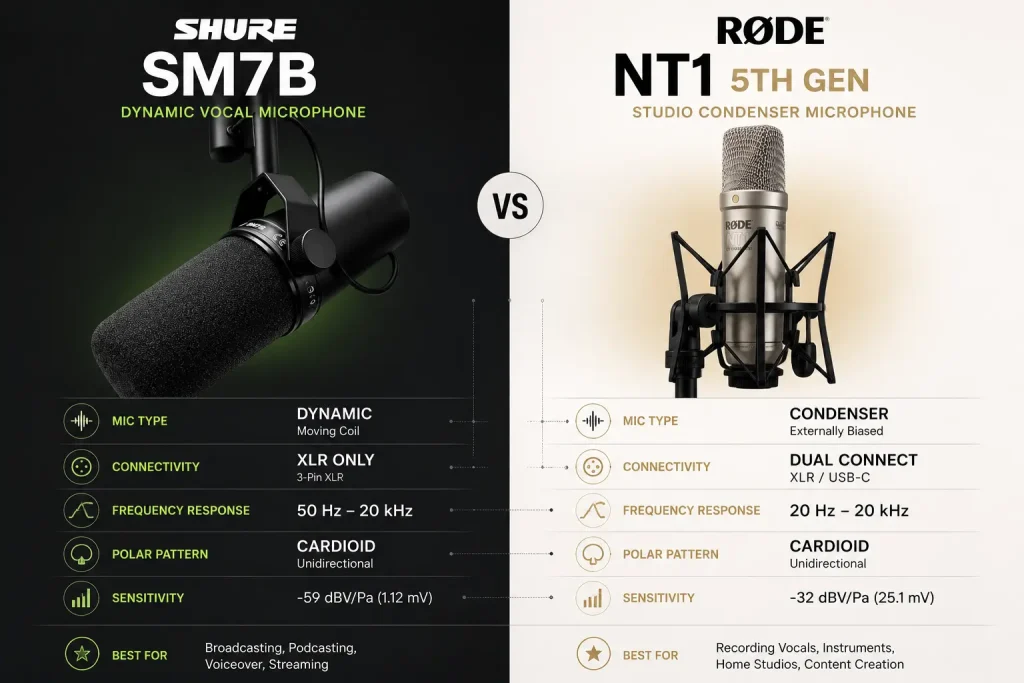
| Specification | Shure SM7B | Rode NT1 5th Generation |
| Transducer Type | Dynamic (Moving Coil) | Large-Diaphragm Condenser (1.00″ HF6) |
| Polar Pattern | Cardioid | Cardioid |
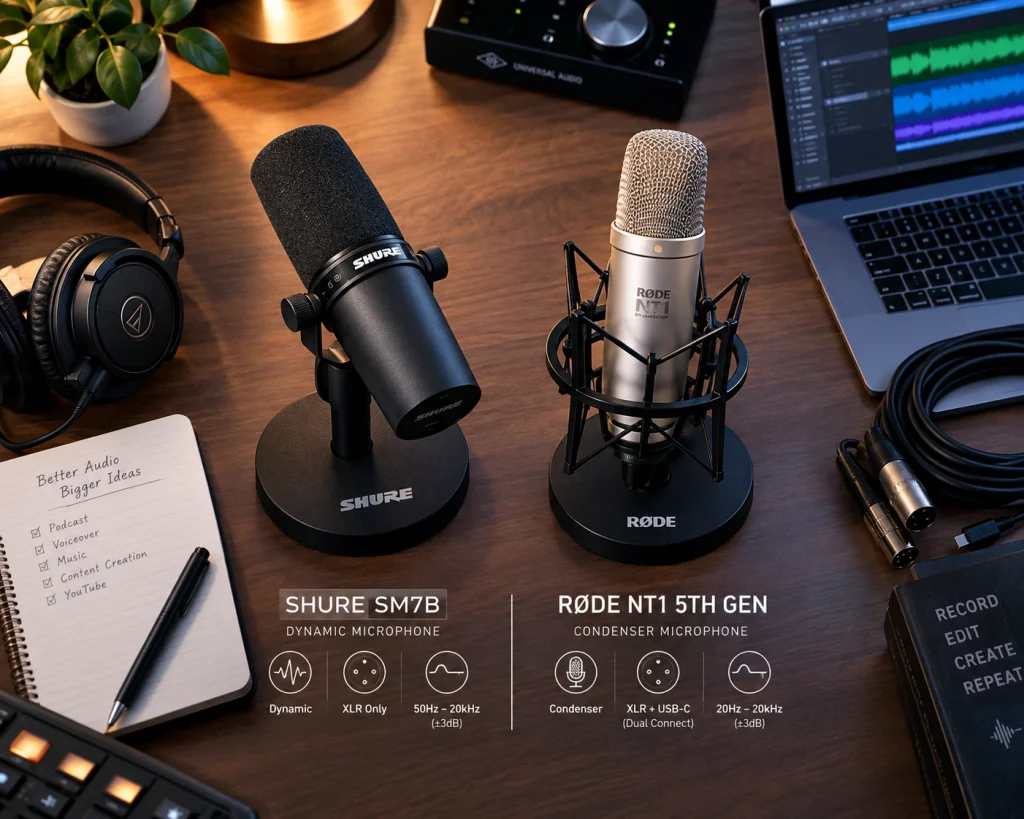
| Frequency Response | 50 Hz to 20,000 Hz | 20 Hz to 20,000 Hz |
| Sensitivity | -59.0 dBV/Pa (1.12 mV) | -32.0 dBV/Pa (25.0 mV @ 94 dB SPL) |
| Self-Noise (Equivalent) | Thermal noise only (Passive) | 4 dBA |
| Max SPL | Not officially rated (Excels at high SPL) | 142 dB SPL |
| Output Connectivity | 3-Pin XLR | Dual Connect (3-Pin XLR & USB-C) |
| A/D Resolution (Digital) | N/A (Analog Only) | 24-bit / 32-bit float (up to 192 kHz) |
| Weight | 765.4 g (1.69 lbs) | 308 g (0.68 lbs) |
| Power Requirement | Passive (No phantom power required) | +48V Phantom Power (XLR) or 5V USB Bus Power |
| Launch MSRP | $399.00 | $249.00 |
Form-Factor and Transducer Analysis
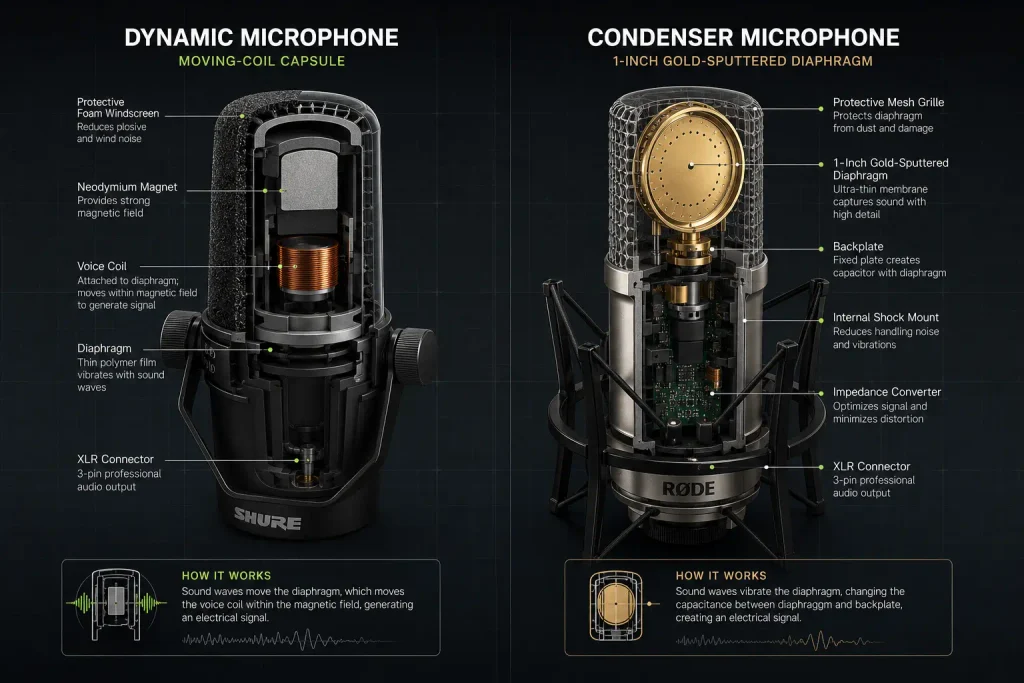
The Shure SM7B and Rode NT1 5th Gen represent two distinct microphone technologies, meaning their mechanical properties dictate how they interact with your room and voice.
Transducer Physics: The Shure SM7B uses a heavier dynamic moving-coil diaphragm. It requires substantial sound energy to move the coil, resulting in low output sensitivity (-59 dBV/Pa) and slower transient response. The Rode NT1 5th Gen employs an ultra-thin, gold-sputtered 1-inch condenser membrane with active electronics, yielding high sensitivity (-32 dBV/Pa) and rapid transient capture across high frequencies.
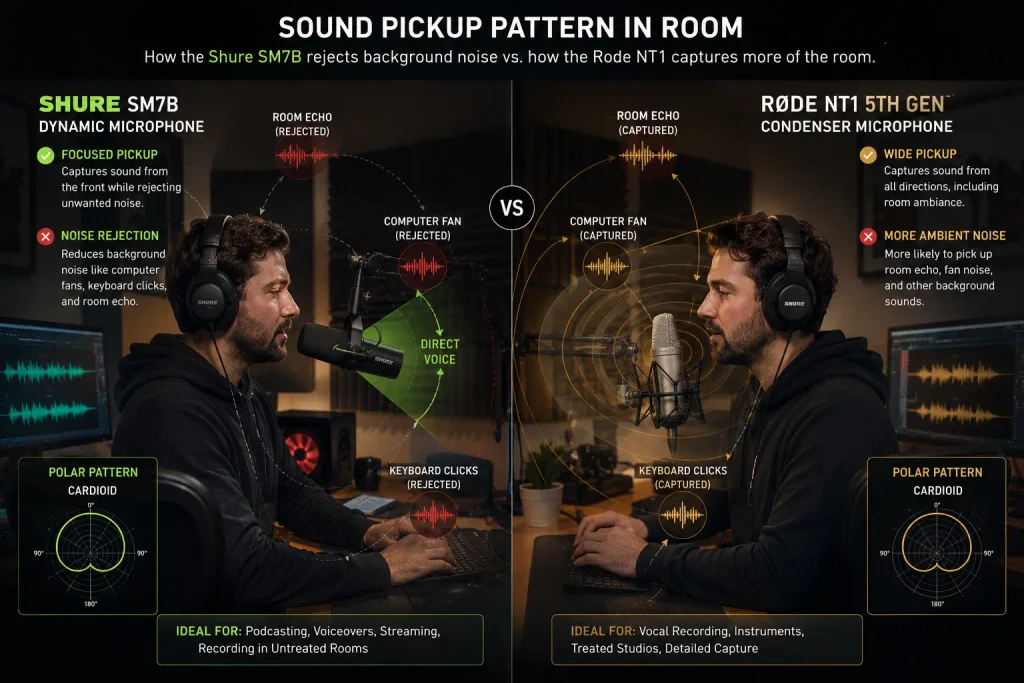
Acoustic Environment Demands: The SM7B excels in untreated rooms, home offices, and podcast studios. Its lower sensitivity and tight pickup ignore distant room reflections, HVAC rumble, and computer fans. In contrast, the NT1 5th Gen captures every sonic nuance, including room reverberation and background noises, making acoustic treatment or digital gating essential in reflective spaces.
Physical Mounting: The SM7B weighs 765.4 g (1.69 lbs) and requires a sturdy, counterbalanced boom arm to prevent sagging. Its integrated yoke mount simplifies positioning. The NT1 5th Gen is much lighter at 308 g (0.68 lbs) and mounts into an included SM6 suspension cradle that isolates mechanical desk vibrations.
How We Evaluated
This comparison synthesizes verified manufacturer technical documentation, independent laboratory benchmarks, audio engineering principles, published acoustic measurements, and documented creator workflows. Microphones are evaluated across dynamic range, self-noise, gain requirements, physical usability, background noise rejection, software processing, and total system setup costs.
Limitations: Acoustic perception, vocal coloration, ambient room pickup, and real-world gain performance vary depending on voice timbre, room reflections, audio interface preamps, and microphone placement.
Shure SM7B Review
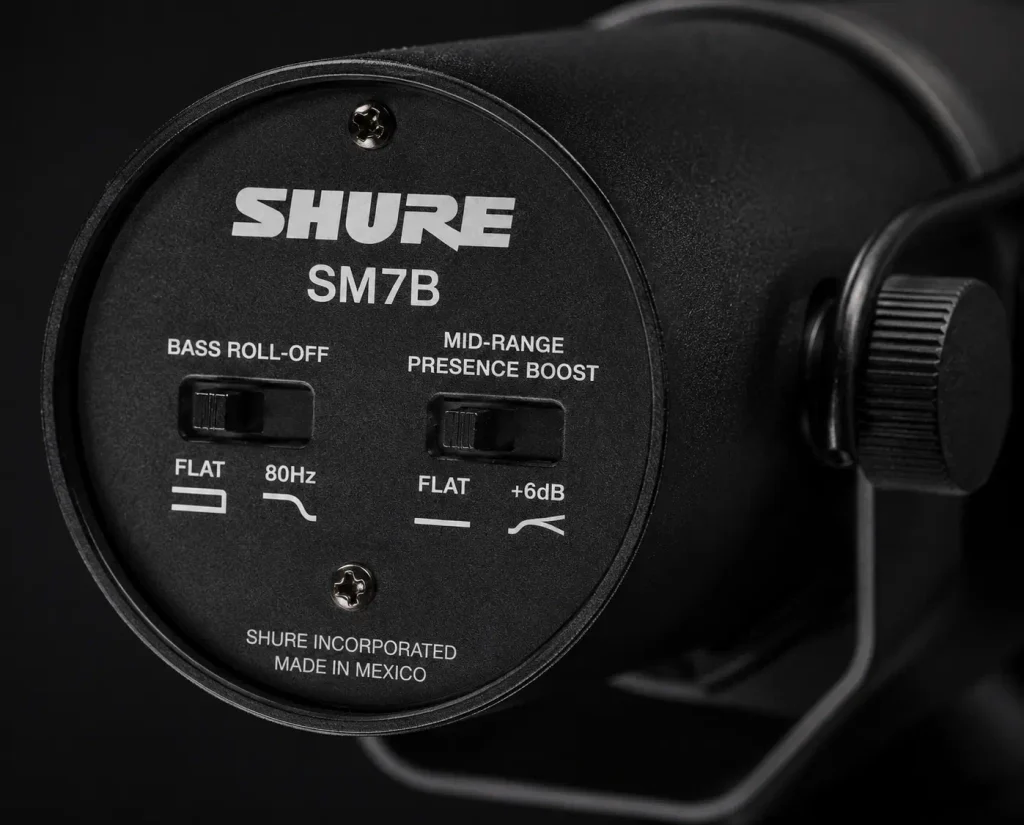
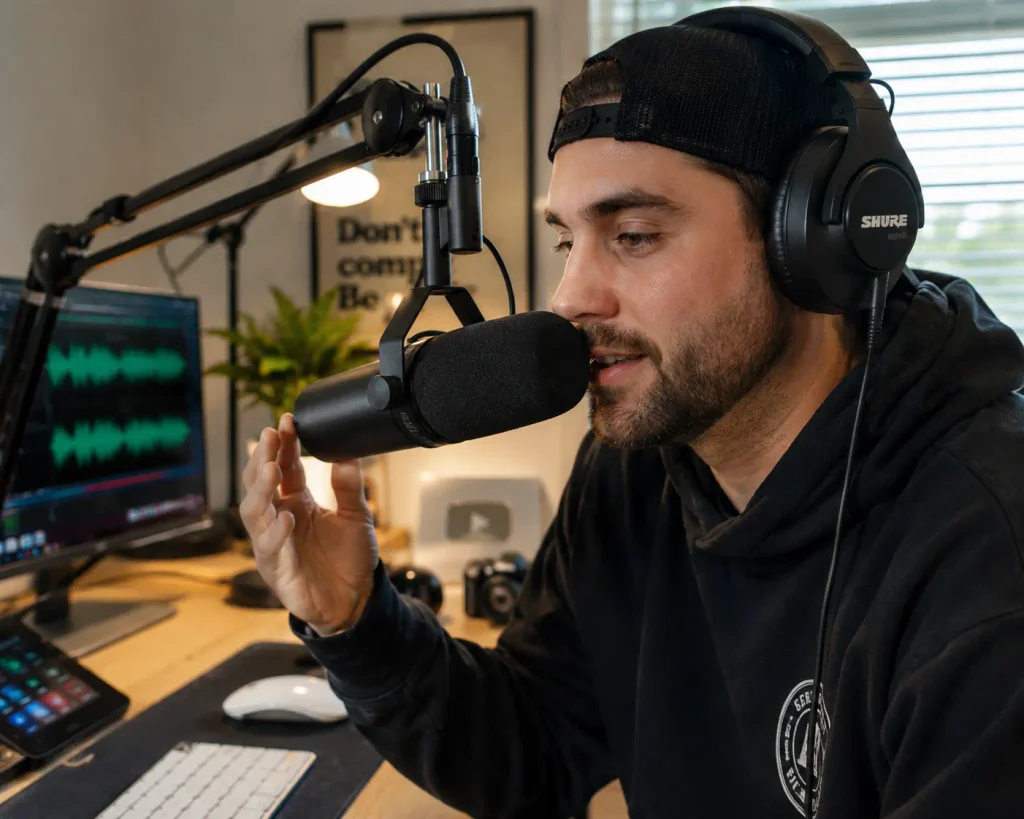
The Shure SM7B is a legendary studio dynamic microphone that has served as a benchmark for broadcast, rock vocals, and podcasting for decades. Its heavy internal air-suspension shock mount, electromagnetic humbucking coil, and thick foam windscreen provide exceptional protection against mechanical vibrations, electrical interference, and vocal plosives.
- What I Like:
- Exceptional passive rejection of room reflections and ambient background noise.
- Warm, forgiving frequency curve that smooths sibilant and harsh vocal characteristics.
- Built-in electromagnetic shielding eliminates hum from studio monitors and PCs.
- Rear passive EQ switches allow quick bass roll-off and mid-range presence boost.
- Built-in yoke mount eliminates the need for bulky external shock cages.
- Handles high sound pressure levels without audible capsule distortion.
- Ships with both standard windscreen and larger A7WS close-talk windscreen.
- What Could Be Better:
- Very low sensitivity (-59 dBV/Pa) demands 60 dB+ of clean preamp gain.
- Often requires an additional inline preamp (e.g., Cloudlifter), raising the total setup cost.
- Heavy 765.4 g chassis requires a robust, high-tension microphone arm.
- Analog XLR output only, requiring an external audio interface.
- Lacks the airy high-frequency extension found in condenser microphones.
Shure SM7B Pros & Cons
| Pros | Cons |
| Superb background and room noise rejection | Very low sensitivity requires expensive preamps or boosters |
| Classic, warm broadcast tone with smooth high frequencies | Heavy chassis causes lightweight boom arms to sag |
| Integrated shock isolation and dual windscreens included | Analog XLR only with no USB or digital DSP options |
| Built-in bass roll-off and presence boost switches | Darker high-end response on quiet or delicate instruments |
Best For:
The Shure SM7B is best suited for podcasters, streamers, voice actors, and vocalists working in untreated rooms or noisy environments. It delivers an authoritative broadcast tone while preventing unwanted room reflections from entering the mix.
Recommendation:
If you have an audio interface capable of delivering over 60 dB of clean gain (or budget for an inline preamp) and record in an average home room, the Shure SM7B delivers reliable, broadcast-ready results.
Rode NT1 5th Generation Review
The Rode NT1 5th Generation modernizes large-diaphragm condenser microphones by combining a 1-inch HF6 gold-sputtered capsule with hybrid Dual Connect technology. It operates as a standard analog XLR microphone or as a digital USB-C recording system featuring 32-bit float conversion, high-gain internal Revolution Preamps, and onboard APHEX DSP.
- What I Like:
- Dual Connect port accepts both traditional 3-pin XLR and USB-C cables.
- 32-bit float digital output prevents digital clipping at any gain setting.
- Ultra-low 4 dBA self-noise delivers a quiet background floor.
- 20 Hz to 20,000 Hz frequency response captures crisp high-end detail and deep low-end.
- Onboard APHEX DSP provides real-time compression, gating, and high-pass filtering via USB.
- Complete studio bundle includes SM6 shock mount, pop shield, XLR, and USB-C cables.
- Lightweight 308 g design mounts easily onto standard desktop stands.
- High sensitivity (-32 dBV/Pa) works with budget audio interfaces without signal boosters.
- What Could Be Better:
- Highly sensitive capsule picks up ambient room echo in untreated spaces.
- Requires software (RØDE Central / Connect) to adjust DSP settings.
- Onboard DSP and 32-bit float features function only over USB-C, not XLR.
- External shock mount and pop shield setup takes up noticeable desk space.
Rode NT1 5th Gen Pros & Cons
| Pros | Cons |
| Hybrid XLR and USB-C connectivity with 32-bit float recording | Sensitive condenser capsule captures room reflections in untreated rooms |
| World-record 4 dBA self-noise floor eliminates hiss | 32-bit float and DSP features unavailable over analog XLR |
| Complete kit with SM6 shock mount, pop filter, and cables | Larger physical footprint when mounted in the shock cradle |
| High sensitivity requires minimal preamp gain | Lacks on-chassis physical EQ switches |
Best For:
The Rode NT1 5th Gen is best for vocalists, voiceover artists, musicians, and creators who record in acoustically treated environments or need a direct-to-computer USB workflow with zero clipping risk.
Recommendation:
If you want an all-in-one studio recording package that eliminates the need for external preamps, interfaces, and gain adjustments, the Rode NT1 5th Gen offers remarkable value and fidelity.
Head-to-Head Comparison
Transducer Architecture and Sound Profile
The Shure SM7B produces a smooth, focused frequency response across 50 Hz to 20,000 Hz, with a natural roll-off in the extreme sub-bass and an intentional high-frequency smoothing that tames sibilant consonants. It provides a radio-style proximity effect when speaking close to the grille.
The Rode NT1 5th Gen delivers an extended 20 Hz to 20,000 Hz frequency response. Its HF6 1-inch condenser capsule captures fast transients, subtle breath details, and crisp treble air.
Winner: Rode NT1 5th Gen for acoustic fidelity and high-end detail; Shure SM7B for smooth, broadcast vocal warmth.
Room Noise and Background Isolation
The SM7B relies on a dynamic capsule with lower sensitivity (-59.0 dBV/Pa). Sound sources must be close to the diaphragm to generate sufficient signal, allowing the mic to naturally reject off-axis room reverberation, air conditioning, and computer fans.
The NT1 5th Gen has a sensitivity of -32.0 dBV/Pa, making it roughly 27 dB more sensitive than the SM7B. While this captures delicate acoustic instruments with ease, it also picks up room reflections, street traffic, and keyboard clicks in untreated environments.
Winner: Shure SM7B.
Gain Demands and Interface Requirements
To drive the Shure SM7B to standard broadcast levels (-18 to -14 LUFS), your audio interface preamp must supply at least +60 dB of clean gain. Budget audio interfaces often introduce audible preamp hiss when turned up to maximum gain, requiring users to buy an inline preamp booster (such as a Cloudlifter CL-1).
The Rode NT1 5th Gen requires standard +48V phantom power on XLR and drives easily with 30 to 40 dB of gain. When connected via USB-C, its internal Revolution Preamp and 32-bit float engine handle all gain staging automatically inside the mic.
Winner: Rode NT1 5th Gen.
Connectivity and Digital Signal Processing
The SM7B is an entirely passive analog XLR microphone. Its tone adjustments are limited to two mechanical rear toggle switches: a low-cut bass roll-off and a mid-range presence boost.
The NT1 5th Gen features RØDE’s Dual Connect architecture. The XLR port has a USB-C jack positioned inside the pin housing. Over USB, users gain access to 32-bit float point conversion (which makes digital clipping virtually impossible) and an onboard APHEX DSP chip that runs a high-pass filter, noise gate, compressor, Aural Exciter, and Big Bottom effects in real time with zero CPU overhead.
Winner: Rode NT1 5th Gen.
Build Quality, Mounting, and Durability
The Shure SM7B is housed in a heavy-duty die-cast aluminum and steel enclosure weighing 765.4 g. It integrates a captive swivel yoke mount with standard 5/8″-27 threading and internal air-suspension shock isolation.
The NT1 5th Gen features a machined aluminum body weighing 308 g. It relies on an external SM6 suspension shock mount and removable dual-axis metal pop filter to isolate structure-borne noise. While the NT1 is well built, the SM7B’s all-in-one steel design is more rugged.
Winner: Shure SM7B.
Evidence-Based “My Take”
My Take: For most home creators working in 2026, the Rode NT1 5th Gen represents the smarter purchase. Its Dual Connect architecture bridges the gap between plug-and-play USB convenience and professional XLR studio setups. The 32-bit float capability removes the risk of ruined takes caused by clipping, and its ultra-low 4 dBA self-noise provides a clean signal.
However, if your recording space is an untreated bedroom with hardwood floors, bare walls, or background noise, the Shure SM7B is worth the additional investment in amplification. The SM7B’s physical capsule design provides acoustic isolation that software filters cannot easily replicate.
Buyer-Specific Recommendations
Best for Untreated Rooms: Shure SM7B. The dynamic moving coil and cardioid polar pattern reject room reflections and environmental noise better than sensitive condensers.
Best for Podcasting & Live Streaming: Shure SM7B. Delivers the classic rich broadcast tone, integrates built-in plosive protection, and looks iconic on camera.
Best for Studio Vocals & Music Production: Rode NT1 5th Gen. Captures full frequency extension, subtle vocal air, and natural dynamics with a flat, clean response.
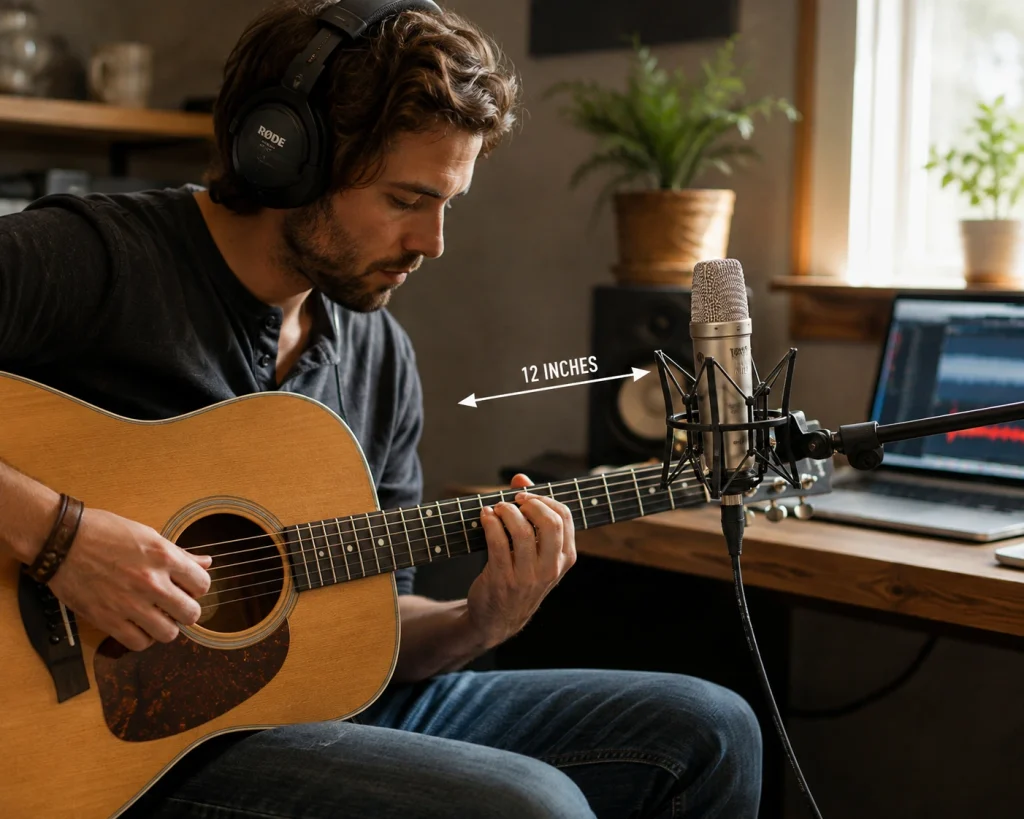
Best for Acoustic Instruments: Rode NT1 5th Gen. Fast transient response accurately tracks acoustic guitars, strings, and delicate percussion without choking high-end harmonic overtones.
Best for Minimalist USB Desktops: Rode NT1 5th Gen. Plugs directly into a Mac or PC via USB-C with 32-bit float and onboard DSP, eliminating the need for an external audio interface.
Best Value / Budget Conscious: Rode NT1 5th Gen. Priced lower at launch ($249 vs $399 MSRP) and includes a shock mount, pop filter, and cables in the box.
Buyer Decision Matrix
| If You Care Most About… | Buy This Microphone | Primary Reason |
| Noisy or untreated recording spaces | Shure SM7B | Low sensitivity dynamic capsule ignores off-axis room echo. |
| Plug-and-play USB connection | Rode NT1 5th Gen | Direct USB-C connectivity with 32-bit float unclippable audio. |
| Pristine vocal detail and air | Rode NT1 5th Gen | 1-inch true condenser capsule captures wide 20 Hz to 20 kHz nuances. |
| Classic radio broadcast warmth | Shure SM7B | Rich proximity effect and smooth, non-fatiguing high frequencies. |
| Zero audible microphone hiss | Rode NT1 5th Gen | World-record 4 dBA equivalent self-noise floor. |
| Lowest total equipment cost | Rode NT1 5th Gen | Lower MSRP with no requirement for audio interfaces or inline boosters. |
| Physical on-mic durability | Shure SM7B | Rugged die-cast metal housing with integrated yoke mount. |
Alternative Competitors to Consider
Shure SM7dB:The SM7dB incorporates a built-in, Shure-designed active preamp powered by +48V phantom power directly into the classic SM7B chassis. It provides selectable +18 dB or +28 dB of clean transparent gain, solving the low-output limitation of the standard SM7B without requiring an external Cloudlifter. It is an ideal choice for buyers who want the SM7B sound profile on standard audio interfaces.
Audio-Technica AT2020 / AT2035:For creators seeking an entry-level studio condenser microphone, the Audio-Technica AT2020 and AT2035 offer balanced frequency response and solid cardioid pickup at a fraction of the cost. While they lack the NT1 5th Gen’s 4 dBA self-noise, USB-C connectivity, and 32-bit float recording, they remain budget-friendly studio workhorses.
Electro-Voice RE20:A broadcast dynamic alternative to the Shure SM7B featuring Variable-D technology, which minimizes the proximity effect when moving closer to the grille. It provides a more linear, neutral frequency response than the SM7B while offering similar room-noise rejection in untreated studios.
Current Price and Total Setup Value
Evaluating the true value of these microphones requires factoring in total setup requirements.
Shure SM7B:
Launch MSRP: $399.00
Current Retail Price: Typically retails between $399.00 and $439.00 at major retailers.
Additional Required Gear: XLR audio interface ($100 to $200), high-gain inline preamp like Cloudlifter CL-1 or FetHead ($100 to $150 if interface preamps provide under 60 dB gain), XLR cables ($20 to $40), and heavy-duty boom arm ($50 to $100).
Total Real-World Setup Cost: ~$600 to $800.
Rode NT1 5th Generation:
Launch MSRP: $249.00
Current Retail Price: Typically retails between $214.00 and $249.00.
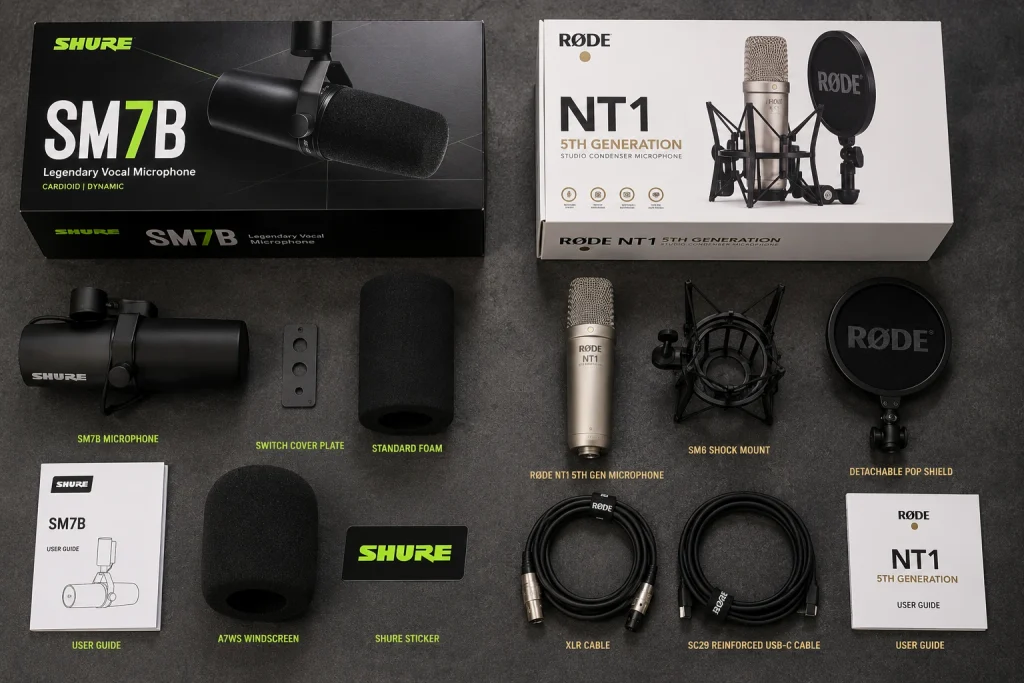
Additional Required Gear: None for USB-C recording (ships with SM6 shock mount, pop filter, USB-C cable, and XLR cable).
Total Real-World Setup Cost: ~$214 to $249 (via USB) or ~$350 to $450 (with budget XLR interface).
The Rode NT1 5th Gen offers substantially higher value per dollar, reducing barrier-to-entry costs while delivering professional recording fidelity.
Who Should Buy Which?
Buy the Shure SM7B If:
- You record in an untreated room with hard reflective surfaces or ambient background noise.
- Your primary content is podcasting, broadcast radio, livestreaming, or loud rock/rap vocals.
- You already own a dedicated audio interface or mixer with 60 dB+ clean preamp gain.
- You want a warm, smooth vocal sound that naturally softens harsh consonants and sibilance.
Buy the Rode NT1 5th Gen If:
- You want a versatile studio microphone for both sung vocals and detailed acoustic instruments.
- You record in a quiet or acoustically treated space.
- You want the flexibility of direct USB-C recording alongside standard analog XLR connectivity.
- You want unclippable 32-bit float recording and onboard APHEX DSP processing.
- You want an all-in-one studio package including a shock mount, pop filter, and cables.
Final Comparison Table
| Evaluation Criteria | Shure SM7B | Rode NT1 5th Gen | Winner |
| Acoustic Transducer | Dynamic Moving-Coil | 1.0″ True Condenser (HF6) | Depends on priorities |
| Frequency Range | 50 Hz to 20,000 Hz | 20 Hz to 20,000 Hz | Rode NT1 5th Gen |
| Self-Noise | Thermal noise only | 4 dBA (Ultra-quiet) | Rode NT1 5th Gen |
| Noise & Room Rejection | Excellent (Tight cardioid) | Moderate (Sensitive capsule) | Shure SM7B |
| Connectivity | XLR only | Hybrid Dual Connect (XLR + USB-C) | Rode NT1 5th Gen |
| Preamp Gain Demands | Very High (~60 dB required) | Low to Moderate (~35 dB or USB Auto) | Rode NT1 5th Gen |
| Onboard Processing | Bass roll-off, presence boost | APHEX DSP (Compressor, Gate, EQ) | Rode NT1 5th Gen |
| Clipping Protection | Passive analog headroom | 32-bit float recording (Digital) | Rode NT1 5th Gen |
| Included Accessories | Dual windscreens, switch cover | Shock mount, pop shield, XLR & USB cables | Rode NT1 5th Gen |
| Chassis Build | Heavy-duty steel & yoke | Machined aluminum | Shure SM7B |
| Overall Value | Premium commercial investment | High-value hybrid solution | Rode NT1 5th Gen |
2026 Check: Dynamic vs Condenser Is a Room Decision, Not a Quality Decision
Start with the room, not the microphone. In an untreated room, the SM7B’s dynamic design rejects more of what you do not want - echo, fan noise, keyboard clicks - while a sensitive condenser like the NT1 captures all of it faithfully. In a quiet, reasonably treated space, that flips: the NT1’s detail and high-end air are exactly what the dynamic cannot deliver. The same two microphones can each “win” depending on the room they are recorded in, which is why the article’s own per-category winners above split the way they do.
Then check the chain. The SM7B needs serious clean gain - budget a strong preamp or inline booster, as covered in our SM7B vs RE20 gain guide. The NT1 5th Gen sidesteps that whole question with USB output and 32-bit float, at the cost of needing a quieter room to shine.
The one-line rule. Untreated room or loud environment: SM7B. Quiet room, interface already owned, detail-first vocals: NT1 5th Gen over XLR. No interface and no room treatment yet: NT1 5th Gen over USB - and treat the spot before blaming the mic. For the NT1’s own generation question, see our NT1 5th Gen vs 4th Gen comparison.
Expert Verdict
The Rode NT1 5th Gen is our overall winner for most home creators, musicians, and voiceover artists. By integrating Dual Connect XLR/USB outputs, unclippable 32-bit float recording, onboard APHEX DSP, and an ultra-low 4 dBA self-noise into a sub-$250 studio bundle, RØDE has eliminated the need for external preamps, signal boosters, and complex gain staging.
Its primary weakness is its high acoustic sensitivity, which will pick up unwanted room reflections if operated in an untreated space.
The Shure SM7B remains the superior choice for spoken-word creators, broadcasters, and streamers who record in imperfect acoustic rooms. Its dynamic capsule naturally suppresses background noise, room echo, and harsh vocal transients, delivering a radio-ready sound at the expense of high gain requirements and a higher total investment.
Choose the Shure SM7B if you need maximum acoustic room rejection, a warm broadcast profile, and have the preamp gain to power it.
Choose the Rode NT1 5th Gen if you want wide frequency capture, direct USB-C flexibility, 32-bit float recording, and superior overall value.
Ready to Choose?
Full Technical Specifications
| Technical Specification | Shure SM7B | Rode NT1 5th Generation |
| Acoustic Principle | Dynamic (Moving Coil) | Externally biased condenser |
| Capsule Size | Not specified by manufacturer | 1.00 inch (25.4 mm) HF6 |
| Diaphragm Coating | Mylar | Gold-sputtered |
| Directional Pattern | Cardioid | Cardioid |
| Frequency Range | 50 Hz to 20,000 Hz | 20 Hz to 20,000 Hz |
| Output Sensitivity | -59.0 dBV/Pa (1.12 mV @ 1 kHz) | -32.0 dB re 1 V/Pa (25 mV @ 94 dB SPL) |
| Equivalent Noise (Self-Noise) | Passive thermal noise only | 4 dBA |
| Max SPL | Not specified (inherently high SPL handling) | 142 dB SPL |
| Output Impedance | 150 ohms actual (300 ohms nominal) | 100 ohms |
| Analog Output | 3-pin XLR male | 3-pin XLR male (via Dual Connect) |
| Digital Output | None | USB-C (USB 2.0 architecture) |
| Digital Resolution / Bit Depth | N/A | 24-bit / 32-bit floating point |
| Sampling Rates (Digital) | N/A | 48 kHz, 96 kHz, 192 kHz |
| Onboard DSP | None (Passive analog filters) | APHEX processing (Compressor, Gate, HPF, Aural Exciter) |
| Hardware Switches | Bass roll-off and Mid-range presence boost | None (Software controlled via USB) |
| Power Requirements | None (Passive dynamic) | +48V Phantom Power (XLR) or 5V USB bus power |
| Dimensions (L x Diam) | 190.2 mm x 63.5 mm (7.49″ x 2.50″) | 189.0 mm x 52.0 mm (7.44″ x 2.05″) |
| Weight | 765.4 g (1.69 lbs) | 308.0 g (0.68 lbs) |
| Mounting | Integrated 5/8″-27 threaded swivel yoke | SM6 shock mount with 3/8″ & 5/8″ thread |
| Country of Origin | Mexico / USA | Australia |
| Warranty | 2 Years | Up to 10 Years (with product registration) |
Frequently Asked Questions (FAQ)
1. Does the Shure SM7B require a Cloudlifter or inline preamp?
The Shure SM7B does not strictly require a Cloudlifter, but it requires roughly +60 dB of clean gain. If your audio interface has low-noise preamps providing 65 dB or more of gain (such as an Elgato Wave XLR, Focusrite 4th Gen, or MOTU M2), an inline booster is unnecessary. If your interface preamps generate hiss above 50 dB, an inline preamp like a Cloudlifter CL-1 or Klark Teknik CT1 is recommended.
2. Can the Rode NT1 5th Gen record via USB and XLR at the same time?
No. The Rode NT1 5th Gen utilizes a patent-pending Dual Connect port where the USB-C socket is housed inside the 3-pin XLR connector. You can plug in either an XLR cable or a USB-C cable, but you cannot connect both simultaneously.
3. What is 32-bit float on the Rode NT1 5th Gen, and why does it matter?
32-bit float is a digital audio format that captures an enormous dynamic range, preventing digital clipping or distortion at the converter stage. If you shout into the microphone and the waveform appears clipped, you can lower the gain in your digital audio workstation (DAW) after recording to restore the audio without distortion.
4. Why is the Shure SM7B so popular for podcasts and streaming?
The SM7B became the podcast standard because its cardioid dynamic capsule suppresses room reflections, keyboard clatter, and background chatter in non-soundproofed rooms. Its internal air-suspension shock mount and thick windscreen allow creators to speak close to the grille without plosives or desk rumble.
5. Does the Rode NT1 5th Gen work on iOS, iPadOS, and Android devices?
Yes. When connected via USB-C, the NT1 5th Gen is class-compliant and functions with iPads, iPhones (with USB-C or Lightning to USB Camera Adapter), and Android devices running RØDE Central or compatible recording applications.
6. Does the Rode NT1 5th Gen work with 48V phantom power when using XLR?
Yes. When connected to an analog audio interface, mixer, or preamp via a standard XLR cable, the NT1 5th Gen functions as a traditional studio condenser microphone and requires standard +48V phantom power to operate.
7. Which microphone is better for female vocals?
The Rode NT1 5th Gen is frequently preferred for female vocals due to its open high-frequency response and detailed transient reproduction. The Shure SM7B can sound slightly dark or thick on delicate female voices unless the mid-range presence boost switch is engaged.
8. Is the Shure SM7B completely silent?
As a passive dynamic microphone, the SM7B generates zero active electrical noise. Any background hiss heard during recording comes from the preamps of the connected audio interface or mixer when pushed to high gain levels.
9. Can I use the onboard APHEX DSP of the NT1 5th Gen over an XLR connection?
No. The onboard APHEX digital signal processing (compressor, noise gate, high-pass filter, Aural Exciter) is powered and processed digitally over the USB-C connection. When connected via analog XLR, the NT1 5th Gen operates as a pure, uncolored analog condenser microphone.
10. Why is the Rode NT1 5th Gen considered the quietest studio condenser?
The NT1 5th Gen features an equivalent self-noise rating of 4 dBA, making it one of the quietest studio condenser microphones in existence. This low noise floor ensures that quiet vocal passages, Foley, and acoustic guitars can be recorded without introducing electronic microphone hiss.
11. Does the Shure SM7B need phantom power?
No. The Shure SM7B is a passive dynamic microphone and does not use +48V phantom power. Passing phantom power through it will not damage the capsule, but it is not required unless you connect an active inline preamp like a Cloudlifter.
12. Which microphone handles louder sources better?
Both handle high sound pressure levels exceptionally well. The Shure SM7B dynamic capsule handles extreme SPL without clipping, making it popular for loud rock vocals, snare drums, and brass. The Rode NT1 5th Gen is rated for up to 142 dB SPL, which easily handles loud vocalists and guitar amplifiers.
Related reading: Shure SM7B review