
The Audio-Technica AT2020 is a side-address cardioid condenser microphone designed for project studios, vocal tracking, and voiceover work. Its primary strength is delivering clean, articulate high-frequency detail and exceptional 144 dB SPL handling at an accessible sub-$100 price point. Its main limitations are a relatively high 20 dB self-noise floor, a lack of onboard switches, and high sensitivity to untreated room acoustics. It is best suited to budget-conscious creators, musicians, and podcasters who record in controlled environments and already own an audio interface with 48V phantom power.
Updated October 2026: The AT2020 is still the default recommendation at this price - but only for buyers who understand what it is. It is an XLR condenser, not a USB mic: it needs an interface with phantom power, an XLR cable, and a stand, and it hears the room as clearly as it hears you. This update adds the disclosure this article was missing, plus a guide to the one complaint that follows this mic everywhere - background noise - and the three fixes that actually work.
Disclosure: This article contains affiliate links. If you buy through them, HeadphoneEcho may earn a small commission at no extra cost to you. Recommendations are based on research and published specifications, not on commissions.
Check Current Price on Audio-Technica AT2020
| Feature | Specification / Detail |
| Microphone Type | Side-address back-electret condenser |
| Capsule Size | 16 mm low-mass diaphragm |
| Polar Pattern | Fixed Cardioid |
| Frequency Response | 20 Hz to 20,000 Hz |
| Open Circuit Sensitivity | -37 dB (14.1 mV) re 1V at 1 Pa |
| Maximum Input SPL | 144 dB SPL (1 kHz at 1% THD) |
| Self-Noise | 20 dB SPL (A-weighted) |
| Dynamic Range | 124 dB (1 kHz at Max SPL) |
| Signal-to-Noise Ratio | 74 dB (1 kHz at 1 Pa) |
| Output Connection | 3-pin XLR male |
| Power Requirements | 48V DC phantom power (2 mA typical) |
| Weight | 345 g (12.1 oz) |
| Included Accessories | Pivoting stand mount (5/8″-27 thread), 3/8″-16 adapter, soft pouch |
How We Evaluated the AT2020
This review is based on published technical specifications, official manufacturer documentation, independent acoustic frequency measurements, and comparative analysis against competing condenser and dynamic microphones in the entry-level category.
Evaluation criteria focus on frequency balance, transient accuracy, noise performance, structural durability, setup complexity, and overall cost-to-performance ratio for home recording environments.
Design and Build Quality
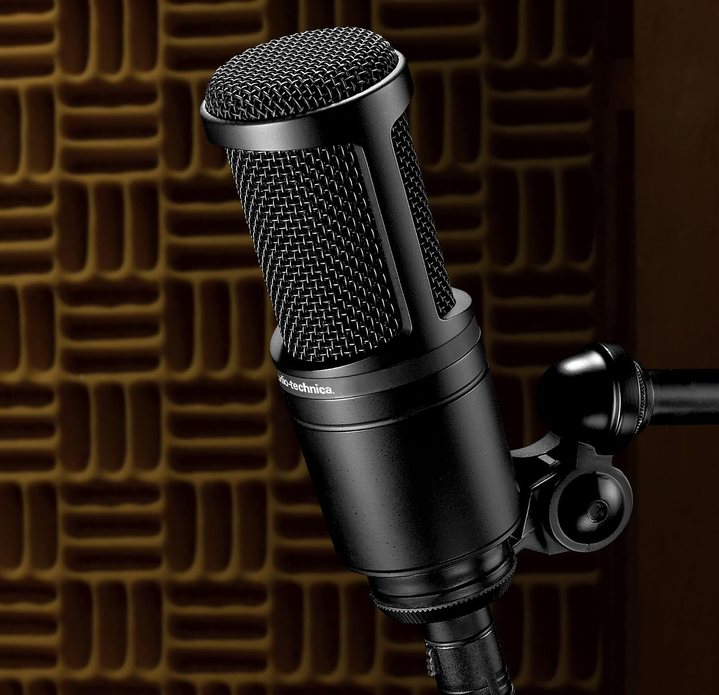
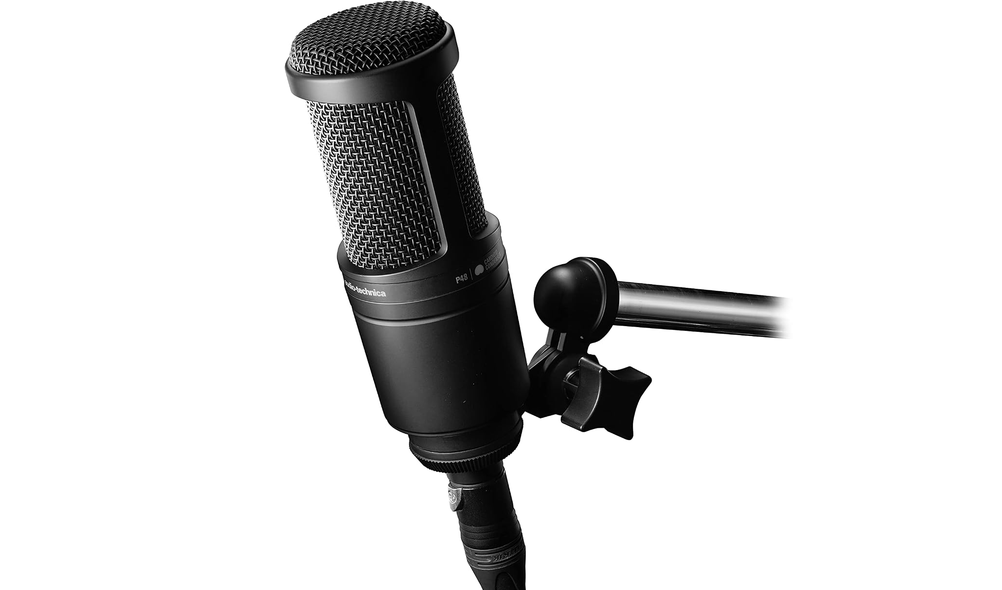
The Audio-Technica AT2020 features a heavy cast-metal body with a dark grey matte finish. Weighing 345 grams, it feels dense and well-machined. The dual-layer wire mesh grille protects the internal 16 mm electret capsule while providing modest diffusion against ambient air movement.
The body is completely free of onboard controls. There is no high-pass filter (low-cut) switch and no attenuation pad. While this minimalist design removes potential points of electronic failure and reduces manufacturing costs, it means all tone adjustments and gain padding must be handled via your audio interface or digital audio workstation (DAW).
The included pivoting stand mount screws directly onto standard 5/8″-27 and 3/8″-16 threaded microphone stands. While functional, it provides zero mechanical isolation. Because the capsule is sensitive to mechanical vibrations, desk bumps, foot taps, and keyboard clicks easily travel up the stand and into the audio signal. Users planning desk-mounted setups will need to factor in the cost of a dedicated elastic shock mount.
Setup and Power Requirements
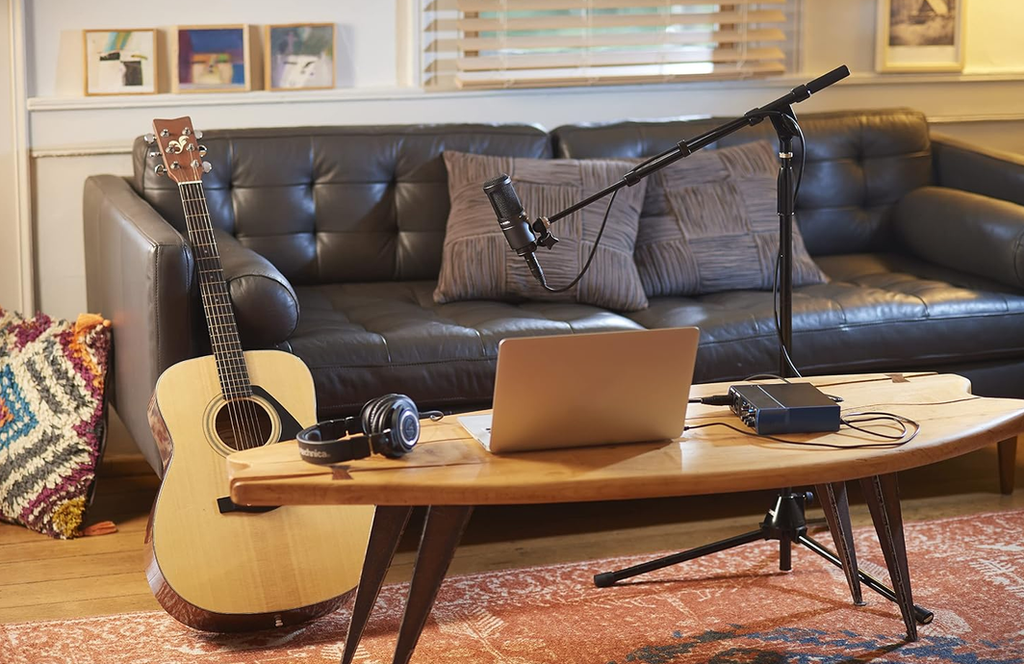
The standard AT2020 uses an analog 3-pin XLR connection. It cannot plug directly into a computer USB port or a standard 3.5 mm headphone jack without intermediate hardware.
To operate the microphone, your signal chain must include:
An audio interface or dedicated microphone preamp capable of providing a full 48V DC phantom power supply.
A balanced 3-pin XLR cable (not included in the box).
A stable microphone stand or boom arm.
With a nominal impedance of 100 ohms and an open-circuit sensitivity rating of -37 dB (14.1 mV), the AT2020 does not demand heavy gain from your preamps. Standard entry-level audio interfaces drive the microphone comfortably without pushing preamp gain into noisy upper registers.
Performance and Acoustic Profile
Frequency Response and Tone
The AT2020 offers a wide 20 Hz to 20,000 Hz frequency response with a distinct acoustic profile.
The low end remains flat down to 100 Hz before rolling off gently toward 20 Hz. This low-end contour prevents deep sub-bass mud while maintaining natural body on male and female vocal sources. The midrange is largely flat and uncolored between 300 Hz and 2 kHz, ensuring that speech, acoustic guitars, and guitar amplifier cabs retain accurate harmonic timbre.
Starting around 5 kHz, the frequency curve features a wide presence boost that peaks around 8 kHz to 9 kHz before gently descending past 15 kHz. This presence lift adds clarity, speech intelligibility, and vocal presence without requiring extensive corrective equalization. However, on naturally bright, sibilant voices or harsh cymbals, this upper lift can occasionally sound slightly aggressive, requiring a slight dip in the 6 kHz to 8 kHz band in post-production.
Transient Accuracy and SPL Handling
The 16 mm low-mass diaphragm delivers fast transient response. Plucked acoustic strings, drum transients, and crisp vocal consonants are captured with high definition compared to typical dynamic broadcast microphones.
Its maximum SPL rating is a massive 144 dB at 1% THD. This allows the AT2020 to capture loud sound sources, such as screaming vocals, brass instruments, drum overheads, and high-output guitar cabinets, without inducing analog capsule distortion.
Self-Noise and Acoustic Environment Sensitivity
The primary technical trade-off of the AT2020 is its 20 dB SPL (A-weighted) self-noise rating.
In comparison, premium studio condensers often achieve self-noise ratings between 4.5 dB and 10 dB. For close-mic vocal tracking, podcasting, musical instruments, and singing, a 20 dB noise floor is rarely intrusive. However, for quiet spoken-word recordings, distant Foley capture, or heavy dynamic compression chains, a faint background hiss can become noticeable in the track.
Furthermore, as a sensitive condenser microphone, the cardioid pattern picks up early reflections from bare walls, desktop bounce, PC cooling fans, and HVAC systems. If your recording space lacks acoustic treatment, the microphone will capture that ambient room sound faithfully.
Key Features in Practice
Custom 16 mm Low-Mass Diaphragm
- Practical Benefit: Balances the rapid transient response of a small diaphragm with the warmth and vocal fullness typical of medium-to-large diaphragm designs.
- Limitation: Fixed polar pattern limits recording flexibility to front-facing solo sources.
- Who Benefits: Solo content creators, vocalists, and acoustic instrumentalists.
144 dB Maximum Sound Pressure Level (SPL)
- Practical Benefit: Allows tracking of exceptionally loud instruments without hardware clipping or capsule overload.
- Limitation: The microphone lacks an onboard -10 dB or -20 dB pad switch, placing the burden of gain staging entirely on your preamp.
- Who Benefits: Rock vocalists, brass players, and home studio engineers micing guitar amplifiers.
Fixed Cardioid Polar Pattern
- Practical Benefit: Rejects sound arriving directly from the rear (180 degrees off-axis), helping isolate the speaker or instrument from background noise.
- Limitation: Off-axis rejection is frequency-dependent. Low-frequency background hums and room reflections can still leak into the side lobes.
- Who Benefits: Podcasters and streamers working in moderately controlled home studio environments.
What We Like
- Clear, Articulate Sound: The balanced midrange and natural high-frequency presence lift provide excellent clarity for spoken word and vocals.
- Exceptional SPL Tolerance: 144 dB max SPL handles loud sound sources without audible distortion.
- Sturdy Metal Construction: Heavy, reliable housing built for long-term studio durability.
- Fast Transient Response: The 16 mm capsule accurately tracks fast plucks, string attack, and crisp consonants.
- Accessible Entry Cost: Provides genuine studio condenser acoustics at a budget-friendly price point.
What Needs Improvement
- 20 dB Self-Noise: Higher internal noise floor than modern competitors, which can be audible during quiet passages or compressed speech.
- No Onboard Controls: Missing physical high-pass filter switches and attenuation pads.
- Basic Pivoting Stand Mount: The included ring mount lacks mechanical shock absorption, allowing desk vibrations to transmit into the audio signal.
- Susceptible to Room Noise: High sensitivity easily exposes untreated room reflections and background ambient noise.
Competitor Comparison
| Model | Capsule Type | Polar Pattern | Max SPL | Self-Noise | Connection | Onboard Controls |
| Audio-Technica AT2020 | 16 mm Condenser | Cardioid | 144 dB | 20 dB | XLR | None |
| Rode NT1 Signature | 1-inch True Condenser | Cardioid | 142 dB | 4 dB | XLR | None |
| Rode PodMic | Dynamic | Cardioid | N/A (Dynamic) | N/A | XLR | None |
| AKG P120 | 0.66-inch Condenser | Cardioid | 150 dB (with pad) | 19 dB | XLR | Low-cut filter, -20 dB Pad |
Audio-Technica AT2020 vs Rode NT1 Signature Series
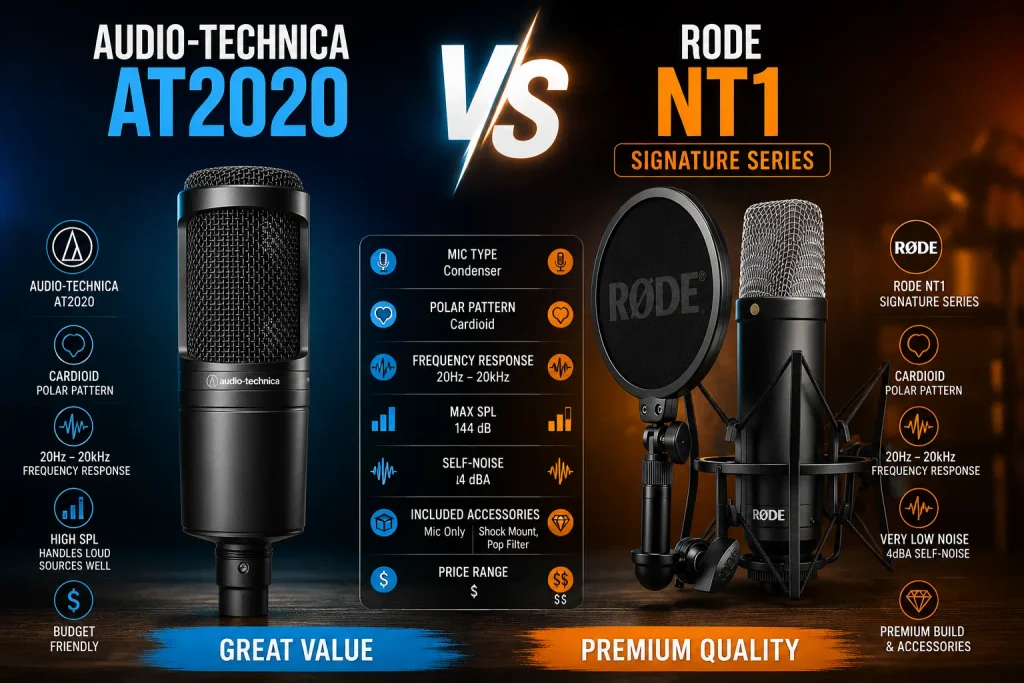
The Rode NT1 Signature Series features a larger 1-inch gold-sputtered capsule and an ultra-low self-noise floor of 4 dBA. This makes the Rode NT1 substantially quieter on delicate acoustic instruments and quiet voiceover work. However, the NT1 costs significantly more and includes a flatter, less aggressive presence profile. Buyers with higher budgets and quiet recording spaces gain cleaner noise performance with the NT1, while the AT2020 remains the better pure budget choice.
Audio-Technica AT2020 vs Rode PodMic
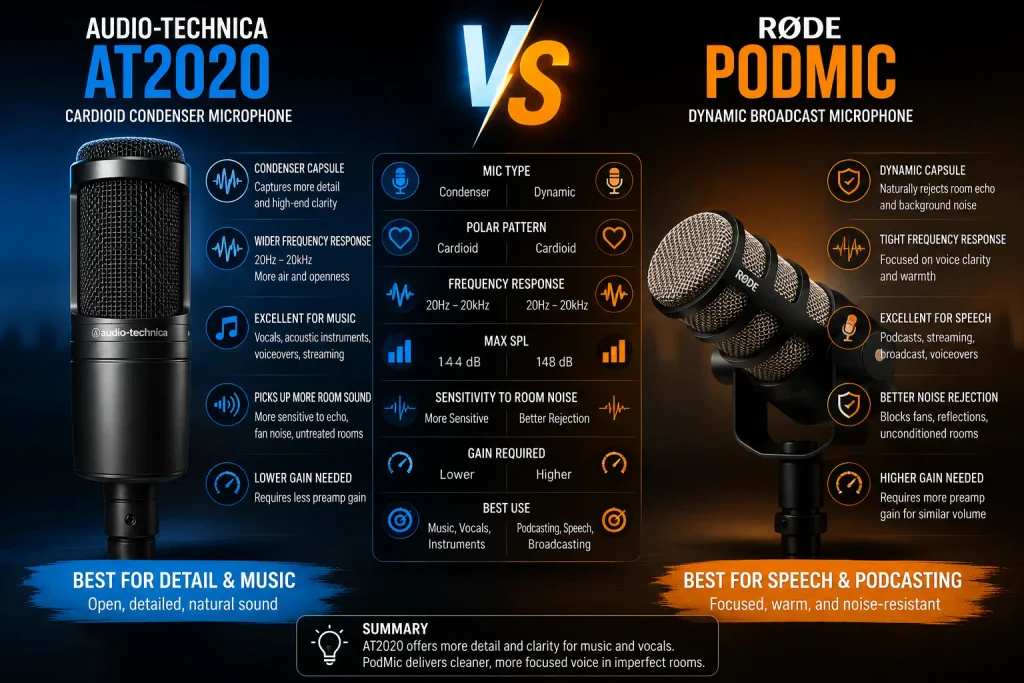
The Rode PodMic is a dynamic broadcast microphone specifically tailored for speech and podcasting. Because it uses a heavier dynamic capsule, it naturally rejects room echo, background computer fan noise, and unconditioned room reflections better than the AT2020. However, the PodMic requires substantially more gain from your interface and lacks the open high-end air, detail, and transient speed that the AT2020 offers on acoustic instruments and singing vocals.
Audio-Technica AT2020 vs AKG P120
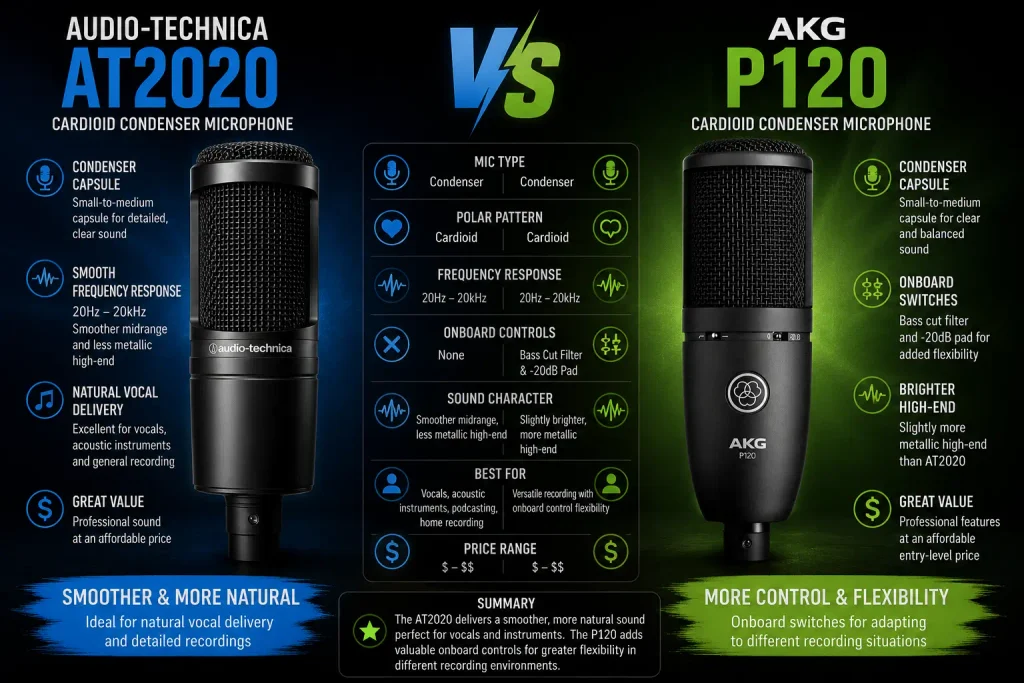
The AKG P120 sits at a similar entry-level price point and uses a similar small-to-medium condenser capsule. Unlike the AT2020, the AKG P120 includes physical onboard switches: a bass cut filter and a -20 dB attenuation pad. In terms of raw acoustic profile, the AT2020 offers a slightly smoother midrange and less metallic high-end response, making the AT2020 preferable for natural vocal delivery despite its lack of onboard switches.
Value for Money
The Audio-Technica AT2020 remains a strong value in the studio audio segment because its acoustic performance matches microphones that cost noticeably more.
When calculating the total investment, buyers must remember that the AT2020 is not a standalone solution. The purchase price covers the microphone and a basic hard mount. To get a functional recording setup, you must budget for:
- An audio interface with 48V phantom power
- A balanced XLR cable
- A pop filter to tame plosives
- A dedicated shock mount or boom arm
Even with these additional accessories included, the total cost remains accessible for emerging musicians, podcasters, and voiceover artists who want to move beyond basic USB desktop microphones.
Who Should Buy It?
- Budget-Minded Vocalists and Musicians: Creators who need a transparent condenser microphone for singing, acoustic guitars, and instruments without spending hundreds of dollars.
- Home Studio Podcasters with Basic Acoustic Treatment: Spoken-word creators recording in quiet, reflection-controlled environments who want crisp speech clarity.
- Creators Upgrading to an XLR Signal Chain: Users who already own an audio interface and want to replace an entry-level dynamic or USB microphone with a detailed condenser.
Who Should Skip It?
- Users in Untreated, Noisy Rooms: If you record next to loud computer fans, traffic noise, or in a room with bare drywall and hard floors, a dynamic microphone like the Rode PodMic or Shure SM58 will isolate your voice far better.
- High-End Voiceover and ASMR Creators: The 20 dB self-noise floor introduces audible hiss on quiet spoken passages with heavy compression applied.
- Plug-and-Play Streamers: Those who do not want to purchase or configure an audio interface, XLR cables, and gain controls should look at dedicated USB options instead.
Score Breakdown
- Performance: 8.5 / 10 (Clear high-end presence, great articulation, high SPL, minor noise floor limitations)
- Build Quality: 9.0 / 10 (All-metal body, durable mesh grille, solid chassis)
- Features: 7.0 / 10 (Fixed cardioid pattern, zero onboard pads or low-cut switches)
- Ease of Use: 8.0 / 10 (Straightforward XLR operation, standard 48V phantom power requirement)
- Value: 9.5 / 10 (Outstanding acoustic clarity and durability for the price)
Overall Score: 8.4 / 10
2026 Check: Why Your AT2020 Picks Up Everything - and the 3 Fixes That Work
It is not a defect; it is the design. A sensitive condenser with a fixed cardioid pattern is built to capture detail, and detail includes the room: keyboard clicks, fan hum, and reflections all reach the capsule. Buyers who expect a mic to filter the room for them end up disappointed - no budget condenser does that, and the AT2020’s sensitivity makes the room more obvious, not less.
Fix 1 - Get closer, then turn the gain down. Most noisy AT2020 recordings come from a mic placed too far away with the gain turned up to compensate, which raises the room along with the voice. Move in, lower the gain until your voice sits at a healthy level, and the room drops away with it.
Fix 2 - Put the noise behind the mic. Cardioid mics reject sound best from directly behind them. Aim the back of the mic at the noisiest thing in the room - the window, the fan, the open door - and keep the front pointed at you.
Fix 3 - Treat the spot, not the whole room. You do not need a treated studio. A closer recording position, soft surfaces near the mic, and a quiet corner do more for this mic than any plugin or replacement mic at this price. If you need plug-and-play simplicity instead, the USB sibling - the AT2020USB-X - is the honest alternative; see the comparison with the AKG P120 for the XLR-versus-XLR choice.
Final Verdict
The Audio-Technica AT2020 is not a universal solution for every recording scenario, but it is one of the most reliable entry-level studio condenser microphones available. It provides crisp vocal intelligibility, robust transient handling, and exceptional SPL tolerance. Provided your recording space is quiet and you pair it with an external shock mount and pop filter, it delivers clean, professional audio that punches well above its price tag.
Check Current Availability for Audio-Technica AT2020
Frequently Asked Questions
Does the Audio-Technica AT2020 require phantom power?
Yes. The standard AT2020 is an analog condenser microphone that requires 48V DC phantom power to operate. You must connect it via a 3-pin XLR cable to an audio interface, dedicated mixer, or external preamp that provides 48V power. It will not function with a passive 3.5 mm adapter.
What is the difference between the AT2020 and the AT2020USB-X?
The standard AT2020 uses an analog XLR connection and requires an external audio interface. The AT2020USB-X features an internal analog-to-digital converter, a USB-C output, an onboard headphone jack for direct monitoring, and a capacitive mute button, allowing it to plug directly into a computer.
Is the AT2020 good for recording vocals and speech?
The AT2020 is well-suited for vocals and speech because of its flat midrange and presence boost between 5 kHz and 9 kHz. This curve enhances consonant articulation and vocal clarity. However, because it is a sensitive condenser, you should use a pop filter to prevent plosives and record in a treated room to avoid capturing room echo.
Can the AT2020 record loud guitar amplifiers or drums?
Yes. With a maximum SPL rating of 144 dB, the AT2020 can capture loud guitar amplifier cabinets, brass instruments, and drum overheads without distorting the capsule.
Does the AT2020 come with a shock mount and XLR cable?
No. Audio-Technica includes a pivoting threaded stand mount and a soft storage pouch. An XLR cable, pop filter, and elastic suspension shock mount must be purchased separately.
Why is my AT2020 picking up background noise?
As a studio condenser microphone, the AT2020 is significantly more sensitive than dynamic microphones. It easily captures computer fans, keyboard clicks, air conditioners, and wall reflections. To reduce background noise, speak closer to the front of the capsule (around 4 to 6 inches away), reduce preamp gain, and add soft materials or acoustic treatment to your room.
Related reading: AKG P120 review and AKG P220 vs P420