
Shure SM7B and the Electro-Voice RE20 represent the two most prominent dynamic vocal microphones in professional broadcasting, podcasting, and voiceover. Both utilize large-diaphragm dynamic capsules engineered to reject ambient room noise in untreated acoustic environments. The defining difference lies in acoustic management: the Shure SM7B utilizes a tight cardioid pattern that emphasizes a warm, low-end proximity effect, whereas the Electro-Voice RE20 relies on patented Variable-D technology to keep frequency response consistent regardless of speaking distance.
Updated October 2026: Two broadcast legends, one hidden cost: gain. Both are dynamic microphones, so both need far more clean preamp gain than any condenser on this site - and the SM7B is the hungrier of the two, which is why so many SM7B owners end up buying an inline booster on top of the mic. This update adds the disclosure this article was missing, plus a gain-first verdict: judge these two by the whole chain, not by the microphone alone.
Disclosure: This article contains affiliate links. If you buy through them, HeadphoneEcho may earn a small commission at no extra cost to you. Recommendations are based on research and published specifications, not on commissions.
For most podcasters, home studio vocalists, and creators recording in imperfect rooms, the Shure SM7B provides a smoother, more forgiving vocal tone with built-in mounting convenience. For commercial voice actors, broadcast announcers, and engineers tracking bass instruments, the Electro-Voice RE20 offers uncolored clarity and zero proximity buildup.
Quick Answer: Shure SM7B vs Electro-Voice RE20
The Shure SM7B is the better overall choice for modern content creators, streamers, and vocalists seeking warm, intimate speech capture and strong electromagnetic hum rejection. The Electro-Voice RE20 is the superior alternative for commercial broadcast studios, multi-host tables, and instrument tracking where consistent tone across changing speaking distances and true-to-life vocal clarity are critical.
Winner by Category
| Category | Winner | Key Advantage |
| Vocal Warmth & Intimacy | Shure SM7B | Rich low-end proximity effect flattering thinner vocal timbres. |
| Tonal Consistency (Off-Axis & Distance) | Electro-Voice RE20 | Variable-D ports eliminate bass buildup when moving close. |
| Room Noise & EMI Rejection | Shure SM7B | Integrated humbucking coil shields against PC monitor interference. |
| High-Frequency Articulation | Electro-Voice RE20 | Extended top-end detail without severe roll-off above 12 kHz. |
| Plosive Protection | Shure SM7B | Thick A7WS close-talk foam windscreen stops aggressive plosives. |
| Gain Efficiency | Electro-Voice RE20 | 2.5 dB higher output sensitivity (-56.5 dBV/Pa vs -59.0 dBV/Pa). |
| Mounting & Cable Ergonomics | Shure SM7B | Integrated captive yoke mount with integrated XLR connector placement. |
| Instrument Tracking Versatility | Electro-Voice RE20 | Exceptional low-end transient response for kick drums and bass cabs. |
| Build Durability | Tie | Both feature heavy all-metal industrial construction designed for decades of use. |
| Overall Value | Shure SM7B | Lower entry price and includes integrated mounting hardware. |
| Overall Winner | Shure SM7B | Better suited to modern creator workflows and acoustically imperfect rooms. |
Quick Specifications
| Feature | Shure SM7B | Electro-Voice RE20 |
| Transducer Type | Dynamic (Moving Coil) | Dynamic (Moving Coil) |
| Polar Pattern | Cardioid | Cardioid |
| Frequency Response | 50 Hz to 20,000 Hz | 45 Hz to 18,000 Hz |
| Sensitivity (1 kHz) | -59.0 dBV/Pa (1.12 mV) | -56.5 dBV/Pa (1.5 mV) |
| Output Impedance | 150 ohms nominal | 150 ohms nominal |
| Proximity Control Tech | Standard acoustic cavity | Variable-D multi-port system |
| Tone Switches | Bass Roll-off & Presence Boost | Bass Roll-off (Tilt-down curve) |
| Electromagnetic Shield | Internal humbucking coil | Heavy steel casing |
| Weight | 765 g (1.69 lbs) | 737 g (1.62 lbs) |
| Mounting Mechanism | Integrated captive yoke | Stand clamp included (309A shock mount optional) |
| Current Retail Price | $399 to $439 | $449 |
Form-Factor & Hardware Analysis
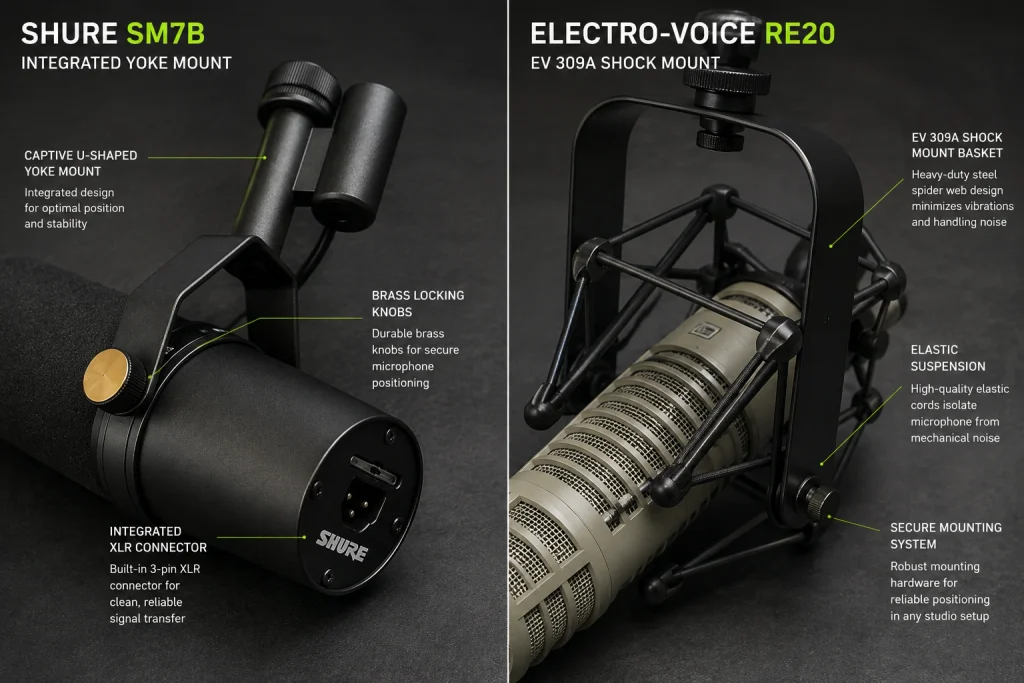
Physical ergonomics impact daily studio workflows significantly when mounting these heavy dynamic microphones on desk-mounted boom arms.
The Shure SM7B incorporates a captive U-shaped yoke mount directly attached to the microphone chassis. This design keeps the center of gravity close to the mounting point, preventing microphone drooping on standard broadcast arms. The XLR connection is placed along the mounting bracket rather than directly behind the capsule barrel, allowing for tidy cable runs. It ships with two interchangeable foam windscreens: a low-profile standard screen and the deep A7WS foam windscreen engineered for close-proximity plosive damping.
The Electro-Voice RE20 uses a traditional cylindrical broadcast body measuring 8.53 inches in length. It relies on a rear-mounted slide-in stand clamp (EV 81715). Because the microphone body extends far forward from the mounting collar, it creates forward-heavy leverage on standard mic arms. For optimal mechanical isolation, broadcasters usually pair the RE20 with the dedicated Electro-Voice 309A suspension basket, an optional accessory that adds roughly $100 to $120 to total setup cost. The RE20 features continuous acoustic slots running down the spine of its steel casing, which house the Variable-D delay lines and must remain unobstructed during use.
How We Evaluated
This comparison synthesizes official manufacturer engineering specifications, published technical white papers, independent frequency response charts, published acoustic measurements, and established broadcast engineering standards.
Evaluation criteria focus on:
Acoustic frequency response: Midrange presence, low-frequency extension, and high-frequency roll-off.
Proximity effect behavior: Bass buildup variance at distances between 1 inch and 6 inches.
Off-axis rejection: Attenuation of ambient room reflections, keyboard clatter, and lateral noise sources.
Preamplifier gain requirements: Signal-to-noise ratios across standard audio interface input stages.
Total ownership cost: Core unit pricing, required shock mounts, windscreens, and inline boosters.
Limitations: Perceived vocal warmth, sibilance, and room reflection rejection vary based on individual vocal anatomy, speaking technique, room acoustic treatment, preamp noise floor, and gain staging.
Shure SM7B Review

The Shure SM7B is an industry-standard dynamic cardioid microphone originally derived from the Unidyne III capsule architecture. Renowned for its presence on thousands of professional podcast sets and studio vocal recordings, it delivers a smooth, dark, and authoritative sound profile. It integrates passive electronic filters on the rear plate that allow users to select flat response, bass roll-off, or midrange presence boost.
What I Like
- Rich, radio-style low-end intimacy that flatters speech and spoken word.
- Exceptional rejection of mechanical desk vibrations and computer monitor electromagnetic hum.
- Included A7WS heavy-duty windscreen eliminates the need for external pop filters.
- Integrated captive yoke mount provides balanced positioning on studio boom arms.
- High acoustic SPL handling handles screaming vocals, brass, and loud guitar amplifiers cleanly.
- Tighter off-axis rejection pattern isolates voice in rooms without acoustic treatment.
- Dual rear switches provide hardware tonal shaping prior to the preamp stage.
What Could Be Better
- Extremely low output sensitivity (-59.0 dBV/Pa) requires at least +60 dB of clean preamp gain.
- Top-end frequency response rolls off noticeably above 12 kHz, requiring treble equalization for modern brightness.
- Pronounced proximity effect can sound overly boomy or muddy if vocalists speak too close without low-cut filtering.
- Rear tone switches require a small flathead tool or fingernail to toggle.
Pros & Cons
| Pros | Cons |
| Smooth, forgiving vocal response | Highly gain hungry; entry-level preamps may introduce hiss |
| Superior humbucking electromagnetic isolation | Muffled top-end air compared to condenser and open dynamic mics |
| Excellent built-in plosive protection | Strong proximity effect requires steady mic distance |
| Robust integrated mounting yoke | Heavy chassis requires a sturdy studio boom arm |
Best For
The Shure SM7B is best suited for solo podcasters, video creators, voiceover artists, and vocalists tracking in untreated rooms who want a warm, broadcast-style vocal signature with maximum isolation from ambient noise.
Recommendation
If your audio interface provides at least +60 dB to +65 dB of clean preamp gain, or if you budget for an inline preamp booster, the Shure SM7B delivers reliable, broadcast-grade speech reproduction with minimal acoustic bleed.
Electro-Voice RE20 Review

The Electro-Voice RE20 is a broadcast standard dynamic cardioid microphone introduced in 1968. Found in traditional radio stations, voiceover booths, and tracking studios worldwide, the RE20 is engineered around Electro-Voice’s Variable-D design. Variable-D utilizes multiple rear acoustic ports across the microphone body to cancel out low-frequency phase reinforcement, virtually eliminating proximity effect. It captures voices with neutral, unhyped accuracy, ensuring the tone does not change when an announcer shifts position.
What I Like
- Variable-D technology keeps vocal bass balance identical whether speaking 1 inch or 8 inches away.
- Natural, uncolored midrange and open high-frequency response that cuts through dense production mixes.
- Excellent transient response captures natural speech articulation without harsh sibilance.
- 2.5 dB hotter output level than the SM7B, reducing the demand on interface preamps.
- Outstanding performance on low-frequency instruments including kick drum, bass guitar cabs, and baritone sax.
- Heavy machined steel housing delivers immense physical durability.
- Smooth bass tilt-down switch quickly compensates for boomy acoustic environments.
What Could Be Better
- Included 81715 stand mount is rigid and front-heavy, transmitting desk bumps without an expensive external shock mount.
- Internal foam pop filter is thinner than the SM7B windscreen, allowing heavy plosives through if spoken directly into the grille.
- Large, industrial body profile can obscure a speaker’s face during on-camera video recordings.
- Higher initial purchase price compared to the base SM7B.
Pros & Cons
| Pros | Cons |
| Zero proximity effect for consistent speech tone | Dedicated 309A shock mount costs roughly $100 extra |
| Natural, open frequency response through 18 kHz | Thinner plosive protection requires careful mic technique |
| Slightly higher output sensitivity than SM7B | Bulky form factor on video cameras |
| Legendary acoustic performance on kick drums and brass | Higher base retail price |
Best For
The Electro-Voice RE20 is best suited for radio announcers, multi-host talk shows, audiobook narrators, and audio engineers who demand neutral frequency accuracy, movement tolerance, and instrument tracking capability.
Recommendation
If you need true-to-life vocal clarity without boomy bass buildup when shifting in your seat, and you have budget for an external shock mount, the Electro-Voice RE20 remains an exceptional broadcast instrument.
Head-to-Head Comparison
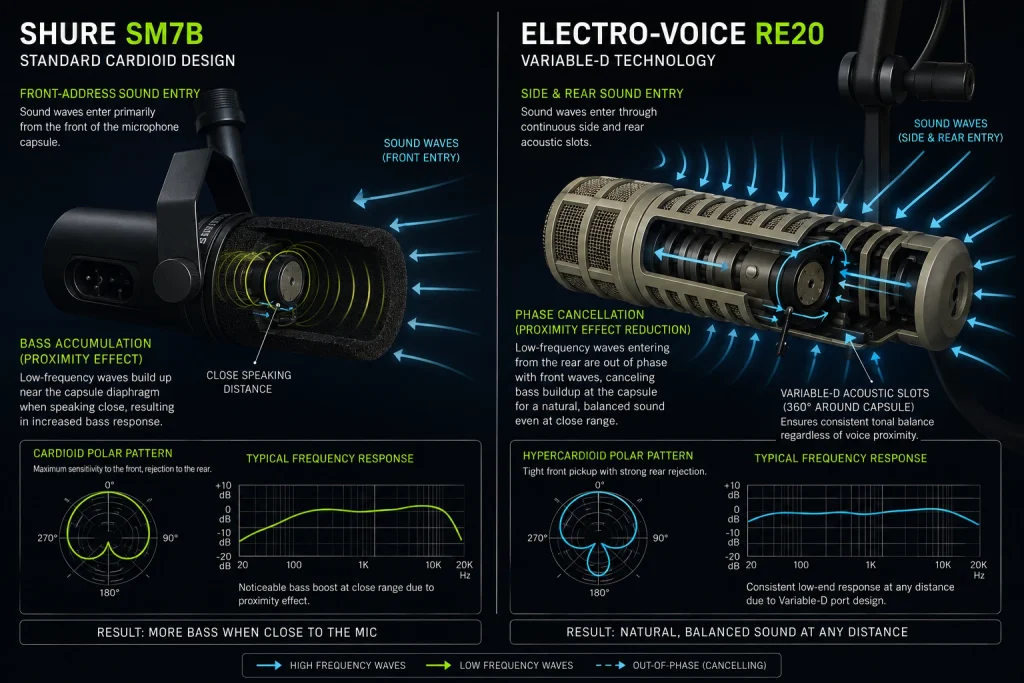
Proximity Effect & Variable-D Technology
The acoustic design of these two microphones dictates how they react to vocal proximity.
Shure SM7B: Behaves like a standard single-diaphragm pressure-gradient cardioid microphone. When a speaker moves within 1 to 2 inches of the grille, low frequencies between 100 Hz and 300 Hz rise dramatically. This proximity effect produces the deep, resonant “radio DJ” signature popularized in modern podcasting. However, if the speaker pulls back to 6 inches, the low end drops off, causing noticeable tonal inconsistency.
Electro-Voice RE20: Employs Electro-Voice’s patented Variable-D design. Continuous rear vents allow acoustic energy to enter behind the diaphragm with frequency-dependent physical phase delays. This mechanical cancellation prevents low frequencies from accumulating as the speaker gets close. An announcer can move from 1 inch to 8 inches away, or speak slightly off-axis, and the fundamental tonal balance remains unchanged.
My Take: If your voice lacks low-end body or you maintain fixed microphone discipline, the SM7B’s proximity boost adds pleasant warmth. If you move your head while speaking, talk animatedly, or host uncooperative podcast guests, the RE20’s Variable-D keeps the mix perfectly level.
Winner: Electro-Voice RE20 (for tonal consistency); Shure SM7B (for deliberate low-end intimacy).
Tonal Profile: Lows, Mids, and Highs
Both microphones capture clean dynamic audio, but their equalization curves serve distinct vocal aesthetics.
Shure SM7B: Features a controlled low end from 50 Hz to 700 Hz, an exceptionally flat midrange across 1 kHz to 4 kHz, and a prominent high-frequency cut above 12 kHz. The resulting tone is smooth, warm, and dark. Sibilant “S” and “T” sounds are naturally softened, reducing the need for aggressive de-essing in post-production.
Electro-Voice RE20: Delivers a wide, flat response across 45 Hz to 18 kHz. It exhibits minor dips around 2 kHz and 4 kHz paired with a gentle presence lift between 5 kHz and 10 kHz, while retaining response out to 18 kHz. This yields an open, articulate, and punchy vocal sound that cuts through background music and complex broadcasts without sounding muddy.
My Take: The RE20 provides a more accurate, production-ready spoken-word sound out of the box. The SM7B sounds darker and thicker, which flatters harsh or thin voices but often requires high-shelf EQ boost in post to regain sparkle.
Winner: Electro-Voice RE20 (for clarity & articulation); Shure SM7B (for smoothing harsh sibilance).
Gain Requirements & Preamp Sensitivity
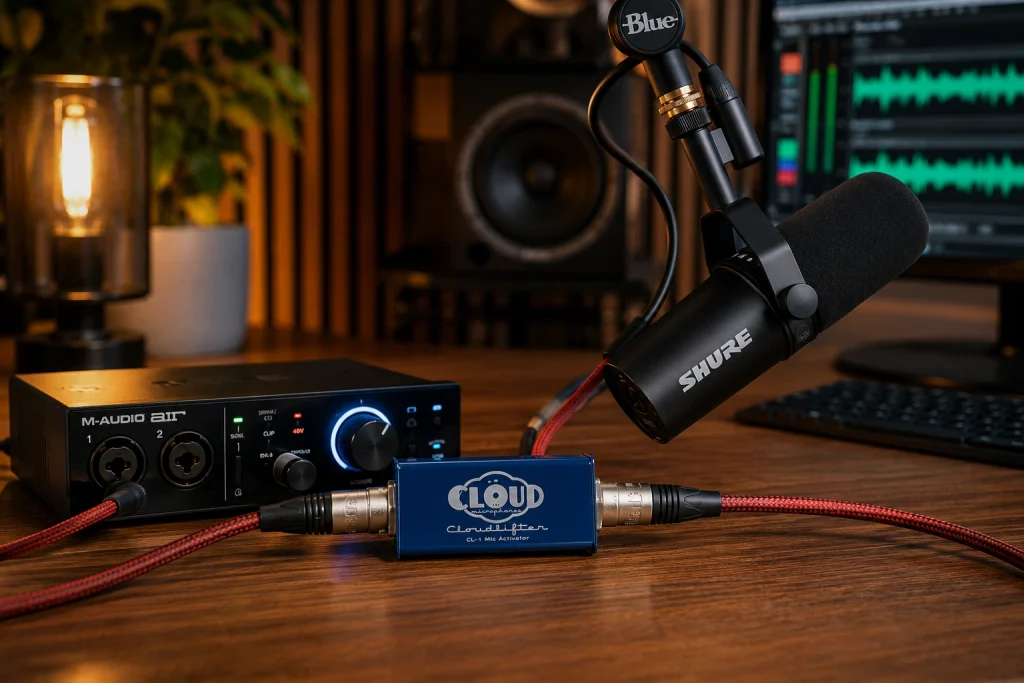
Dynamic microphones require clean amplification, but their sensitivity ratings differ.
Shure SM7B: Rated at -59.0 dBV/Pa (1.12 mV). To achieve standard broadcast levels (-18 LUFS to -14 LUFS) on typical spoken word, the SM7B requires between +58 dB and +65 dB of clean preamplification. When paired with entry-level audio interfaces that cap out at +50 dB or +55 dB of gain, users must run preamps at 100%, introducing audible electronic hiss. An inline signal booster like a Cloudlifter CL-1 or inline preamp ($100 to $150) is frequently required.
Electro-Voice RE20: Rated at -56.5 dBV/Pa (1.5 mV). While still a dynamic microphone requiring substantial gain, its output is 2.5 dB hotter than the SM7B. Mid-tier interfaces with +56 dB to +60 dB of gain range can drive the RE20 comfortably for normal voiceover without requiring an inline booster.
My Take: The RE20 is slightly easier to drive on modern USB audio interfaces. The SM7B almost always requires checking your audio interface’s maximum clean gain specs before purchase.
Winner: Electro-Voice RE20.
Off-Axis Noise Rejection & Acoustic Isolation
In non-soundproofed rooms, background noise rejection determines whether recorded audio sounds professional.
Shure SM7B: The cardioid capsule is set deep inside the metal barrel, creating a tight acceptance angle. It provides steep attenuation at 90 degrees and maximum rejection at 180 degrees directly behind the mic. It also integrates an internal humbucking coil designed to cancel electromagnetic hum generated by studio monitors, laptops, and lighting dimmers.
Electro-Voice RE20: The Variable-D side and rear venting system causes the RE20’s polar pattern to maintain exceptional cardioid linearity across all frequencies. Off-axis sound is attenuated smoothly without severe frequency coloration, making room reflections sound natural rather than hollow. However, the open acoustic slots make it slightly more susceptible to ambient room bleed from side angles compared to the tight front-focused SM7B.
My Take: For content creators recording at computer desks surrounded by computer monitors, cooling fans, and untreated drywall, the SM7B’s electromagnetic shielding and tight pattern isolate speech more aggressively.
Winner: Shure SM7B.
Plosive Handling & Internal Wind Protection
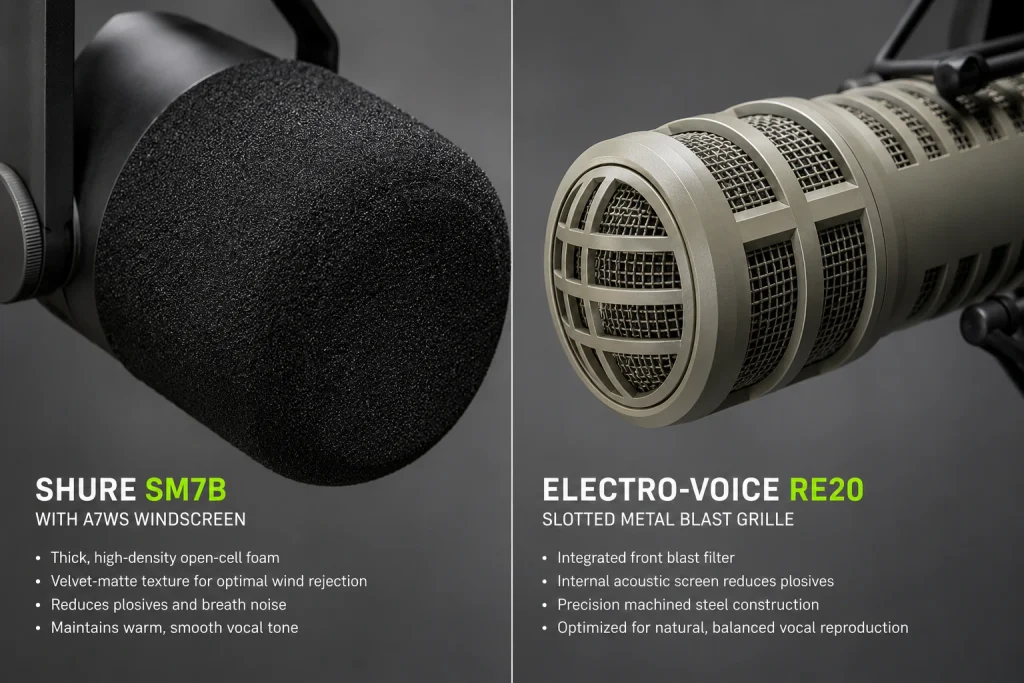
Plosive bursts (“P”, “B”, and “T” sounds) create low-frequency distortion if air blasts impact the microphone diaphragm.
Shure SM7B: Ships with both a standard foam filter and the oversized A7WS close-talk windscreen. The A7WS creates a large physical air pocket between the outer foam and the capsule. Spoken plosives are virtually eliminated, even when speaking directly against the foam.
Electro-Voice RE20: Utilizes an internal multi-stage blast filter covering the capsule diaphragm. While it stops normal conversational air movement, aggressive close-mic plosive blasts can still cause low-end popping. Broadcasters who speak within 1 inch often add an external foam pop sleeve or studio pop filter.
My Take: The SM7B with its A7WS windscreen is nearly impervious to plosives, making it far more forgiving for untrained speakers and close-proximity streamers.
Winner: Shure SM7B.
Buyer-Specific Recommendations
Best for Podcasting in Untreated Rooms: Shure SM7B
The SM7B combines a tight pickup pattern, internal air-suspension shock damping, humbucking electromagnetic shielding, and the dense A7WS windscreen. It ignores computer fan hum, keyboard clatter, and untreated room slapback more effectively than almost any studio dynamic microphone.
Best for Radio & Commercial Voiceover: Electro-Voice RE20
The RE20 delivers the neutral clarity, vocal articulation, and presence required for broadcast radio, narration, and commercial reads. Voices sound realistic and unhyped, sitting naturally over audio beds without extensive surgical EQ.
Best for Multi-Host Panels & Dynamic Speakers: Electro-Voice RE20
When recording multi-person roundtables, guests constantly lean back, turn their heads, or shift distance from the microphone. The RE20’s Variable-D technology ensures their vocal bass levels do not spike or vanish as they move.
Best for Screaming Vocals & Loud Guitar Amps: Shure SM7B
Originally popularized on Michael Jackson’s Thriller sessions, the SM7B thrives on high sound pressure levels. Its flat midrange, tamed high-frequency response, and plosive resistance make it the standard choice for aggressive rock, metal screamers, and close-miked high-gain guitar cabinets.
Best for Bass Instruments & Kick Drums: Electro-Voice RE20
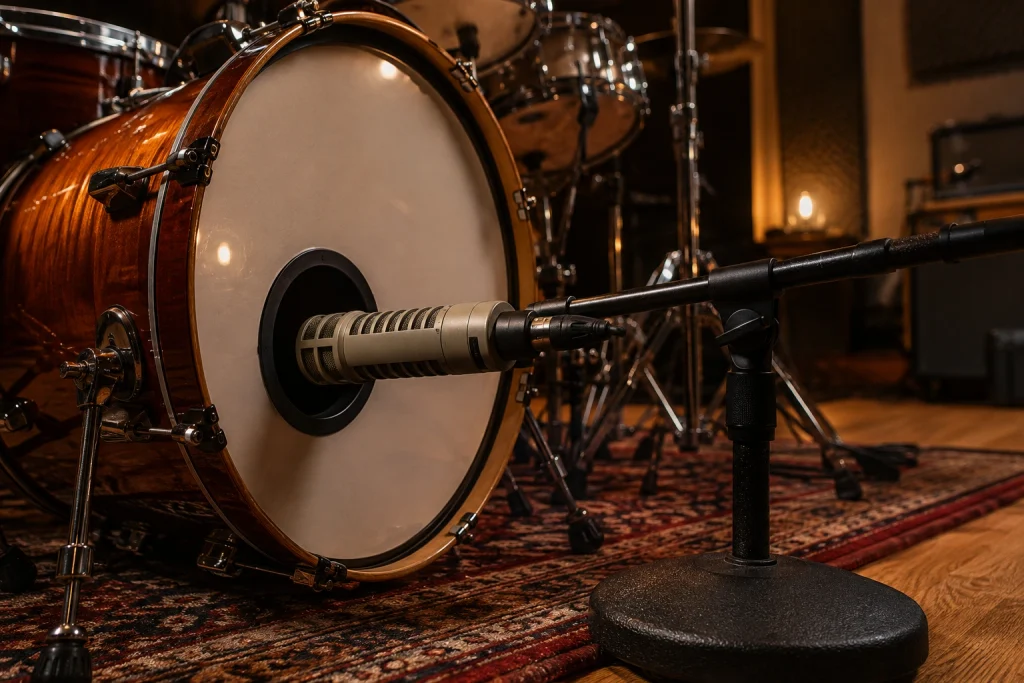
The RE20’s high SPL handling combined with Variable-D allows it to capture kick drum transients and bass guitar speaker cabinets down to 45 Hz with tight punch and zero muddy resonance.
Best Value for Home Studios: Shure SM7B
At an MSRP of $399 with an integrated yoke and two windscreens included, the SM7B costs significantly less to deploy than an RE20 ($449) paired with its necessary 309A shock mount ($100 to $120).
Buyer Decision Matrix
| If You Care Most About… | Buy This Microphone | Primary Justification |
| Untreated Room Isolation | Shure SM7B | Tighter cardioid rear pattern and superior electromagnetic shielding. |
| Tonal Consistency at Any Distance | Electro-Voice RE20 | Patented Variable-D eliminates proximity bass buildup entirely. |
| Warm, Low-End Radio Tone | Shure SM7B | Strong proximity effect adds richness to thin or higher-pitched voices. |
| Natural High-End Articulation | Electro-Voice RE20 | Extended flat treble through 18 kHz provides open speech clarity. |
| Budget & Included Mounting | Shure SM7B | Integrated yoke eliminates need to purchase external suspension baskets. |
| Kick Drums & Bass Tracking | Electro-Voice RE20 | Studio workhorse for bass instruments without muddy low-end boom. |
| Plosive-Free Close Speaking | Shure SM7B | Deep A7WS windscreen stops aggressive breath blasts directly at the grille. |
Alternative Microphones to Consider
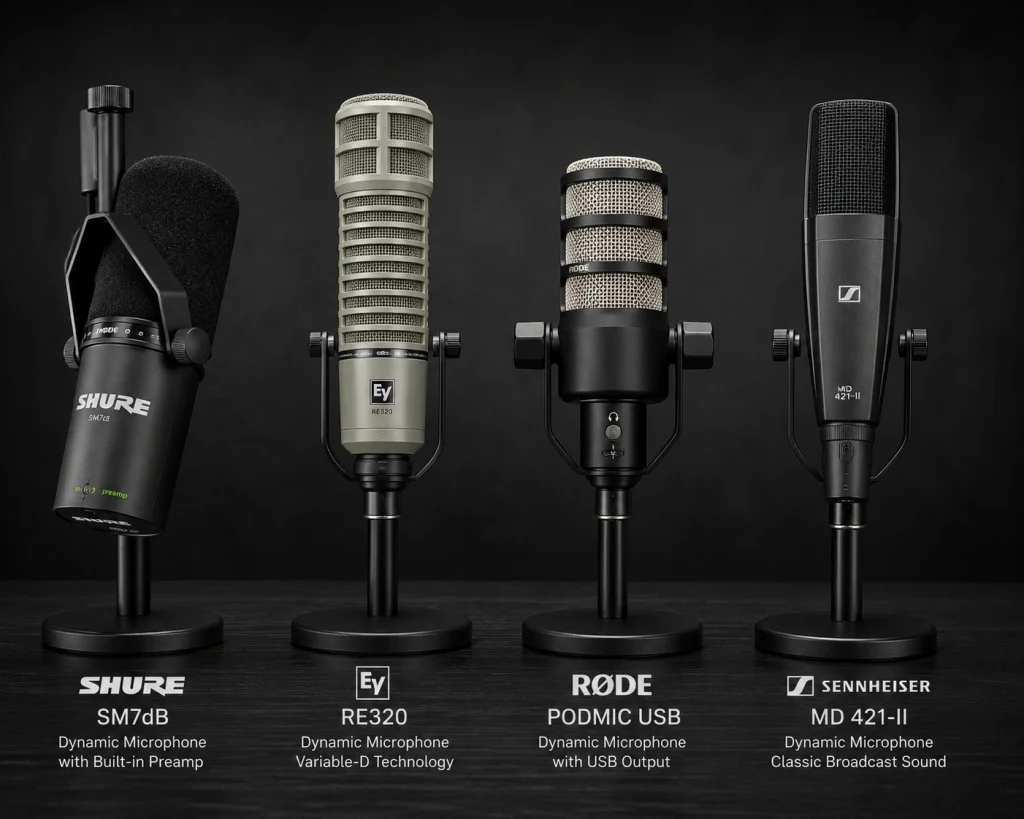
1. Shure SM7dB
The Shure SM7dB incorporates the exact acoustic cartridge and tone switches of the SM7B while adding an internal Shure-designed active preamplifier licensed from Cloud Microphones. It delivers switchable +18 dB or +28 dB of clean active gain via 48V phantom power. It is the ideal choice for buyers who want the SM7B tone without buying an outboard Cloudlifter.
2. Electro-Voice RE320
The RE320 utilizes the same Variable-D housing architecture as the RE20 but incorporates a higher-output neodymium magnet and a dual-voicing switch. Priced around $299, it offers a brighter vocal response curve and a specialized kick drum EQ profile, serving as a cost-effective alternative to the RE20.
3. Rode PodMic USB
For budget-conscious creators, the Rode PodMic USB provides both analog XLR and digital USB-C connectivity with onboard DSP processing. While it lacks the smooth midrange refinement of the SM7B or RE20, it offers an accessible entry point for basic podcasting without requiring standalone audio interfaces.
4. Sennheiser MD 421-II
The Sennheiser MD 421-II is a large-diaphragm dynamic microphone featuring a five-position bass roll-off switch. Like the RE20, it excels equally on spoken broadcast, guitar cabs, toms, and brass, offering a distinctively punchy midrange character.
Price and Value Comparison
Microphone system costs must account for necessary accessories, mounting hardware, and preamplification hardware.
Shure SM7B:
Original Launch MSRP: $399.00
Current Verified Retail Price: $399.00 to $439.00
Hardware Included: Integrated yoke mount, 5/8″-to-3/8″ thread adapter, standard windscreen, A7WS close-talk windscreen, switch cover plate.
Hidden Add-on Costs: May require an inline preamp booster ($100 to $150) if your audio interface provides less than +60 dB of clean gain.
Electro-Voice RE20:
Original List Price: $599.00
Current Verified Retail Price: $449.00
Hardware Included: EV 81715 hard stand clamp, zippered storage case.
Hidden Add-on Costs: The dedicated EV 309A suspension shock mount costs approximately $100 to $120, bringing the functional broadcast setup cost to roughly $550 to $570.
Value Verdict: The Shure SM7B provides superior out-of-the-box value. It includes a built-in shock mount, integrated yoke, and two high-grade windscreens at a lower initial retail price.
Who Should Buy Which?
Buy the Shure SM7B if:
- You record in an untreated room with PC fan noise, traffic, or acoustic reflections.
- You want an intimate, warm, low-end vocal tone without harsh sibilance.
- You speak directly into the microphone and want zero plosive p-pops.
- You want a compact, balanced mounting profile that does not require an external spider shock mount.
- You track aggressive rock, rap, or metal singing vocals in a project studio.
Buy the Electro-Voice RE20 if:
- You want tonal consistency that does not change when you move closer or further from the mic.
- You prefer natural, articulate speech clarity that cuts through broadcast mixes without muddy bass buildup.
- You produce multi-guest talk shows or interview podcasts where guests have inconsistent mic discipline.
- You plan to double the microphone as a studio tracking tool for kick drums, bass cabinets, and horns.
- You already own or plan to purchase a dedicated broadcast shock mount like the EV 309A.
Final Comparison Table
| Feature / Category | Shure SM7B | Electro-Voice RE20 | Verdict |
| Acoustic Design | Pressure Gradient Dynamic | Variable-D Dynamic | RE20 prevents proximity buildup. |
| Frequency Range | 50 Hz to 20,000 Hz | 45 Hz to 18,000 Hz | SM7B reaches higher; RE20 reaches lower. |
| Treble Character | Rolled-off above 12 kHz (Dark) | Extended flat to 18 kHz (Open) | RE20 has superior high-end air. |
| Proximity Effect | Heavy low-end boost close up | Minimal proximity effect | Depends on vocal preference. |
| Sensitivity | -59.0 dBV/Pa | -56.5 dBV/Pa | RE20 is 2.5 dB hotter. |
| Gain Demands | Very High (+60 dB required) | Moderate-High (+55 dB required) | RE20 is slightly easier to drive. |
| Plosive Control | Outstanding (A7WS included) | Moderate (internal screen only) | SM7B handles plosives better. |
| Mounting Hardware | Integrated captive yoke | Basic clamp (Shock mount extra) | SM7B has superior stock mounting. |
| EMI Shielding | Internal Humbucking Coil | Heavy Steel Casing | SM7B rejects computer hum better. |
| Versatility (Instruments) | Guitar cabs, rock vocals, brass | Kick drum, bass cab, horns, speech | RE20 wins on low-end instruments. |
| Verified Retail Price | $399.00 to $439.00 | $449.00 | SM7B is more affordable. |
| Overall Recommendation | Best for Podcasters/Creators | Best for Radio/Broadcasting | Shure SM7B Wins Overall. |
2026 Check: The Gain Question Decides This One
Budget the preamp, not just the mic. A dynamic broadcast mic into a weak interface preamp sounds thin and noisy no matter which legend you buy - the gain has to come from somewhere, and turning a weak preamp all the way up adds hiss. Before choosing between these two, check what your interface actually delivers cleanly; if it struggles, the honest total for the SM7B route includes an inline booster or a stronger preamp, and that changes the value math in the article’s own price comparison above.
If your chain is already strong, pick by voice and room. With clean gain handled, the choice returns to the article’s head-to-head: the SM7B’s rejection and handling for untreated rooms and loud sources, against the RE20’s Variable-D control of proximity effect for broadcast and voiceover work. Neither is “better” in the abstract - the winner is the one whose strengths match your voice, your room, and your loudest source.
The shortcut if gain worries you. The SM7dB - the SM7B with a built-in preamp, listed among this article’s alternatives - exists precisely for buyers who want the SM7B sound without the booster question. It costs more than the plain SM7B, but often less than mic plus booster plus the research to match them. If your interface is modest and your heart is set on the Shure sound, that is the route that avoids the most common SM7B regret.
Expert Verdict
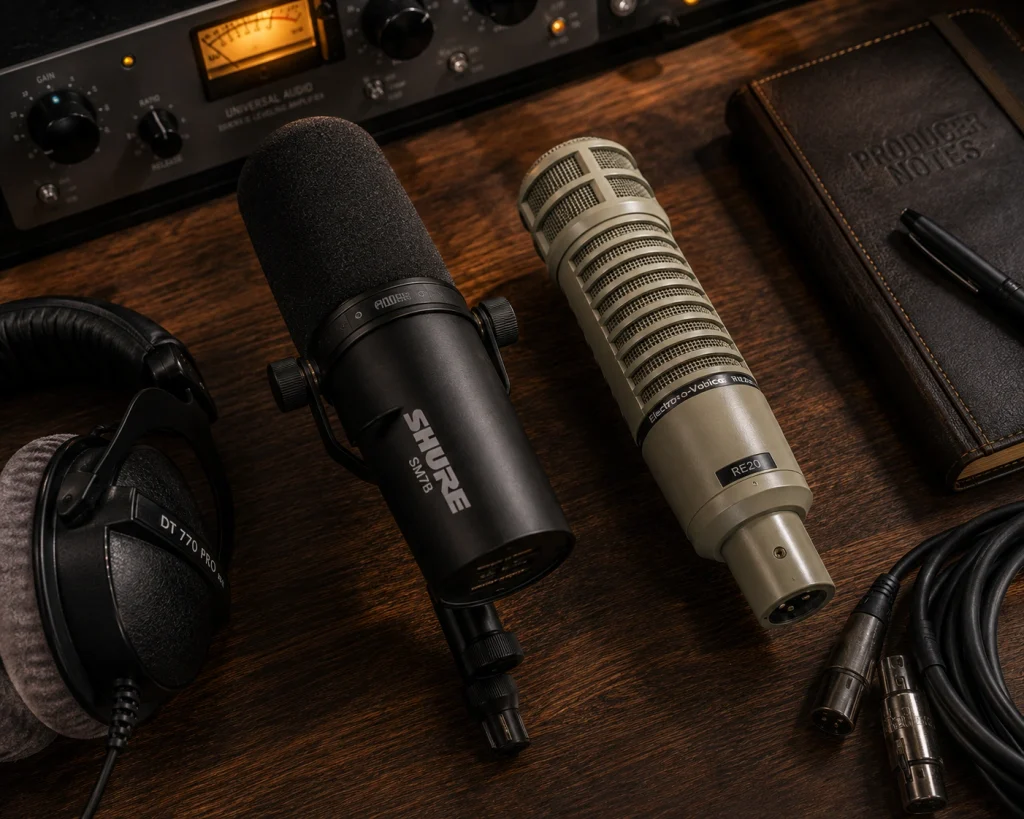
The Shure SM7B and Electro-Voice RE20 are both legendary broadcast dynamic microphones capable of producing professional, release-ready recordings.
The Shure SM7B wins our overall recommendation for home studio creators, streamers, and podcasters. Its built-in captive yoke mount, aggressive electromagnetic hum shielding, bundled A7WS close-talk windscreen, and warm, forgiving low-end profile make it the most reliable solution in untreated acoustic spaces. Its primary limitation is extreme gain hunger, which necessitates a capable audio interface or an inline preamp.
The Electro-Voice RE20 remains an unmatched broadcast tool for professional voiceover and multi-host environments. Its Variable-D acoustic architecture eliminates proximity effect, preserving uniform vocal balance regardless of speaker movement. While it costs more once paired with a proper suspension shock mount, its open high-end articulation and utility on kick drums make it a revered studio asset.
- Choose the Shure SM7B if you want a warm, forgiving vocal sound with built-in plosive protection and electromagnetic shielding for podcasting or streaming in untreated rooms.
- Choose the Electro-Voice RE20 if you need uncolored vocal accuracy, zero proximity bass buildup when shifting positions, or a dual-purpose microphone for speech and bass instrument recording.
Full Technical Specifications
| Technical Specification | Shure SM7B | Electro-Voice RE20 |
| Transducer Principle | Dynamic (Moving Coil) | Dynamic (Moving Coil) |
| Diaphragm Construction | Mylar with air suspension | Acoustalloy with internal shock mount |
| Polar Pattern | Cardioid (Uniform with frequency) | Cardioid (Variable-D directional) |
| Frequency Response | 50 Hz to 20,000 Hz | 45 Hz to 18,000 Hz |
| Sensitivity (at 1 kHz) | -59.0 dBV/Pa (1.12 mV) | -56.5 dBV/Pa (1.5 mV) |
| Impedance | 150 ohms (rated) / 150 ohms (actual) | 150 ohms (rated) / 150 ohms (actual) |
| Polarity | Positive pressure produces positive voltage on pin 2 | Positive pressure produces positive voltage on pin 2 |
| Switchable Filters | Bass roll-off (slotted) and Mid-range presence boost | Bass roll-off (slotted tilt-down curve) |
| Hum Rejection | 60 Hz hum pickup: 11 dB equivalent SPL | Heavy-gauge magnetic steel case shielding |
| Connector | 3-pin XLR male | 3-pin XLR male |
| Housing Material | Dark gray enamel aluminum and steel | Machined steel (Fawn beige or black) |
| Dimensions (L x Max Dia) | 190 mm x 96 mm x 63 mm (7.49″ x 3.78″ x 2.50″) | 217 mm x 54 mm (8.53″ x 2.14″) |
| Net Weight | 765.4 grams (1.69 lbs) | 737.0 grams (1.62 lbs) |
| Included Accessories | Standard foam windscreen, A7WS windscreen, switch cover | 81715 stand clamp, protective storage case |
| Country of Manufacture | Mexico | USA |
Frequently Asked Questions
Which microphone has better background noise rejection: Shure SM7B or EV RE20?
The Shure SM7B offers slightly tighter off-axis rejection in home environments. Its deeply recessed capsule design and built-in humbucking coil reject ambient room reflections and electromagnetic interference from computer screens more aggressively than the open-vented casing of the RE20.
Does the Electro-Voice RE20 require a Cloudlifter like the Shure SM7B?
The Electro-Voice RE20 is 2.5 dB more sensitive than the Shure SM7B (-56.5 dBV/Pa vs -59.0 dBV/Pa). While it still requires a quality audio interface with at least +55 dB of clean gain, it does not mandate an inline preamp as urgently as the SM7B does for normal speech levels.
What is Variable-D technology on the Electro-Voice RE20?
Variable-D (Variable Distance) is an acoustic design that utilizes precision-tuned rear and side ports along the microphone body. Acoustic waves entering these ports cancel low-frequency phase buildup behind the diaphragm. This eliminates proximity effect, allowing speakers to move closer or further without altering the bass balance of their voice.
Which microphone is better for female voices: SM7B or RE20?
The Electro-Voice RE20 is often preferred for female voices or naturally higher-pitched speakers who want pristine speech intelligibility without muddy mid-bass buildup. The SM7B can sometimes sound overly dark on higher voices unless the high-frequency presence boost switch is engaged or treble EQ is applied in software.
Why is the Electro-Voice RE20 more expensive than the Shure SM7B?
The RE20 costs more ($449 vs $399) due to its complex internal Variable-D acoustic chambering, heavy machined steel casing, and domestic manufacturing in the United States. In addition, setting up an RE20 often requires the optional EV 309A suspension shock mount, which adds around $100 to the total investment.
Can I plug the Shure SM7B or EV RE20 directly into a computer using a USB cable?
Neither microphone has native USB connectivity; both use analog 3-pin XLR outputs. You must connect them via an XLR cable to an audio interface, mixer, or USB preamp capable of converting analog audio to digital USB for your computer.
Which microphone handles plosives and breath pops better?
The Shure SM7B provides superior protection against plosives (“P” and “B” popping sounds). When outfitted with its included A7WS high-density foam windscreen, air blasts are completely dissipated before reaching the diaphragm. The RE20 relies on an internal screen that can still pop under direct, heavy air blasts.
Is the Shure SM7B or EV RE20 better for recording musical vocals?
Both are industry staples. The SM7B is the standard for aggressive rock, metal screamers, and rap vocals due to its smooth top-end roll-off and punchy midrange. The RE20 is preferred for dynamic vocalists who move around while performing, as well as baritone singers seeking uncolored chest resonance.
Why is the Shure SM7B so popular among podcasters and YouTubers?
The SM7B became the visual and acoustic standard for podcasting because of its sleek aesthetic, dark radio-style vocal warmth, integrated yoke mounting, and excellent performance in untreated bedrooms and office spaces.
Can the Electro-Voice RE20 be used to record instruments?
Yes. The RE20 is considered a legendary studio utility microphone for tracking bass guitar amplifier cabinets, kick drums, floor toms, brass sections, and acoustic bass due to its wide frequency response and lack of proximity boom.
Do either of these microphones require 48V phantom power?
No. Both the Shure SM7B and the Electro-Voice RE20 are passive dynamic microphones that operate entirely without phantom power. However, if you add an active inline signal booster (such as a Cloudlifter CL-1), that booster will require 48V phantom power to operate.
What is the difference between the beige and black Electro-Voice RE20?
The classic RE20 features a “Fawn Beige” finish, while the RE20 Black features a matte dark finish. Internal components, acoustic Variable-D tuning, frequency response, and performance are identical; the difference is purely aesthetic.