
classic recording decision: all-in-one USB convenience versus dedicated studio XLR fidelity. The Blue Yeti, manufactured under Logitech for Creators, provides a multi-pattern USB setup with integrated gain, mute, and headphone controls that work right out of the box. In contrast, the Audio-Technica AT2020 is a dedicated cardioid condenser microphone with an XLR output that requires an external audio interface supplying 48V phantom power.
While the Blue Yeti excels in desktop versatility and rapid setup for streaming or multi-person interviews, the Audio-Technica AT2020 delivers a more transparent, articulate frequency response, lower handling noise, and a modular upgrade path that better serves solo podcasters, vocalists, and voiceover artists working in controlled acoustic spaces.
Updated October 2026: This comparison still comes down to one decision: convenience or upgrade path. The Blue Yeti is a complete USB solution - plug it in and record, with multiple patterns for different jobs. The AT2020 (XLR version) is only the microphone half of a setup: it also needs an audio interface, an XLR cable, and a stand to work at all, so compare total cost, not mic-only price, before deciding the AT2020 is the cheaper option. If you already own an interface, the comparison flips - the AT2020’s simpler, focused design usually wins on pure vocal clarity for the money.
Quick Answer
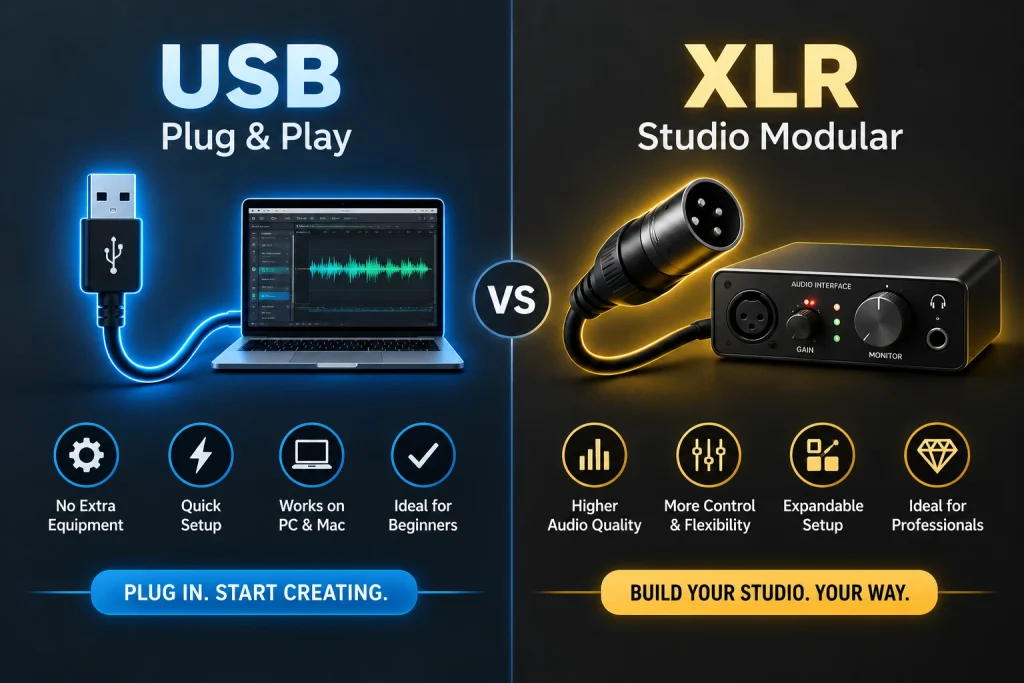
The Audio-Technica AT2020 is the better microphone for vocal purity, transient detail, and long-term home studio expansion, provided you budget for an external audio interface. The Blue Yeti is the best alternative for non-technical users who demand immediate plug-and-play USB convenience, multi-person recording patterns, and direct on-mic hardware controls without buying extra equipment.
Winner by Category
| Category | Winner | Key Advantage |
| Form Factor | Audio-Technica AT2020 | Compact, lightweight chassis (345g) fits cleanly on standard boom arms. |
| Sound Quality | Audio-Technica AT2020 | Flatter vocal reproduction with superior transient accuracy. |
| Acoustic Versatility | Blue Yeti | Four hardware polar patterns (Cardioid, Omnidirectional, Bidirectional, Stereo). |
| Ease of Setup | Blue Yeti | Direct USB plug-and-play connectivity; no audio interface or extra drivers needed. |
| Noise Handling & SPL | Audio-Technica AT2020 | Handles up to 144 dB SPL with tighter off-axis rejection. |
| Hardware Controls | Blue Yeti | Onboard physical dials for gain, headphone volume, mute, and pattern switching. |
| Software Processing | Blue Yeti | Native Logitech G HUB and Blue VO!CE integration for digital EQ and presets. |
| Build & Longevity | Audio-Technica AT2020 | Heavy-duty cast metal housing with a modular, repairable XLR connection. |
| System Upgradeability | Audio-Technica AT2020 | Works with professional audio interfaces, analog preamps, and hardware mixers. |
| Out-of-Box Value | Blue Yeti | Includes heavy metal desk stand and internal ADC; zero secondary hardware costs. |
| Overall Decision | Depends on your priorities | Choose AT2020 for acoustic fidelity; choose Blue Yeti for desktop simplicity. |
Quick Specifications
| Feature | Blue Yeti | Audio-Technica AT2020 |
| Transducer Type | Tri-capsule condenser (3 x 14mm capsules) | Fixed-charge back plate, permanently polarized condenser (16mm) |
| Polar Patterns | Cardioid, Omnidirectional, Bidirectional, Stereo | Cardioid only |
| Output Connection | Mini-USB (digital) | 3-pin XLR male (analog balanced) |
| Power Requirements | 5V USB bus power | 48V DC phantom power (2 mA typical) |
| Frequency Response | 20 Hz – 20,000 Hz | 20 Hz – 20,000 Hz |
| Bit Depth / Sample Rate | 16-bit / 48 kHz | Determined by external audio interface (commonly 24-bit / 96+ kHz) |
| Maximum SPL | 120 dB (THD 0.5% at 1 kHz) | 144 dB SPL (1 kHz at 1% THD) |
| Signal-to-Noise Ratio | Not specified by manufacturer | 74 dB (1 kHz at 1 Pa) |
| Self-Noise | Not specified by manufacturer | 20 dB SPL |
| Onboard Controls | Gain knob, Mute button, Volume dial, Pattern switch | None (controlled via external interface) |
| Headphone Jack | 3.5mm (zero-latency monitoring, 130mW output) | None on microphone body |
| Chassis Weight | 550 g / 1.2 lbs (Microphone only); 1,000 g (Stand) | 345 g / 12.1 oz (Microphone only) |
| Included Accessories | Integrated cast-metal desktop stand, USB cable | 5/8″-27 threaded stand mount, 3/8″-16 adapter, soft pouch |
Form-Factor Comparison: USB Desktop vs Modular Studio XLR
The physical design and connectivity architecture of these two microphones target distinct user workflows.
The Blue Yeti is an integrated digital workstation microphone. It combines three 14mm condenser capsules, an internal preamplifier, an analog-to-digital converter (ADC), a headphone amplifier, and physical hardware dials inside a massive 1.55 kg metal desktop package. Because the microphone sits directly on an included desk stand, it occupies a substantial desktop footprint (nearly 12 inches tall). While this format eliminates the need to purchase external hardware, its physical mass and direct desk contact make it vulnerable to picking up mechanical vibrations from typing, mouse movements, and desk bumps unless decoupled using a dedicated shockmount on a sturdy boom arm.
The Audio-Technica AT2020 is an analog side-address studio condenser microphone adhering strictly to traditional recording studio form factors. Weighing 345 grams, its compact cylindrical metal body is designed for suspension on a standard microphone boom arm or studio floor stand using its included threaded stand mount. It has no buttons, switches, or internal converters. The balanced 3-pin XLR connection routes an analog signal directly to an external audio interface or mixer. This requires an external box on your desk, but it keeps the microphone lightweight, easy to position around computer monitors, and immune to digital conversion bottlenecks inside the microphone body.
How We Evaluated
This comparison is based on manufacturer technical documentation, published independent acoustic testing from established audio engineering resources (including SoundGuys and RTINGS), real-world user reliability data, and objective hardware specifications.
The evaluation criteria include:
- Acoustic Performance: Frequency balance, vocal clarity, self-noise, transient response, and off-axis room noise rejection.
- Hardware Usability: Setup complexity, signal-chain versatility, physical controls, and physical desk footprint.
- Component Architecture: Capsule engineering, maximum sound pressure handling, and analog-to-digital conversion capabilities.
- Financial Value: Initial retail price compared against total ownership costs, including necessary cables, stands, and external preamps.
Limitations: Acoustic perception, room reverberation, mechanical desk noise, and vocal coloration vary significantly depending on individual vocal timbre, mouth-to-capsule positioning, room acoustic treatment, and the specific audio interface paired with an XLR microphone.
Blue Yeti Review
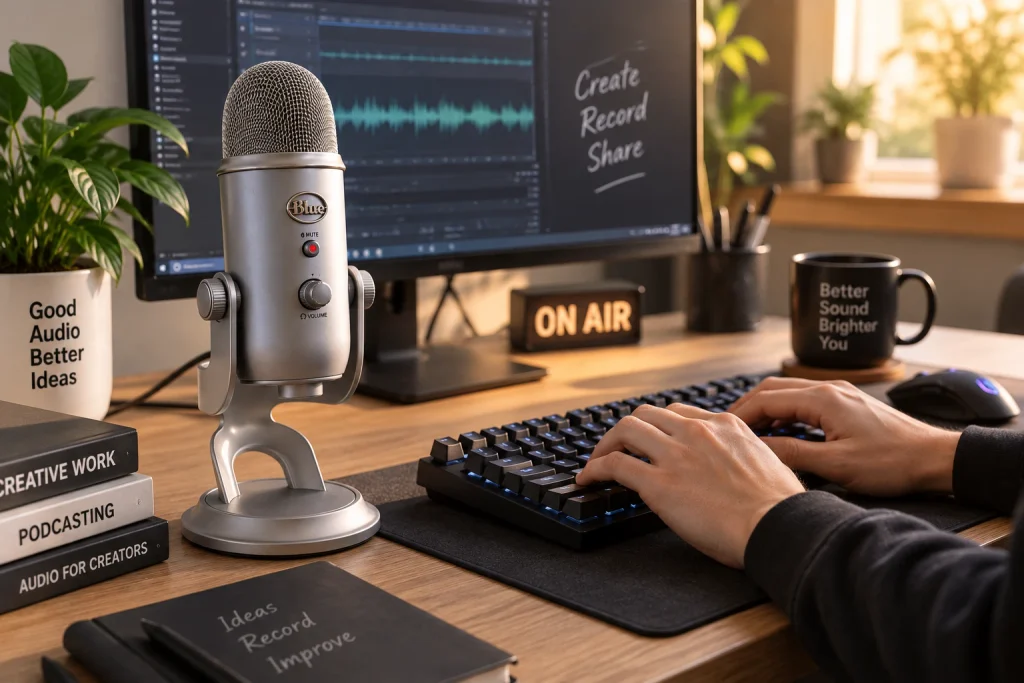
Is the Blue Yeti good? For creators looking for a direct, all-in-one audio solution, the Blue Yeti remains an accessible desktop condenser microphone. Built around a proprietary tri-capsule array, it provides multi-pattern pickup functionality that allows users to record single voices, face-to-face interviews, room ambiances, and musical duos using a single device. Its internal headphone amplifier provides instant, zero-latency feedback, while physical dials grant direct control over hardware gain, headphone output level, and muting.
However, the Yeti operates on an older internal architecture limited to 16-bit/48 kHz analog-to-digital conversion. Because it uses highly sensitive condenser capsules mounted inside a heavy desktop shell, it is prone to capturing room reflections, HVAC hum, and mechanical keyboard clicks when placed on a desk without an isolated boom arm.
What I Like
- Direct USB Convenience: Connects to PC or Mac platforms without requiring secondary hardware, driver installations, or external power.
- Four Selectable Polar Patterns: Cardioid, omnidirectional, bidirectional, and stereo modes handle varied recording arrangements.
- Comprehensive Physical Controls: Hardware dials for gain adjustment, headphone volume, instant muting, and pattern selection on the mic body.
- Zero-Latency Monitoring: Built-in 3.5mm stereo output allows direct vocal monitoring with zero computer buffer lag.
- Solid Industrial Base: Heavy cast-metal desktop stand keeps the microphone stable on flat surfaces without tipping.
- Integrated Software Processing: Compatibility with Logitech G HUB unlocks Blue VO!CE digital filters, noise reduction, and EQ presets.
What Could Be Better
- High Acoustic Sensitivity: Readily captures untreated room reverberation, PC fan noise, and mechanical keyboard typing.
- Hefty Physical Weight: At 1.55 kg with its desktop stand, it causes cheaper desk boom arms to sag or slip.
- Dated Connection Hardware: Standard models continue to use older mini-USB connections rather than modern, reinforced USB-C ports.
- Fixed 16-bit / 48 kHz Resolution: Lacks the 24-bit headroom found on newer consumer USB microphones and studio audio interfaces.
Pros & Cons
| Pros | Cons |
| Plug-and-play USB operation with no extra audio interface required | Sensitive condenser array easily captures room echo and background noise |
| Versatile 4-pattern recording options for solo and multi-person projects | Substantial weight and bulk require a heavy-duty arm for suspension |
| Direct onboard dials for mute, headphone volume, and input gain | Internal ADC is limited to 16-bit / 48 kHz recording resolution |
| Integrated headphone amplifier with latency-free hardware monitoring | Desktop stand transfers desk knocks and typing vibrations to audio |
Best For
The Blue Yeti is best suited for streamers, remote office workers, casual gamers, and podcasters who want clear speech capture without learning audio engineering. It is particularly effective for users who conduct occasional two-person interviews across a table or need to switch between individual streaming and group roundtables.
Recommendation
If your priority is simplicity, quick deployment, and multiple pickup patterns on a single desk stand, the Blue Yeti delivers reliable utility. Buyers should, however, invest in a pop filter and consider an aftermarket boom arm to keep desk vibrations out of their audio recordings.
Check Blue Yeti Price on Amazon →
Audio-Technica AT2020 Review
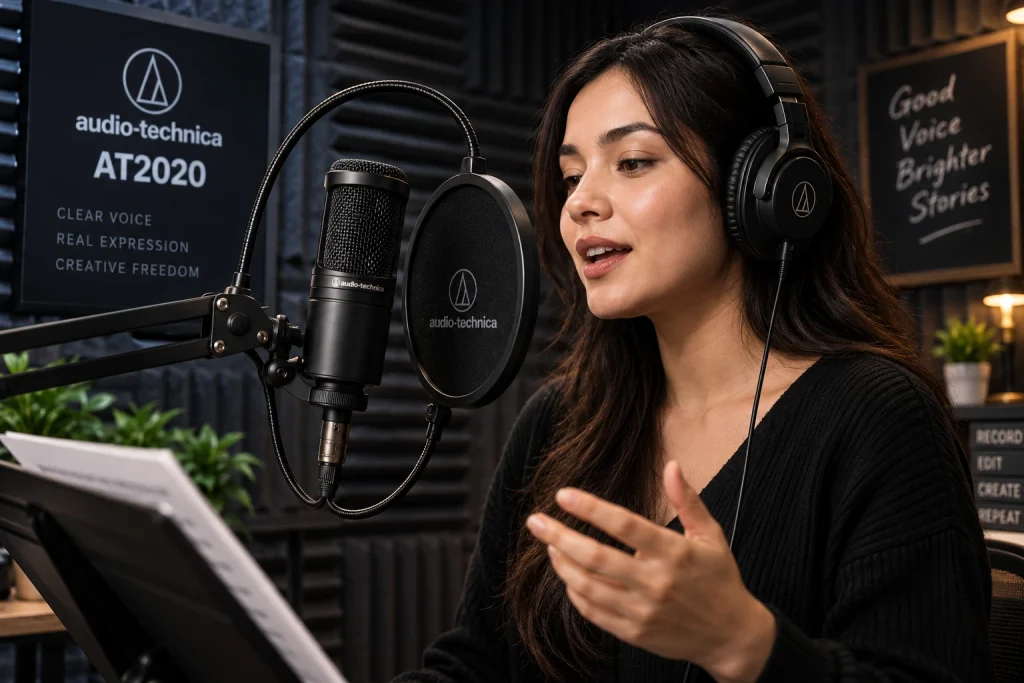
Is the Audio-Technica AT2020 good? The AT2020 is widely regarded as a reference point for budget studio condenser microphones. Featuring a custom-engineered 16mm low-mass diaphragm with a fixed cardioid pickup pattern, it delivers a transparent, balanced frequency curve with articulate upper-midrange response. Designed specifically for project studios, voiceover booths, and musical instrument tracking, it offers high sound pressure level handling (144 dB SPL) and clean transient capture that outperforms typical USB desktop microphones.
Because it is a pure analog XLR microphone, it has zero onboard volume knobs, zero digital converters, and cannot plug directly into a computer USB port. It requires an external audio interface, a standard XLR cable, and active 48V phantom power to operate. Additionally, with an equivalent input noise rating of 20 dB SPL, it has higher self-noise than high-end studio condensers, requiring appropriate preamplification gain staging.
What I Like
- Acoustic Detail and Accuracy: Delivers clean vocal articulation with natural tonal reproduction across the 20 Hz to 20,000 Hz spectrum.
- High SPL Capacity: Handles loud guitar amplifiers, percussive instruments, and aggressive vocals up to 144 dB SPL without clipping.
- Narrow Cardioid Rejection: Focused front-address pickup pattern rejects rear sound reflections more cleanly than wide desktop USB arrays.
- Compact, Rugged Metal Chassis: Heavy-duty die-cast construction weighs only 345 grams, easily fitting standard studio mounts and arms.
- Modular Signal Chain: Connects to any professional XLR interface, allowing you to upgrade your preamps, converters, or hardware processors over time.
- Consistent Studio Longevity: Lacks internal electronic converters or digital firmware that could become obsolete as computer operating systems update.
What Could Be Better
- Requires Secondary Audio Hardware: Cannot function without an external USB audio interface or mixer that supplies 48V phantom power.
- No On-Mic Physical Controls: Input gain, headphone monitoring levels, and muting must be adjusted on the connected audio interface.
- Susceptible to Vocal Plosives: The internal mesh head basket provides minimal protection against heavy breath blasts, requiring an external pop filter.
- Moderate Self-Noise: Rated at 20 dB SPL self-noise, which can produce a mild hiss when recording very quiet acoustic sources or whispers.
Pros & Cons
| Pros | Cons |
| Professional-grade vocal clarity and accurate high-frequency response | Cannot plug directly into a computer; requires an external audio interface |
| High 144 dB SPL handling accommodates dynamic instruments and loud vocals | Adds secondary hardware costs (XLR cable, preamp/interface, desk stand) |
| Standard 345g studio form factor fits cleanly on any budget boom arm | No physical gain dials, mute buttons, or headphone jacks on the chassis |
| Analog XLR connection will never become obsolete due to software changes | Sensitive to vocal plosives without a dedicated dual-layer pop filter |
Best For
The Audio-Technica AT2020 is best for aspiring voice actors, musicians, solo podcasters, and home studio producers who prioritize audio fidelity and plan to build a permanent, modular recording setup. It is ideal for users working in acoustically managed rooms who want accurate, uncolored vocal capture.
Recommendation
If sound quality, vocal nuance, and studio upgrade potential are your main goals, the Audio-Technica AT2020 is the superior acoustic investment. Just ensure you budget an additional $60 to $120 for an audio interface, an XLR cable, and a desktop boom arm.
Check Audio-Technica AT2020 Price on Amazon →
Head-to-Head Comparison
Form Factor and Desktop Footprint
The Blue Yeti and Audio-Technica AT2020 take radically different approaches to physical construction. The Blue Yeti is designed as a standalone desktop fixture. Its microphone body measures 12 cm x 12.5 cm x 29.5 cm with its cast-metal base attached, bringing its total weight to 1.55 kg (3.4 lbs). While this massive base prevents tipping, placing a heavy condenser microphone directly on a wooden desk positions the capsules 12 to 18 inches away from your mouth, right next to keyboard switches and computer cooling fans.
The Audio-Technica AT2020 measures 162 mm in length with a maximum body diameter of 52 mm, weighing 345 grams (12.1 oz). It does not include a desktop base; it ships with a 5/8″-27 threaded pivot mount and a 3/8″-16 adapter intended for studio boom arms or microphone stands. Suspending the AT2020 on an arm allows you to position it 4 to 6 inches from your mouth, maximizing direct vocal capture while isolating it from desk vibrations.
Editorial Judgment: The Audio-Technica AT2020 wins for ergonomic flexibility and boom arm compatibility. The Blue Yeti is practical only if you have ample desk space and do not want to mount a boom arm.
Sound Profile and Vocal Articulation
Microphone frequency response directly impacts vocal timbre. According to manufacturer technical specifications, both units cover the full human hearing spectrum of 20 Hz to 20,000 Hz. However, their acoustic tuning differs noticeably.
Independent measurements from audio testing publications indicate that the Audio-Technica AT2020 maintains a relatively neutral frequency curve through the low and mid frequencies, followed by a gentle, broad presence rise starting around 5 kHz and peaking near 8 kHz to 10 kHz. This high-frequency elevation adds crisp articulation and speech intelligibility to spoken words and vocal tracks without sounding excessively harsh. Its custom 16mm low-mass diaphragm delivers fast transient response, allowing it to capture subtle consonant details and acoustic string attacks.
The Blue Yeti exhibits slight mid-range recessions between 2 kHz and 4 kHz, followed by an aggressive high-frequency boost around 8 kHz to 10 kHz. This tuning creates an immediate “broadcast” character out of the box, but it can emphasize sibilance (harsh “s” and “t” sounds) in higher-pitched voices. When speaking off-axis or at varying distances, the Yeti can sound hollower due to phase interactions between its internal multiple capsules.
Editorial Judgment: The Audio-Technica AT2020 is the clear winner for acoustic fidelity. It produces a cleaner, more realistic vocal profile that responds predictably to software equalization.
Polar Patterns and Recording Versatility
Capsule flexibility is the Blue Yeti’s strongest hardware advantage. It contains a proprietary array of three 14mm condenser capsules controlled by a four-position rotary switch on the rear housing:
- Cardioid: Captures audio directly from the front, rejecting sound from behind. Best for solo streaming, gaming, and podcasting.
- Bidirectional (Figure-8): Captures sound from the front and rear while rejecting the sides. Best for two people sitting across a table conducting a face-to-face interview.
- Omnidirectional: Captures audio equally from all 360 degrees. Best for conference room tables or capturing natural room ambiance.
- Stereo: Uses left and right channels to capture a wide acoustic image. Best for acoustic guitar ensembles or ASMR content.
The Audio-Technica AT2020 contains a single 16mm diaphragm wired permanently in a cardioid pickup pattern. It cannot record bidirectional interviews or 360-degree rooms. However, because its internal acoustic chamber is optimized exclusively for cardioid reception, its off-axis rejection is noticeably tighter and more uniform than the Blue Yeti’s cardioid mode.
Editorial Judgment: The Blue Yeti wins this category decisively. If you need to record multi-guest interviews or group discussions using a single microphone, the AT2020 cannot do it without buying additional microphones.
Background Noise Rejection and Room Acoustics
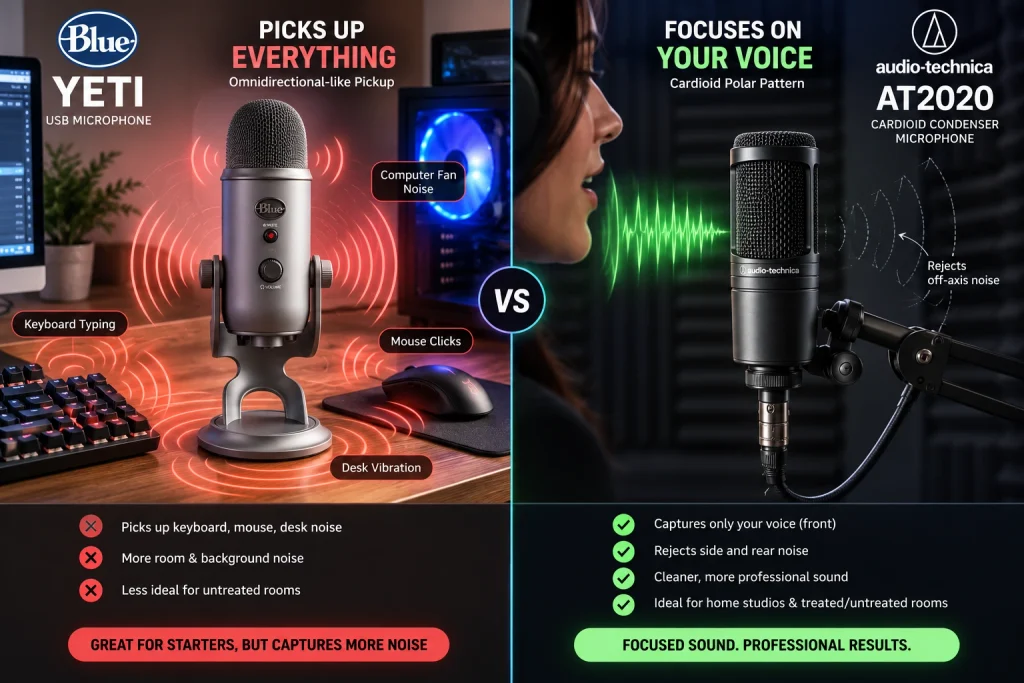
A common criticism of both microphones is their tendency to capture unwanted ambient noise, but they handle acoustic environments differently. Because both units use condenser capsules, their light, electrically charged diaphragms react instantly to minute sound pressure variations, including air conditioning airflow, street traffic, computer fans, and wall reflections.
The Audio-Technica AT2020 has an open-circuit sensitivity of -37 dB (14.1 mV) re 1V at 1 Pa, compared to the Blue Yeti’s higher capsule sensitivity of 4.5 mV/Pa. Furthermore, the AT2020 has a narrower pickup angle that attenuates sound arriving from 180 degrees off-axis by more than 20 dB. When mounted close to the speaker’s mouth with proper gain staging on an audio interface, the AT2020 rejects ambient room noise more effectively.
The Blue Yeti, particularly when placed on its desktop stand, frequently sits closer to the computer keyboard than to the speaker’s mouth. Users compensate by raising the hardware gain dial, which amplifies room reflections, keyboard clatter, and PC fan noise. Even in cardioid mode, the Yeti’s capsule arrangement allows more ambient bleed from the sides than the AT2020.
Editorial Judgment: The Audio-Technica AT2020 offers superior off-axis rejection. Neither microphone is forgiving in echoey rooms, but the AT2020 captures less room reverberation when properly positioned.
Connectivity, Setup Complexity, and Signal Chain
The Blue Yeti connects directly through a USB cable, operating via class-compliant audio drivers on Windows, macOS, and Linux. It draws 5V bus power directly from the computer port. Setup requires plugging in the cable and selecting the Yeti as your default recording and playback device in your operating system. All digital conversion happens inside the microphone chassis.
The Audio-Technica AT2020 is purely analog. It terminates in a standard balanced 3-pin XLR male connector. It cannot interface with a computer directly. To use the AT2020, you must construct a complete signal chain:
- Audio-Technica AT2020 microphone ($99 MSRP)
- Standard balanced XLR cable ($15–$25)
- External USB audio interface with 48V phantom power (such as a Focusrite Scarlett Solo, PreSonus AudioBox, or Elgato Wave XLR, costing $80–$160)
- Microphone boom arm or floor stand ($25–$100)
While the AT2020 requires higher initial effort and technical understanding, an XLR signal chain separates your microphone capsule from the computer’s digital processing. If an audio interface breaks or computer connection ports change from USB-A to USB-C, you simply replace the interface or cable without discarding the microphone.
Editorial Judgment: The Blue Yeti wins for immediate plug-and-play simplicity. The Audio-Technica AT2020 wins for long-term modular durability and professional workflow integration.
Hardware Controls and Monitoring
The Blue Yeti provides complete physical command on the microphone body. The front face features a smooth headphone volume knob and an illuminated, push-button mute toggle with an LED status indicator (solid red for active, flashing red for muted). The rear face features a physical analog gain dial and the four-position polar pattern rotary selector. On the bottom plate, an integrated 3.5mm headphone amplifier provides direct, zero-latency monitoring with a rated output of 130 mW into 16-ohm loads.
The Audio-Technica AT2020 features no buttons, knobs, switches, or headphone ports. Adjusting microphone gain, engaging phantom power, muting your voice, or listening to low-latency monitor audio must be handled entirely through your connected audio interface or streaming software.
Editorial Judgment: The Blue Yeti wins for onboard hardware convenience. Having immediate physical access to a mute button and gain dial directly on the microphone is a notable practical benefit for live streamers and remote workers.
Software Integration and Digital Processing
The Blue Yeti integrates with Logitech G HUB software, granting access to the Blue VO!CE signal processing suite. This platform includes real-time digital voice processing tools, such as high-pass filters, noise gates, compressors, de-essers, limiters, and custom EQ presets. These software tools allow streamers to clean up noisy rooms and shape their vocal broadcast tone without purchasing separate digital audio plugin packages.
The Audio-Technica AT2020 has no proprietary software application. Any acoustic shaping, noise gating, compression, or equalization must be handled through digital audio workstations (like Reaper, Audacity, or Adobe Audition), broadcasting software (like OBS Studio), or the virtual control software provided by your specific audio interface.
Editorial Judgment: The Blue Yeti wins for beginner-friendly software integration. Logitech G HUB allows non-technical users to apply useful vocal filters with a single click.
Durability, Build Quality, and SPL Handling
Both microphones utilize all-metal construction capable of surviving years of studio use. The Blue Yeti uses a thick steel chassis and wire mesh grille, giving it a heavy, durable feel. However, its internal moving parts, including rotary potentiometers, the pattern switch, and the mini-USB port, represent potential points of mechanical failure over extended use. In particular, mini-USB ports are susceptible to pin wear and loose physical connections if cables are frequently connected and disconnected.
The Audio-Technica AT2020 is built like an industrial studio tool. It features a rugged cast-metal body, a heavy wire-mesh outer basket, and an internal fine mesh layer. It has no moving parts, no electronic switches, and a solid 3-pin XLR connector that locks securely into place. Furthermore, the AT2020 handles a massive 144 dB SPL (at 1% THD), making it virtually impossible to distort through vocal performance, whereas the Blue Yeti is rated for a maximum of 120 dB SPL (at 0.5% THD).
Editorial Judgment: The Audio-Technica AT2020 wins for long-term durability, connection integrity, and extreme sound pressure tolerance.
My Take
My Take: If your goal is to set up a clean, reliable home recording space for voiceover, singing, or solo podcasting, the Audio-Technica AT2020 is the superior investment because its acoustic profile delivers greater vocal clarity and its XLR foundation lets your studio grow with you over time. However, for everyday streamers, gamers, and remote professionals who want a fast, zero-friction desk setup without managing external interface boxes, the Blue Yeti remains a practical, versatile workhorse.
Buyer-Specific Recommendations
Best for Live Streaming and Discord: Blue Yeti
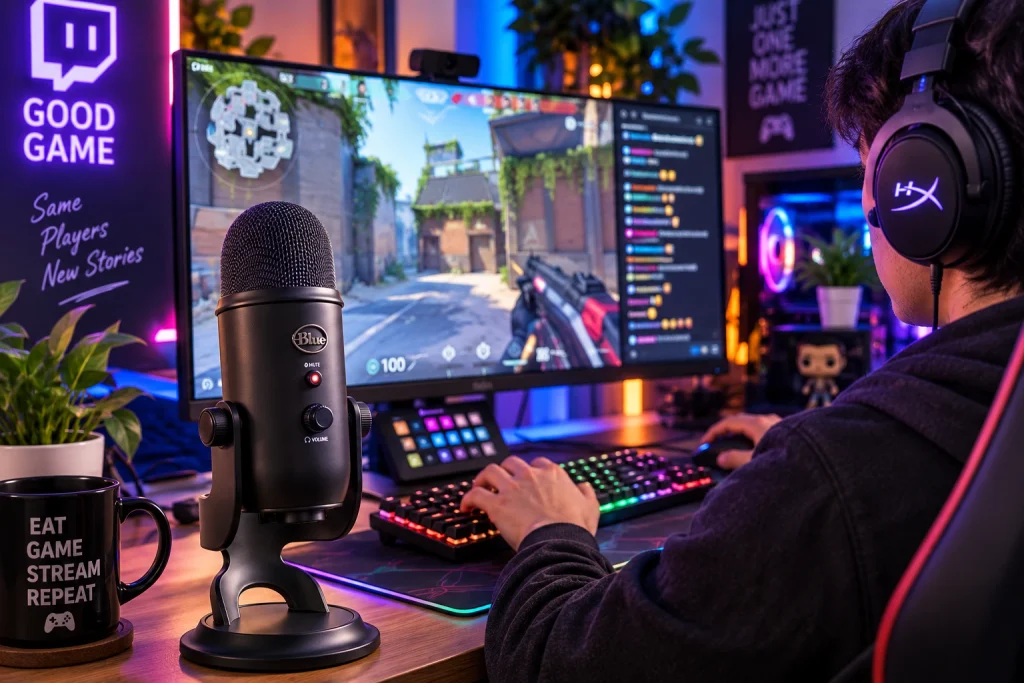
Streamers benefit immensely from direct physical mute buttons, instant volume dials, and simple USB cabling. The Blue Yeti connects directly to a gaming PC, integrates with OBS Studio and Discord without extra audio drivers, and allows quick vocal enhancement through Blue VO!CE in Logitech G HUB.
Best for Voiceover, Audiobooks, and Vocals: Audio-Technica AT2020
Voice artists need uncolored sound capture, low off-axis distortion, and clean transient handling. The AT2020’s 16mm low-mass diaphragm reproduces subtle dynamic expressions and speech nuances without the sibilant high-frequency peaks found in the Yeti’s capsule array.
Best for Multi-Person In-Room Podcasting: Blue Yeti
If you host a podcast with two people sitting across a table or record round-table discussions with limited equipment, the Blue Yeti’s bidirectional (Figure-8) and omnidirectional pickup modes allow a single microphone to capture multiple speakers cleanly, saving you the expense of buying multiple microphones and multi-channel interfaces.
Best for Musicians and Home Studio Recording: Audio-Technica AT2020
Recording acoustic guitars, brass, percussion, or loud guitar amplifier cabinets demands high sound pressure handling and linear frequency response. The AT2020 handles up to 144 dB SPL without analog distortion and integrates directly into standard studio patch bays and multi-track audio interfaces.
Best for Minimalist Desktops and Travel: Blue Yeti
While heavy, the Blue Yeti requires only a single USB cable and its included desktop stand. There are no external power bricks, interface boxes, or thick XLR cables to route, making it easier to transport for remote work or deploy in temporary workstations.
Buyer Decision Matrix
| If You Care Most About… | Recommended Microphone | Primary Reason |
| Lowest Total Setup Cost | Blue Yeti | No external audio interface, mixer, or specialty cables required. |
| Vocal Purity and Realism | Audio-Technica AT2020 | Flatter frequency curve with superior transient articulation. |
| Direct Plug-and-Play Setup | Blue Yeti | Connects via USB; recognized immediately by all major operating systems. |
| Recording Instruments / Amps | Audio-Technica AT2020 | Exceptional 144 dB SPL handling prevents clipping on loud audio sources. |
| Onboard Mute and Gain Dials | Blue Yeti | Physical hardware dials on the microphone body allow instant adjustments. |
| Multi-Guest / Table Interviews | Blue Yeti | Bidirectional and omnidirectional patterns capture multiple speakers. |
| Professional Studio Upgrades | Audio-Technica AT2020 | Modular XLR standard works with high-end preamps and professional gear. |
| Boom Arm Compatibility | Audio-Technica AT2020 | Weighs only 345 grams, preventing boom arm sag and mounting strain. |
Competitor Alternatives
Elgato Wave:3
The Elgato Wave:3 ($149.99 MSRP) is a direct USB condenser competitor that solves several of the Blue Yeti’s shortcomings. It features 24-bit/96 kHz analog-to-digital conversion, a lightweight compact frame, proprietary Clipguard technology that prevents digital clipping during loud shouts, and the Wave Link digital audio mixing software, making it a stronger choice for dedicated PC game streamers.
Audio-Technica AT2020USB-X
If you prefer the acoustic signature of the AT2020 but want USB convenience, Audio-Technica offers the AT2020USB-X ($129.00 MSRP). It retains the cardioid condenser capsule of the AT2020 while adding 24-bit/96 kHz internal digital conversion, a USB-C port, a silent capacitive mute switch, and a headphone monitoring output with a blend control dial.
Shure MV7+
For creators recording in untreated rooms with heavy background noise, the Shure MV7+ ($279.00 MSRP) is a hybrid USB/XLR dynamic microphone. Because it uses a dynamic capsule rather than a sensitive condenser diaphragm, it naturally rejects room echo and ambient noise far better than either the Blue Yeti or the AT2020.
Rode NT-USB+
The Rode NT-USB+ ($169.00 MSRP) provides an upgraded USB condenser experience featuring an internal Revolution Preamp, 24-bit/48 kHz analog-to-digital conversion, an integrated high-power headphone amp, and onboard DSP processing powered by Rode Central software, complete with an included high-grade metal pop filter.
Price and Value Comparison
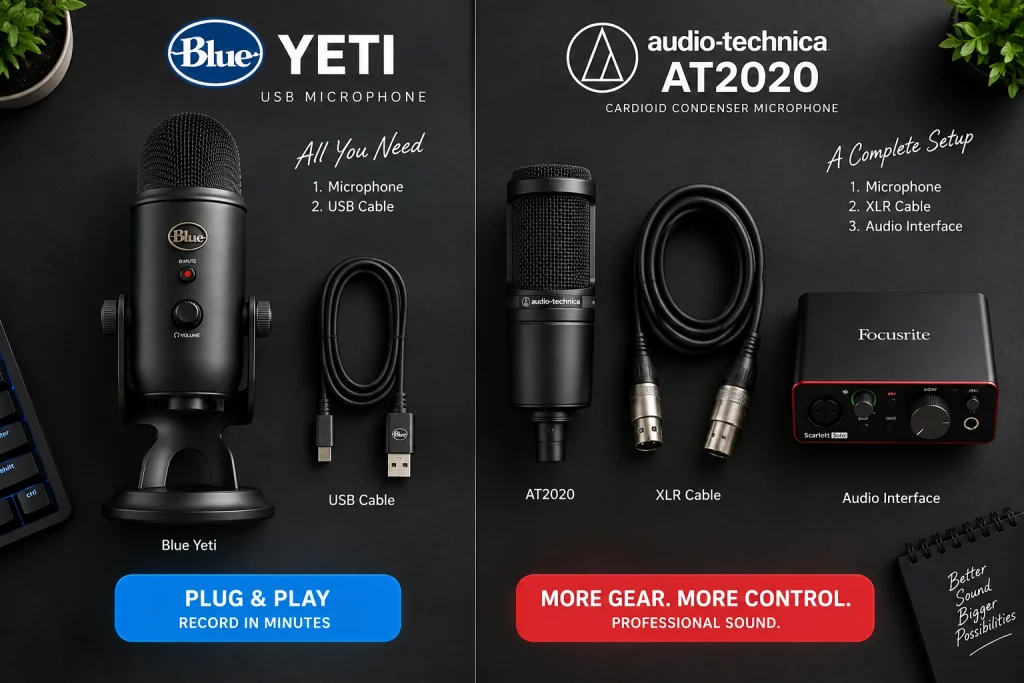
Evaluating the value of these two microphones requires looking beyond the sticker price of the microphone body alone.
Blue Yeti Financial Breakdown
Launch MSRP: $129.99
Current Retail Price: Typically fluctuates between $99.99 and $129.99 depending on color variant and retail promotions.
Included Components: Heavy metal desktop stand, USB cable.
Additional Required Purchases: $0 (An aftermarket pop filter for $10–$15 or a boom arm for $25–$50 is optional but recommended).
Total Out-of-Pocket Cost to Start Recording: Approximately $100–$130.
Audio-Technica AT2020 Financial Breakdown
Launch MSRP: $99.00
Current Retail Price: Consistently retails at $99.00 (frequently discounted to $79.00–$89.00 during holiday sales).
Included Components: Pivoting stand mount (5/8″-27 thread), 3/8″-16 threaded adapter, soft protective storage pouch.
Additional Required Purchases:
External USB audio interface with 48V phantom power (e.g., Focusrite Scarlett Solo or PreSonus AudioBox): $80.00–$130.00.
Balanced 3-pin XLR cable: $15.00–$25.00.
Desktop boom arm or tripod desk stand: $20.00–$45.00.
Total Out-of-Pocket Cost to Start Recording: Approximately $200–$270.
Value Verdict: The Blue Yeti provides substantially higher immediate out-of-the-box value for budget-conscious buyers because it requires zero secondary hardware. The Audio-Technica AT2020 represents superior long-term hardware value for recording enthusiasts, because its XLR design will outlive digital port changes, and its components can be upgraded modularly without replacing the microphone itself.
Who Should Buy Which?
Buy the Blue Yeti If:
- You want a complete microphone setup that works within two minutes of opening the box.
- You do not want to buy or configure an external audio interface, mixer, or XLR cables.
- You need physical controls for instant mute, headphone volume, and microphone gain at your fingertips.
- You plan to record two-person interviews, roundtables, or ambient sound using multiple polar patterns.
- You stream games or participate in video calls from a stationary desk setup.
Buy the Audio-Technica AT2020 If:
- You prioritize transparent, accurate vocal reproduction over convenience.
- You already own an audio interface with 48V phantom power, or you have budgeted $200+ for a full setup.
- You plan to record acoustic instruments, loud singing, voiceovers, or audiobooks.
- You intend to mount your microphone on a standard desktop boom arm.
- You want a professional XLR audio foundation that you can upgrade over the next decade.
Final Comparison Table
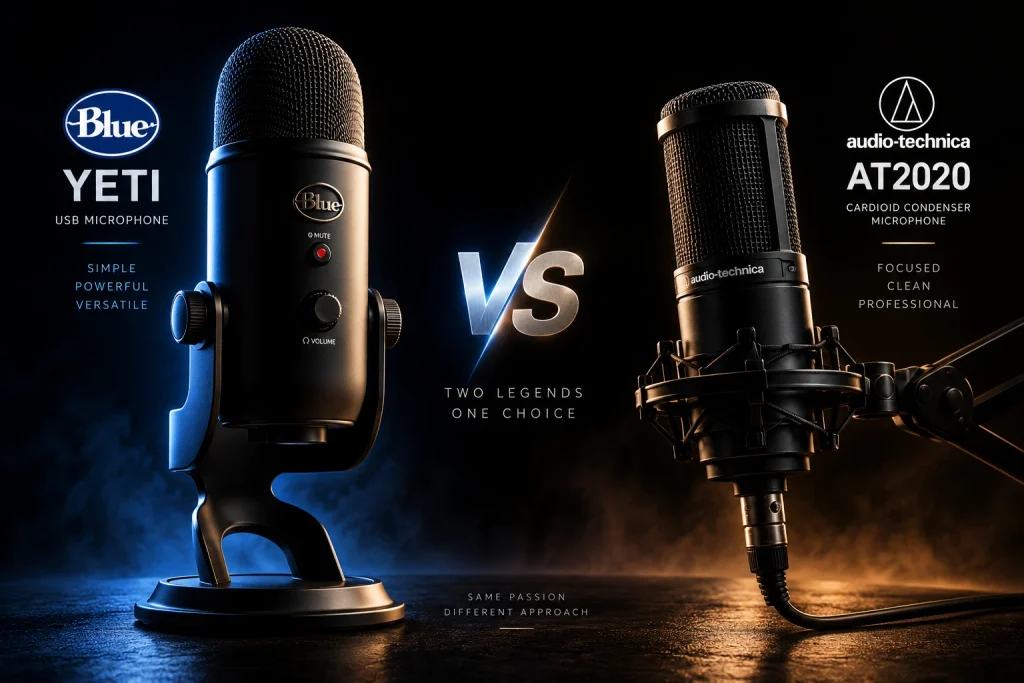
| Category | Blue Yeti | Audio-Technica AT2020 | Verdict |
| Acoustic Fidelity | Good; broad high-frequency lift with mild mid recessions | Excellent; neutral mids with smooth, airy presence boost | Audio-Technica AT2020 |
| Pickup Flexibility | Outstanding (4 switchable hardware polar patterns) | Limited to a single cardioid pattern | Blue Yeti |
| Off-Axis Rejection | Moderate; wide pickup area captures room echo | Tight; clean rear attenuation reduces room reflections | Audio-Technica AT2020 |
| SPL Capability | 120 dB SPL (handles speech and moderate singing) | 144 dB SPL (handles loud drums, guitar amps, and screams) | Audio-Technica AT2020 |
| Setup Speed | Immediate plug-and-play via USB cable | Requires connecting interface, XLR cable, and phantom power | Blue Yeti |
| Physical Controls | Mute, headphone volume, gain knob, pattern dial | None on microphone body | Blue Yeti |
| Hardware Portability | Bulky and heavy (1.55 kg with stand) | Compact and lightweight (345 g) | Audio-Technica AT2020 |
| Software Ecosystem | Logitech G HUB and Blue VO!CE processing | None (relies on third-party DAW or interface software) | Blue Yeti |
| Hardware Longevity | Vulnerable to USB port wear and digital obsolescence | Analog XLR connection lasts indefinitely | Audio-Technica AT2020 |
| Initial Cost to Start | $99–$130 all-inclusive | $200–$270 including necessary interface and cabling | Blue Yeti |
| Overall Recommendation | Best for everyday creators, streamers, and multi-pattern utility | Best for aspiring audio engineers, vocalists, and voice talent | Split by User Intent |
Expert Verdict
The Blue Yeti and Audio-Technica AT2020 represent two distinct philosophies in desktop recording.
The Audio-Technica AT2020 is the superior recording instrument. Its lightweight 345-gram frame, high 144 dB SPL ceiling, and articulate 16mm condenser diaphragm deliver uncolored, studio-grade speech and musical reproduction that the Blue Yeti cannot match. However, its analog XLR requirement introduces friction: you must invest in an external audio interface, route balanced cabling, and manage gain staging manually.
The Blue Yeti sacrifices ultimate acoustic transparency in favor of unmatched desktop utility. Its four selectable polar patterns, onboard gain dial, zero-latency headphone port, hardware mute switch, and direct USB connectivity provide everything an everyday content creator needs inside a single purchase. Its biggest weaknesses are its heavy 1.55 kg desk footprint and high sensitivity to keyboard clatter and room echo.
Choose the Blue Yeti if you want an all-in-one USB microphone for gaming, streaming, multi-person podcasting, and remote meetings with zero technical friction.
Choose the Audio-Technica AT2020 if you want professional vocal fidelity for voiceover, music, or solo podcasting, and you are ready to invest in a dedicated XLR studio signal chain.
Final Purchasing Options
Check Blue Yeti Deals on Amazon →
Check Audio-Technica AT2020 Deals on Amazon →
Full Technical Specifications
| Technical Specification | Blue Yeti (Logitech G) | Audio-Technica AT2020 | Source Attribution |
| Product Manufacturer | Logitech / Blue Microphones | Audio-Technica Corporation | Official Manufacturer Specifications |
| Transducer Principle | Condenser, pressure gradient | Fixed-charge back plate, permanently polarized condenser | Official Manufacturer Specifications |
| Diaphragm / Capsule Array | Three 14mm proprietary condenser capsules | 16mm custom low-mass diaphragm | Official Manufacturer Specifications |
| Directional Polar Patterns | Cardioid, Bidirectional, Omnidirectional, Stereo | Cardioid | Official Manufacturer Specifications |
| Frequency Response Range | 20 Hz – 20,000 Hz | 20 Hz – 20,000 Hz | Official Manufacturer Specifications |
| Sensitivity | 4.5 mV/Pa (1 kHz) | -37 dB (14.1 mV) re 1V at 1 Pa | Official Manufacturer Specifications |
| Output Impedance | Headphone amp: 16 ohms | 100 ohms | Official Manufacturer Specifications |
| Maximum Input Sound Level | 120 dB SPL (THD: 0.5% 1 kHz) | 144 dB SPL (1 kHz at 1% THD) | Official Manufacturer Specifications |
| Dynamic Range | Not specified by manufacturer | 124 dB (1 kHz at Max SPL) | Official Manufacturer Specifications |
| Signal-to-Noise Ratio | Not specified by manufacturer | 74 dB (1 kHz at 1 Pa) | Official Manufacturer Specifications |
| Self-Noise (Equivalent Noise) | Not specified by manufacturer | 20 dB SPL | Official Manufacturer Specifications |
| Digital Audio Resolution | 16-bit / 48 kHz | Dependent on external interface ADC | Official Technical Documentation |
| Power Requirements | 5V 150mA (via USB bus power) | 48V DC phantom power, 2.0 mA typical | Official Manufacturer Specifications |
| Output Connectors | Mini-USB & 3.5mm stereo headphone jack | Integral 3-pin XLR male connector | Official Technical Documentation |
| Headphone Amp Output Power | 130 mW into 16 ohms | Not applicable (no onboard headphone jack) | Official Manufacturer Specifications |
| Headphone Amp THD | 0.009% | Not applicable | Official Manufacturer Specifications |
| Headphone Amp Frequency | 15 Hz – 22,000 Hz | Not applicable | Official Manufacturer Specifications |
| Microphone Dimensions | 12 cm x 12.5 cm x 29.5 cm (with stand) | 162.0 mm (6.38″) length, 52.0 mm (2.05″) max diameter | Official Manufacturer Specifications |
| Microphone Weight | Mic only: 550 g (1.2 lbs); Stand: 1,000 g (2.2 lbs) | 345 g (12.1 oz) | Official Manufacturer Specifications |
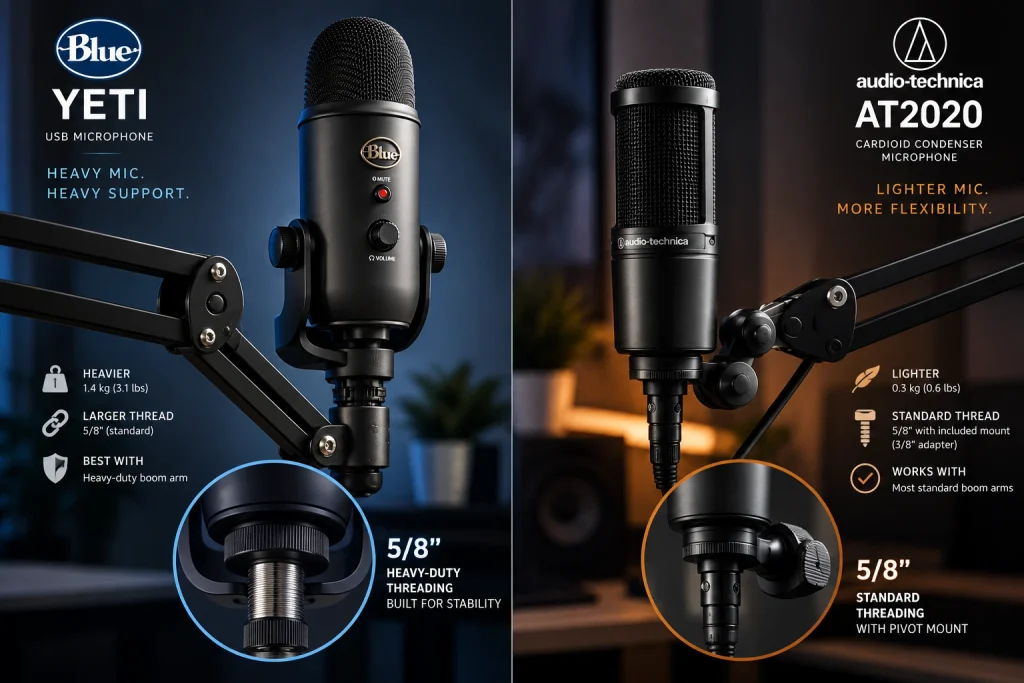
| Mounting Threading | 5/8″-27 standard microphone thread | 5/8″-27 stand mount with 3/8″-16 threaded adapter | Official Manufacturer Specifications |
Frequently Asked Questions
Which microphone has better overall sound quality?
The Audio-Technica AT2020 has better overall sound quality. It utilizes a custom 16mm low-mass studio condenser diaphragm that produces a more balanced, neutral frequency response with smoother high-frequency detail and faster transient response. The Blue Yeti has a more processed, sibilant frequency profile that can sound slightly harsh on certain voices, and its capsule array exhibits minor phase coloration when speaking off-axis.
Can I plug the Audio-Technica AT2020 directly into my computer?
No, you cannot plug the standard Audio-Technica AT2020 directly into a computer USB port. It is an analog XLR microphone that requires a balanced 3-pin XLR cable and an external USB audio interface or mixer capable of delivering 48V phantom power. If you want an Audio-Technica microphone that connects directly via USB, look at the Audio-Technica AT2020USB-X instead.
Does the Blue Yeti require an external audio interface?
No, the Blue Yeti does not require an audio interface. It contains an internal preamplifier, analog-to-digital converter, and headphone amplifier built into its chassis. It connects directly to your PC, Mac, or compatible gaming console using the included USB cable, drawing 5V bus power directly from the computer port.
Why does my Blue Yeti pick up so much keyboard and background noise?
The Blue Yeti picks up ambient noise because it uses sensitive condenser capsules and typically sits on a desktop stand close to your keyboard and mouse. Condenser diaphragms are engineered to capture minute acoustic details, meaning they readily register mechanical desk vibrations, room echo, and computer fans. You can minimize this by lowering the physical gain knob on the back of the mic, placing it closer to your mouth, switching to cardioid mode, and mounting it on a padded boom arm.
Which microphone is better for singing and music production?
The Audio-Technica AT2020 is significantly better for singing, tracking acoustic guitars, and recording music. It handles high sound pressure levels up to 144 dB SPL without clipping, captures realistic vocal dynamics, and connects directly to professional studio audio interfaces and digital audio workstations. The Blue Yeti is rated to 120 dB SPL and is capped at 16-bit/48 kHz resolution, which restricts dynamic headroom during professional mixing.
Can the Audio-Technica AT2020 record two people at once?
The Audio-Technica AT2020 is not designed to record two people at once because it has a fixed cardioid pickup pattern that captures sound almost exclusively from the front. While two people can crowd in front of it, they must share a narrow acoustic window. The Blue Yeti is far better for two speakers because its bidirectional (Figure-8) pattern captures audio cleanly from both the front and back while rejecting room noise from the sides.
Does the Blue Yeti work with an iPhone or iPad?
Yes, the Blue Yeti can work with modern iOS and iPadOS devices. For devices with USB-C ports, it connects using a standard USB-to-USB-C data cable or adapter. For older devices with Lightning ports, it requires an official Apple Lightning to USB Camera Adapter with an active external power connection, as the Yeti’s internal electronics draw up to 150 mA, which can exceed the Lightning port’s default output limit.
Is the Audio-Technica AT2020 worth the extra cost of an audio interface?
Yes, the Audio-Technica AT2020 is well worth the extra investment if you care about long-term audio quality, speech clarity, and studio versatility. While adding an audio interface increases your total initial cost by $80 to $130, it gives you tactile gain controls, clean preamps, professional XLR connectivity, zero computer driver dependency, and a modular setup that allows you to upgrade individual components in the future.
Can you mount both microphones on a boom arm?
Yes, both microphones can be mounted on a standard boom arm, but the experience differs significantly. The Audio-Technica AT2020 weighs only 345 grams and fits virtually any budget boom arm using its included 5/8″-27 threaded stand mount and 3/8″-16 adapter. The Blue Yeti weighs 550 grams without its desk stand and requires a heavy-duty, tension-adjustable boom arm to prevent sagging, along with a compatible 5/8″-27 mounting thread.
Does the Blue Yeti support 24-bit audio recording?
The standard Blue Yeti does not support 24-bit audio recording; its internal analog-to-digital converter operates at 16-bit / 48 kHz. While 16-bit resolution is completely adequate for podcasting, streaming, and remote conferencing, it offers less dynamic headroom for post-production editing than the 24-bit or 32-bit conversion available on modern external audio interfaces paired with the AT2020.
Which microphone is better for streaming on Twitch and YouTube?
The Blue Yeti is generally better for entry-level and intermediate live streaming because of its physical convenience. It features an instantaneous onboard mute button with an LED indicator, a direct headphone volume dial, and plug-and-play USB connectivity that integrates seamlessly with OBS Studio and Discord. However, advanced streamers seeking broadcast-quality vocal isolation frequently prefer the AT2020 paired with an interface like the Elgato Wave XLR.
What polar pattern should I use on the Blue Yeti for solo talking?
You should always use Cardioid mode (represented by the heart-shaped icon on the pattern selector dial) for solo talking, streaming, podcasting, and voiceover. Cardioid mode captures audio directly in front of the Blue logo while rejecting sound coming from the rear of the microphone, significantly cutting down on room echo and computer fan noise.
Related reading: Blue Yeti review · Audio-Technica AT2020 review · Does Blue Yeti work with MacBook Pro?