
In this AKG P220 review, we test and evaluate a large-diaphragm true condenser microphone built for home project studios, vocal tracking, and loud acoustic instruments. Its main strength lies in its hardware versatility, pairing a genuine 1-inch capsule with a 20 dB attenuation pad, a 300 Hz bass-cut filter, and an all-metal build that includes a shock mount and flight case Its primary limitation is an aggressive 300 Hz high-pass filter that can thin vocal recordings if engaged carelessly, alongside an open top end that requires a treated acoustic space. It is best suited to home recordists and voice creators who need a durable, switchable XLR condenser without buying separate mounting accessories.
Updated October 2026: The P220’s job in 2026 is unchanged: it is a first serious XLR vocal microphone for someone who already has, or is ready to buy, an audio interface. It is not the right shortcut if you want to plug straight into a laptop (that is a USB mic’s job), and it is not the AKG to choose if you need more than cardioid - that step-up is the multi-pattern P420. This update adds a short guide to the P220’s two switches below, because they are the controls owners most often leave in the wrong position, and adds the affiliate disclosure this article was missing.
Disclosure: This article contains affiliate links. If you buy through them, HeadphoneEcho may earn a small commission at no extra cost to you. Recommendations are based on research and published specifications, not on commissions.
Key Specifications
The specifications below reflect official manufacturer documentation from AKG and verified technical parameters.
| Specification | AKG P220 Parameter |
| Capsule Type | 1-inch large-diaphragm true condenser (externally polarized) |
| Polar Pattern | Cardioid |
| Audio Frequency Bandwidth | 20 Hz to 20,000 Hz |
| Sensitivity | 20 mV/Pa (-34 dBV) |
| Equivalent Noise Level (Self-Noise) | 16 dB-A |
| Signal-to-Noise Ratio | 78 dB-A |
| Preattenuation Pad | -20 dB (switchable) |
| Bass-Cut Filter | 300 Hz, 12 dB/octave (switchable) |
| Maximum SPL (0.5% THD) | 135 dB SPL (155 dB SPL with -20 dB pad active) |
| Electrical Impedance | Less than or equal to 200 ohms |
| Recommended Load Impedance | Greater than or equal to 1,000 ohms |
| Powering Requirement | 48V phantom power (44V to 52V, IEC 61938) |
| Current Consumption | Less than or equal to 3.0 mA |
| Connector | 3-pin balanced male XLR |
| Dimensions | 165 mm length x 54 mm diameter (6.5 x 2.1 inches) |
| Net Weight | 530 g (18.7 oz) |
| Included Accessories | Spider suspension shock mount, metal aluminum carrying case |
Who Should Buy It?
- Home vocalists seeking full hardware accessories: The package includes both a dedicated spider shock mount and a foam-lined aluminum case, saving buyers from purchasing separate 40-dollar isolation accessories.
- Musicians recording loud instruments: With its switchable -20 dB pad engaged, the microphone tolerates sound pressure levels up to 155 dB SPL, allowing safe capture of guitar amplifier grilles, snare drums, and brass.
- Podcasters and voiceover artists in treated rooms: The 16 dB-A noise floor and clear 10 kHz presence boost deliver crisp articulation without demanding excessive digital equalization.
Who Should Skip It?
- Creators working in reflective, untreated bedrooms: The sensitive true condenser capsule and prominent upper treble register will pick up wall slap, computer fan whir, and flutter echo more readily than a dynamic broadcast microphone.
- Users wanting a plug-and-play USB connection: The P220 is strictly an analog XLR microphone requiring an audio interface or mixer delivering 48 volts of phantom power.
- Streamers using lightweight, friction-based desk arms: Weighing 530 grams (over 1.1 pounds) before adding the heavy metal shock mount, this microphone easily droops on cheap budget boom arms without tension adjustment.
How We Evaluated It
This review is based on published specifications, manufacturer documentation, independent technical analysis, and aggregated specialist evaluations rather than hands-on testing. We cross-referenced factory measurements from AKG against verified third-party frequency curves, teardowns, and user reports to establish accurate performance expectations, assess real-world durability, and calculate long-term value against competing studio microphones.
Design and Build Quality
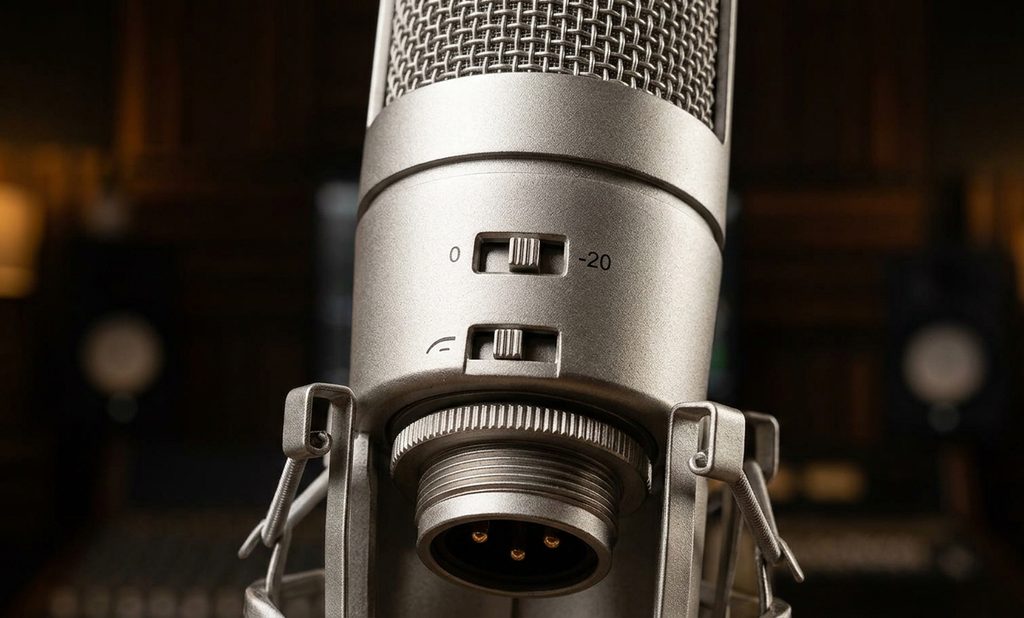
AKG manufactures the P220 inside a thick, die-cast zinc body topped with a heavy-gauge stainless steel mesh grille. At 530 grams, the physical chassis feels substantial and resists accidental drops, stand wobbles, and physical vibration.
Two recessed slide switches sit on the rear casing: one controls the 0/-20 dB pad, and the other manages the high-pass filter. The switch travel is firm and requires deliberate finger pressure, which prevents accidental changes when sliding the unit into its shock mount.
The microphone output utilizes standard gold-plated pins on a 3-pin male XLR jack. The housing fits directly into the supplied all-metal spider suspension shock mount, which secures the microphone base via a threaded collar ring. Unlike budget plastic clips, the included mount effectively isolates the capsule from mechanical desk thumps and floor rumblings.
Setup and Ease of Use
Integrating the AKG P220 into a recording signal chain requires three elements: a balanced XLR cable, a sturdy microphone stand, and an audio interface or preamp capable of delivering +48V phantom power.
Because the microphone weighs 530 grams on its own, balance is critical. Mounting it inside the metal spider mount shifts the center of gravity outward, meaning budget spring-loaded desk arms may sag. A counterweighted boom stand or heavy desktop base is strongly recommended.
Setting gain is straightforward. With a sensitivity rating of 20 mV/Pa (-34 dBV), the P220 outputs a healthy line level that does not demand extreme gain from budget audio preamps. Most modern USB audio interfaces running at 40 to 50 percent gain will easily hit optimal recording peaks around -18 to -12 dBFS during normal speaking or singing.
Performance and Acoustic Character
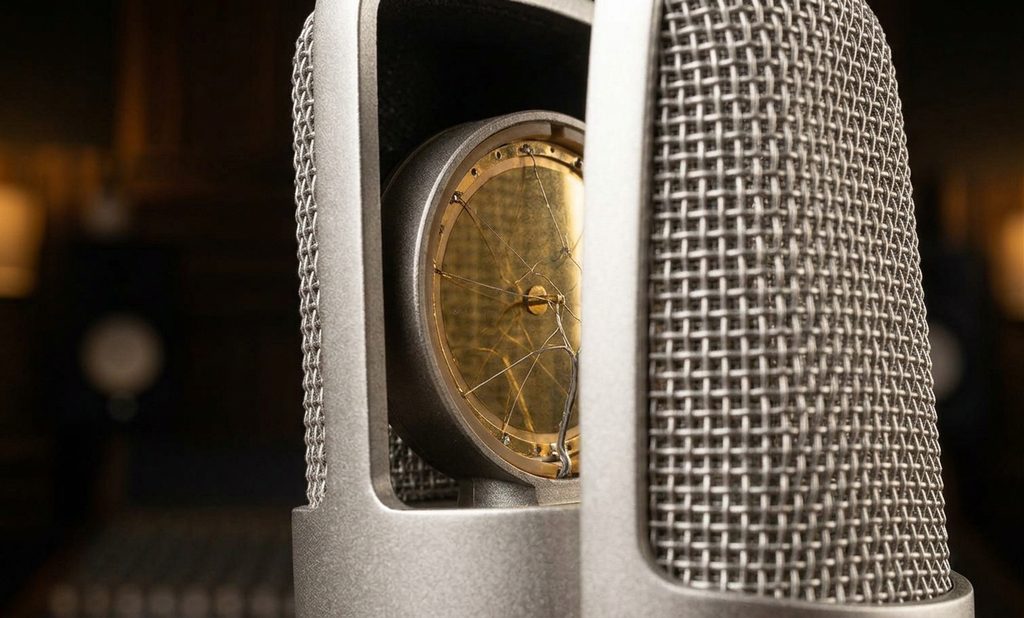
Capsule Architecture
Unlike electret designs common in entry-level condenser models, the P220 houses a true, externally polarized 1-inch large-diaphragm capsule with a gold-sputtered Mylar membrane. This design provides quick transient response and an open soundstage across acoustic instruments.
Frequency Balance
The frequency delivery of the P220 is defined by three distinct regions:
- Low End: The bass response remains flat down to 50 Hz before rolling off naturally toward 20 Hz. Working within two to four inches creates a pronounced proximity effect, giving male vocals and voiceovers a deep, intimate warmth.
- Midrange: The response between 300 Hz and 3 kHz is neutral. This avoids nasal colorations and boxy resonances on spoken word, letting speech intelligibility come through without aggressive subtractive equalization.
- Treble: A broad presence rise begins around 6 kHz, peaks near 10 kHz to 12 kHz, and rolls off above 15 kHz. This upper-treble boost adds air and vocal shine, helping recordings sit naturally in modern music mixes. However, on harsh voices or sibilant speakers, it can accentuate sharp “s” and “t” sounds if not tamed with careful microphone angling or a dedicated pop filter.
Self-Noise and SPL Tolerances
The P220 specifies an equivalent noise level of 16 dB-A. While this is not as whisper-quiet as top-tier studio models operating below 6 dB-A, it is completely silent enough for close-proximity voiceover, podcasts, sung vocals, and acoustic guitars. Preamplifier hiss is rarely audible under typical gain structures.
For volume handling, the microphone handles 135 dB SPL at baseline. Engaging the hardware pad increases that ceiling to 155 dB SPL, allowing users to place the capsule directly in front of screaming guitar amplifiers, percussion, and horn sections without encountering analog circuit clipping.
Key Features in Practice
1. 20 dB Preattenuation Pad
- Practical Benefit: Drops incoming analog signal levels before they reach the internal electronics, allowing loud sources to be captured cleanly.
- Limitation: Unnecessary for typical speech, podcasting, or gentle acoustic guitar.
- Who Benefits: Drummers and rock guitarists tracking high-output guitar cabinets or snare drums.
2. 300 Hz Bass-Cut Filter
- Practical Benefit: Cuts out low-frequency rumble from HVAC systems, mechanical floor noise, and stage vibrations.
- Limitation: The 300 Hz cutoff point is noticeably higher than the typical 80 Hz or 100 Hz filters found on competing studio microphones. Because 300 Hz cuts deep into vocal fundamentals, engaging this switch can strip away the natural body and weight of human speech.
- Who Benefits: Acoustic guitar players battling excessive body boom, or live stage environments with extreme stage rumble. Voice creators are generally better off leaving it bypassed and using digital high-pass filtering in their DAW.
3. Spider Suspension Shock Mount and Flight Case
- Practical Benefit: The included metal shock mount decouples the microphone from desk bumps, while the aluminum case provides secure storage and safe transport.
- Limitation: The metal cage adds substantial overall weight to the assembly.
- Who Benefits: Mobile creators, traveling musicians, and home studio owners building a setup on a strict budget.
What We Like
- True large-diaphragm capsule: Delivers a warm, detailed response with convincing proximity effect.
- Generous accessory package: Includes a functional metal spider shock mount and a hard transport case.
- Exceptional sound pressure limits: Handles up to 155 dB SPL with the pad active, preventing distortion on loud sources.
- Durable metal construction: Zinc-alloy body and heavy mesh withstand daily studio use.
- Low self-noise for its class: At 16 dB-A, it performs quieter than several similarly priced competitors.
What We Don’t Like
- Aggressive high-pass filter frequency: A 300 Hz cutoff point cuts too far into fundamental vocal warmth, limiting its usefulness on speech.
- Upper-register brightness: The 10 kHz boost can sound sharp or sibilant on untreated rooms or naturally harsh voices.
- Heavy overall weight: Combined with its metal mount, it demands a robust, high-tension microphone stand.
Competitor Comparison
The sub-150-dollar studio condenser category is densely contested. The table below outlines how the AKG P220 compares to its closest rivals.
| Feature | AKG P220 | Audio-Technica AT2020 | Rode NT1 Signature | Lewitt LCT 240 PRO |
| Capsule Class | 1-inch true condenser | 16 mm electret condenser | 1-inch true condenser | 17 mm back-electret |
| Self-Noise | 16 dB-A | 20 dB-A | 4 dB-A | 19 dB-A |
| Max SPL | 135 dB / 155 dB (with pad) | 144 dB SPL | 142 dB SPL | 142 dB SPL |
| Onboard Pad | Yes (-20 dB) | No | No | No |
| Low-Cut Filter | Yes (300 Hz) | No | No | No |
| Included Mount | Spider shock mount | Hard stand clamp | Deluxe shock mount + pop filter | Hard stand clamp |
| Storage Case | Aluminum hard flight case | Vinyl pouch | Dust bag | Faux-leather pouch |
| Typical Price | ~$139 to $149 | ~$99 | ~$159 | ~$99 to $119 |
AKG P220 vs. Audio-Technica AT2020
The AT2020 costs around 40 dollars less, but it uses a smaller 16 mm electret element rather than a true large diaphragm. The P220 delivers a quieter noise floor (16 dB-A versus 20 dB-A), provides two physical hardware switches (attenuation pad and bass roll-off), and includes a spider shock mount that costs roughly 30 to 40 dollars if purchased separately for the AT2020. Buyers with a strict 100-dollar ceiling will appreciate the AT2020, but the P220 offers significantly higher hardware value per dollar spent.
AKG P220 vs. Rode NT1 Signature Edition
The Rode NT1 Signature Edition costs slightly more, but it features a class-leading 4 dB-A self-noise rating, making it practically silent for delicate vocal and instrument tracking. It also comes with a pop filter integrated into its shock mount. However, the NT1 lacks hardware switches for attenuation and high-pass filtering, and its high-end frequency response is voiced flatter. The P220 remains the superior tool for tracking loud instruments like snare drums and guitar cabs where a pad is essential.
AKG P220 vs. Lewitt LCT 240 PRO
The LCT 240 PRO is a compact back-electret microphone tailored for modern vocal brightness. While it sounds crisp and fits into tight desktop spaces, it lacks onboard switches and only comes with a standard rigid plastic mount in its base package. The P220 provides deeper low-end response, better mechanical decoupling via its included shock mount, and higher maximum volume handling.
Value Analysis
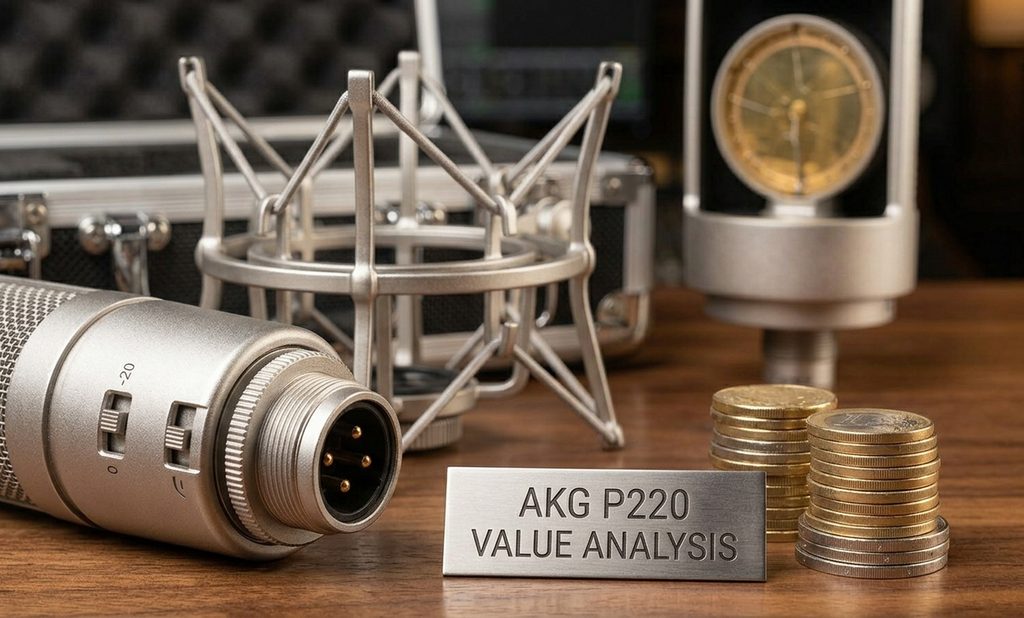
At an approximate street price of 139 to 149 dollars, the AKG P220 sits in a sweet spot between barebones entry-level condensers and premium studio tools.
What you are paying for:
- A true 1-inch externally polarized condenser capsule.
- An all-metal enclosure engineered for reliable longevity.
- Functional hardware switches for pad and bass cut.
- Complete mounting and storage hardware inside the retail box.
What you sacrifice:
- The ultra-quiet 4 to 5 dB-A noise floors found on modern Rode condensers.
- A practical vocal high-pass filter: the 300 Hz cutoff is too high for natural speech tuning.
- Flat, uncolored treble: the 10 kHz boost requires attention in untreated rooms.
Buyers who already own a high-end shock mount and only record quiet acoustic instruments will find better specialization elsewhere. However, for users setting up their first comprehensive recording chain, the included hardware saves money that would otherwise go toward secondary accessories.
2026 Check: The 2 Switches Most P220 Owners Misuse
The -20 dB pad is for loud sources, not a default. The pad lowers the signal before it reaches your interface, which protects against distortion on drums, guitar cabinets, and very loud voices. Left on for normal vocal recording, it forces you to add that level back with interface gain - and extra gain usually means extra hiss. For a typical speaking or singing voice at a normal distance, the pad should be off.
The 300 Hz bass-cut filter is a corrective tool, not a room fix. Cutting below 300 Hz is aggressive: it removes rumble and proximity boom, but it also removes vocal body, and it does nothing about echo or room reflections, which live at higher frequencies. Use it when a close-miked voice sounds boomy or when floor rumble is getting into the recording - not as an always-on setting, and not as a substitute for moving the mic or treating the room.
Final Verdict and Score Breakdown
The AKG P220 remains a practical, versatile workhorse microphone for budget project studios. While its 300 Hz high-pass filter is tuned too aggressively for most vocal recording tasks, its true 1-inch capsule, 16 dB-A self-noise, massive 155 dB SPL ceiling, and included metal spider shock mount make it one of the most complete equipment packages available in the sub-150-dollar market.
Score Breakdown
- Performance: 8.5 / 10 (Clean articulation and excellent SPL capacity, tempered by a bright top end)
- Build Quality: 9.0 / 10 (Heavy zinc body, steel grille, and robust metal shock mount)
- Features: 8.5 / 10 (Includes pad and filter, though the 300 Hz cutoff is overly broad)
- Ease of Use: 8.5 / 10 (Standard 48V operation with high output sensitivity; requires a strong stand)
- Value: 9.0 / 10 (All-metal shock mount and flight case eliminate hidden accessory costs)
- Overall Score: 8.7 / 10
Check Price and Availability for the AKG P220
Frequently Asked Questions
Does the AKG P220 require phantom power?
Yes. The P220 is a true condenser microphone and requires 48 volts of phantom power (+44V to +52V) supplied through a standard 3-pin XLR cable from an audio interface, mixer, or standalone preamp. It cannot plug directly into a computer USB port or 3.5 mm headphone jack without an interface.
Can the AKG P220 be used for podcasting and streaming?
Yes, provided the microphone is used in a reasonably quiet, acoustically treated room. Because it is a sensitive condenser microphone, it will pick up background noise such as computer fans, keyboard clicks, and room reflections more readily than dynamic microphones like the Shure SM58 or PodMic.
What does the -20 dB switch on the AKG P220 do?
The -20 dB switch activates an internal preattenuation pad. It lowers the signal strength coming off the capsule before it reaches the microphone preamplification stage. This increases the maximum sound pressure limit to 155 dB SPL, allowing clean recording of loud sources like guitar amplifiers, brass instruments, and drums without distortion.
Should I turn on the 300 Hz bass-cut filter for vocals?
In most home recording situations, no. A 300 Hz cutoff is unusually high and will remove lower-mid vocal frequencies between 100 Hz and 300 Hz, leaving male and female voices sounding thin and hollow. It is better to leave the switch set to flat and apply a gentle 80 Hz high-pass filter inside your recording software.
What is the difference between the AKG P120 and the AKG P220?
The AKG P120 uses a smaller 0.66-inch electret capsule, has a higher self-noise level (19 dB-A), and ships with a simple hard stand adapter. The P220 features a true 1-inch large-diaphragm capsule, lower self-noise (16 dB-A), and includes both a dedicated spider shock mount and an aluminum flight case.
Does the AKG P220 come with an XLR cable?
No. The microphone package includes the P220 microphone, the SH100 spider suspension shock mount, a stand thread adapter, and an aluminum flight case. A balanced 3-pin XLR cable must be purchased separately.
Related reading: AKG P220 vs P420, AKG P120 review, Audio-Technica AT2020 review