
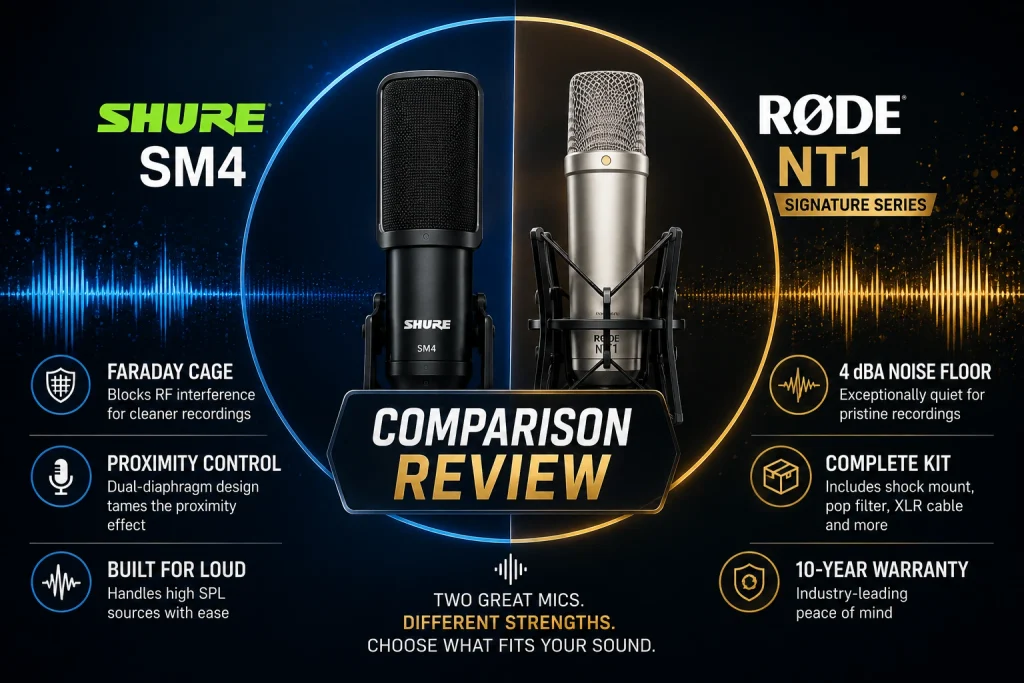
Shure SM4 and the Rode NT1 represent two of the most compelling large-diaphragm cardioid condenser microphones available for home studios, voiceover artists, and vocalists. Shure engineered the SM4 specifically to combat the acoustic and electronic challenges of modern project studios, incorporating a custom dual-diaphragm brass capsule and patent-pending RF interference shielding.
Updated October 2026: New does not automatically mean better here. The SM4 is the newer dynamic design; the NT1 is the established condenser standard. The real split is the same one that decides most dynamic-versus-condenser comparisons: the SM4 forgives a noisy, untreated room, while the NT1 rewards a quiet one with detail a dynamic cannot reach. This update adds the disclosure this article was missing, plus a noise-floor-first verdict below.
Disclosure: This article contains affiliate links. If you buy through them, HeadphoneEcho may earn a small commission at no extra cost to you. Recommendations are based on research and published specifications, not on commissions.
The Rode NT1 lineup, spanning the analog NT1 Signature Series and the hybrid NT1 5th Generation, remains an industry benchmark due to its class-leading 4 dBA self-noise floor and transparent frequency response. Choosing between them comes down to whether your recording space requires heavy protection against wireless interference and proximity effect, or if you demand the quietest possible noise floor for delicate acoustic sources.
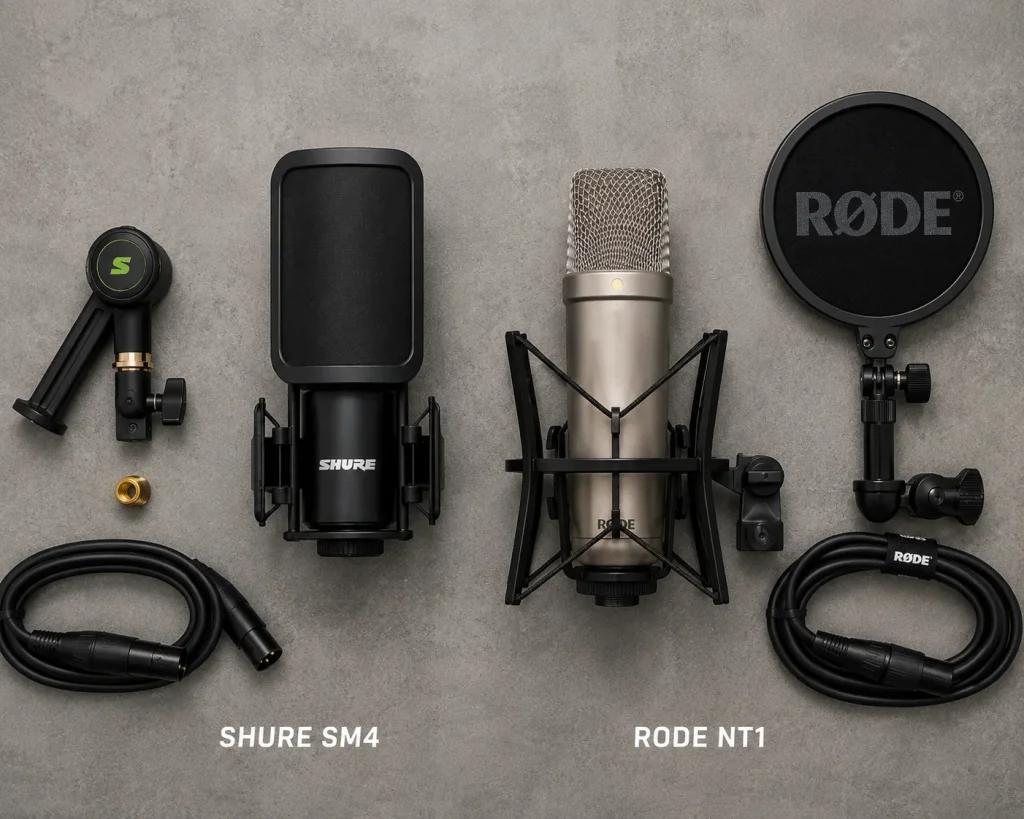
Which Is Better?
The Rode NT1 is the better all-around studio microphone for most buyers due to its class-leading 4 dBA self-noise floor, flatter response, and generous bundled accessories. However, the Shure SM4 is the superior choice for desktop creators working in compact, untreated spaces near Wi-Fi routers and smartphones, thanks to its built-in RF shielding and controlled dual-diaphragm design.
Winner by Category
| Category | Winner | Key Advantage |
| Self-Noise Floor | Rode NT1 | World-class 4 dBA equivalent noise level versus 17 dBA on the SM4 |
| RF / Wireless Shielding | Shure SM4 | Integrated woven Faraday cage mesh blocks smartphone and Wi-Fi noise |
| High SPL Handling | Shure SM4 | Handles up to 145 dB SPL (2.5kΩ load) with high transient stability |
| Out-of-the-Box Kit Value | Rode NT1 | Standard package includes SM6 studio shock mount, pop filter, and cable |
| Proximity Effect Control | Shure SM4 | Dual-diaphragm capsule provides a wider, more forgiving sweet spot |
| Connectivity Options | Rode NT1 (5th Gen) | Dual Connect XLR and 32-bit float USB-C digital output on 5th Gen model |
| Acoustic Neutrality | Rode NT1 | Exceptionally balanced midrange and smooth top-end air |
| Durability & Warranty | Rode NT1 | Solid aluminum body backed by an industry-leading 10-year warranty |
| Overall Value | Rode NT1 | Lower entry price on Signature Series with complete accessory kit included |
Quick Specifications
| Feature | Shure SM4 | Rode NT1 (5th Gen / Signature) |
| Transducer Type | 1-inch Dual-Diaphragm Condenser | 1-inch HF6 Gold-Sputtered True Condenser |
| Polar Pattern | Cardioid | Cardioid |
| Frequency Range | 20 Hz to 20,000 Hz | 20 Hz to 20,000 Hz |
| Self-Noise (A-Weighted) | 17 dBA | 4 dBA |
| Sensitivity | -38 dBV/Pa (12.6 mV) | -32 dBV/Pa (25.1 mV) |
| Maximum SPL | 140 dB (1kΩ) / 145 dB (2.5kΩ) | 142 dB SPL |
| Output Impedance | 150 Ω | 100 Ω |
| Connectivity | 3-Pin XLR | XLR (Signature) / XLR + USB-C (5th Gen) |
| Power Requirement | +48V DC Phantom Power | +48V Phantom (or 5V USB on 5th Gen) |
| Weight (Mic Only) | 463 g (1.02 lbs) | 308 g (0.68 lbs) |
| MSRP | $199 (Mic Only) / $269 (Kit) | $159 (Signature) / $249 (5th Gen) |
Form-Factor and Capsule Architecture
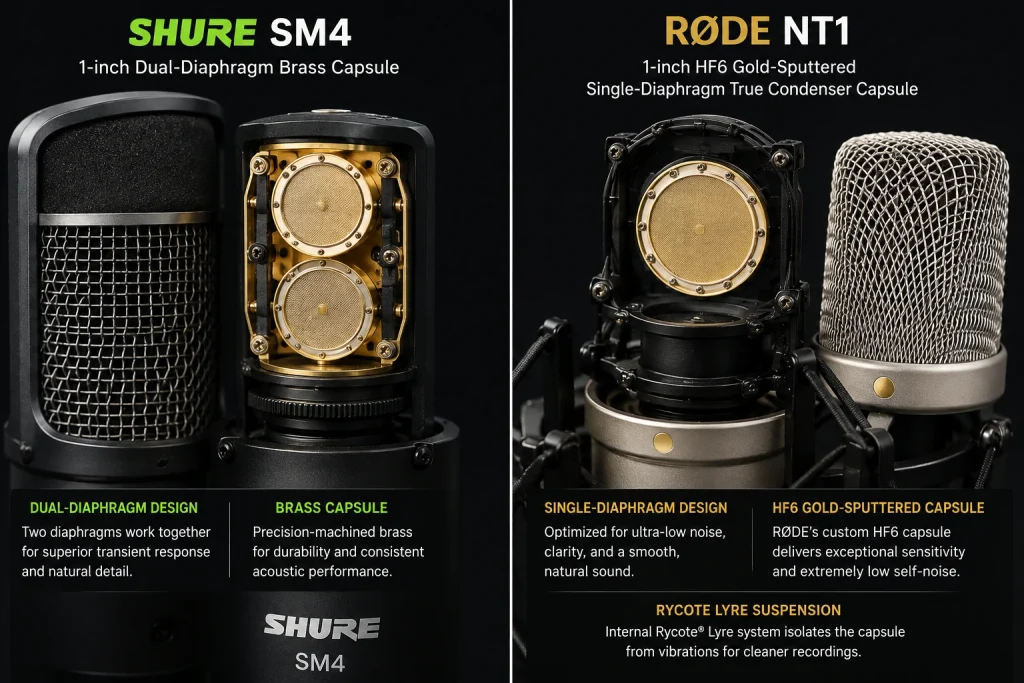
Both microphones use side-address large-diaphragm condenser form factors designed for stand mounting in studio environments. However, their internal architectures address acoustic physics differently.
The Shure SM4 employs a 1-inch dual-diaphragm brass capsule inside an all-metal chassis with a low-profile aesthetic. Traditional single-diaphragm cardioid condensers can create exaggerated low-frequency buildup (proximity effect) when a vocalist moves close to the grille. Shure uses a secondary rear diaphragm specifically to smooth off-axis response and control low-end boominess. Additionally, the SM4 incorporates an integrated Faraday cage mesh directly beneath the outer grille to block electromagnetic and radio frequency interference.
The Rode NT1 utilizes a custom-engineered 1-inch HF6 gold-sputtered single-diaphragm true condenser capsule mounted on an internal Rycote Lyre shock-suspension system. This internal suspension isolates the capsule directly at the transducer level, reducing handling vibrations before they reach the body. The NT1 body is machined from high-grade 6061 aluminum and treated with an electro-static finish resistant to scratches and corrosion.
How We Evaluated
This comparison synthesizes manufacturer engineering specifications, official technical documentation, independent laboratory measurements from established audio test platforms, published frequency response curves, and documented user performance across home recording and voiceover environments.
Evaluation criteria focused on:
Inherent Electronic Noise: Comparing measured A-weighted self-noise floors.
Acoustic Transduction & EQ Profile: Evaluating frequency linearity, treble boost, sibilance management, and vocal intelligibility.
Environmental Rejection: Assessing immunity to RF hash from electronics and rear off-axis isolation in untreated spaces.
Mechanical Handling & Ergonomics: Reviewing mounting hardware, shock absorption, and form-factor convenience.
Commercial Value: Calculating total cost of ownership, including essential accessories (shock mounts, pop filters, cables).
Limitations: Perceived vocal tone, sibilance, and acoustic room interaction depend heavily on the performer’s vocal timbre, source distance, preamp gain staging, room treatment, and monitoring environment.
Shure SM4 Review
The Shure SM4 is a modern large-diaphragm cardioid condenser microphone engineered to solve common pain points found in modern home and bedroom recording studios. Rather than focusing purely on laboratory-level self-noise figures, Shure prioritized real-world problem solving: blocking radio frequency interference from mobile devices and taming harsh low-end variations.
What I Like:
- Patent-pending RF shielding effectively rejects buzzing and clicks caused by nearby smartphones, Wi-Fi routers, and laptop power supplies.
- Dual-diaphragm brass capsule keeps the proximity effect smooth and manageable for expressive vocalists.
- High maximum sound pressure level handling (up to 145 dB SPL) allows safe capture of loud guitar cabinets and percussion.
- Integrated internal pop filter significantly cuts down plosive impact even without an external screen.
- Low-profile visual design prevents camera obstruction during live streaming and video content creation.
- Rugged all-metal construction provides reliable long-term durability.
What Could Be Better:
- Self-noise of 17 dBA is noticeably higher than competing studio condensers in this price class.
- Standard $199 package includes only a basic hard stand clamp; the shock mount and magnetic pop filter require purchasing the $269 kit.
- No onboard low-cut high-pass filters or attenuation pad switches.
- Slightly elevated treble response can emphasize sibilance on bright or thin voices without post-EQ.
Pros & Cons
| Pros | Cons |
| Outstanding resistance to smartphone and Wi-Fi RF interference | 17 dBA self-noise floor is relatively high for delicate acoustic instruments |
| Consistent low-frequency response across shifting vocal distances | Complete shock mount kit raises the price to $269 |
| Excellent high-SPL handling up to 145 dB | No physical low-cut filter or pad switches on the body |
| Sturdy all-metal housing and camera-friendly low profile | Requires careful EQ adjustments for sibilant vocalists |
Best For:
The Shure SM4 is best for project studio musicians, podcasters, and content creators recording in untreated desktop setups surrounded by laptops, smartphones, and wireless devices where electromagnetic interference is a constant risk.
Recommendation:
If you frequently experience RF buzzing in your recording chain or struggle with inconsistent low-end boominess when singing close to the mic, the Shure SM4 is a rugged, mix-ready problem solver.
Check Current Shure SM4 Pricing
Shure SM4
Best for: Creators recording near computers, phones, and unshielded home electronics.
Offers built-in Faraday cage RF shielding and a dual-diaphragm capsule for controlled vocal low end.
Check Current Price on Sweetwater / Retailers
Rode NT1 Review
The Rode NT1 is one of the most widely recognized studio condenser microphones in the world, celebrated for its exceptionally quiet internal circuitry and balanced frequency reproduction. Available in both the analog NT1 Signature Series and the hybrid analog/digital NT1 5th Generation, it provides a versatile foundation for professional vocal and instrument tracking.
What I Like:
- Benchmark 4 dBA self-noise floor delivers virtually noiseless audio capture, ideal for whisper-quiet voiceover and subtle dynamic passages.
- Transparent and neutral sound profile preserves natural vocal and acoustic instrument timbre without harsh artificial coloration.
- The NT1 Signature Series package includes the premium SM6 shock mount, detachable pop filter, and a 6-meter XLR cable as standard.
- High output sensitivity (-32 dBV/Pa) requires minimal preamp gain from entry-level audio interfaces.
- NT1 5th Generation version features dual XLR and USB-C connectivity with 32-bit float recording to prevent digital clipping.
- Backed by Rode’s standard 10-year extended manufacturer warranty upon product registration.
What Could Be Better:
- Capsule is sensitive to ambient room acoustics, making acoustic treatment necessary to avoid picking up room reflections.
- Large SM6 shock mount and pop shield combination requires significant desk space and a sturdy boom arm.
- Lacks physical high-pass filter and pad switches on the analog microphone body.
- Does not include specialized RF shielding for extreme high-interference electronic environments.
Pros & Cons
| Pros | Cons |
| Ultra-low 4 dBA self-noise floor creates a pitch-black background | Highly sensitive capsule picks up room reflections in untreated rooms |
| Exceptional out-of-the-box value with included studio shock mount and pop shield | Large form factor can obscure facial sightlines on video |
| High output level reduces gain demands on audio interface preamps | No physical pad or filter switches on the analog model |
| 10-year manufacturer warranty provides unmatched long-term peace of mind | NT1 5th Generation digital DSP requires Rode software suite |
Best For:
The Rode NT1 is best for voice actors, acoustic instrumentalists, and studio vocalists working in acoustically controlled or treated recording spaces who require pure signal transparency and an ultra-quiet noise floor.
Recommendation:
If you want an industry-proven studio centerpiece that captures every delicate nuance of your voice or acoustic guitar without adding circuit hiss, the Rode NT1 remains the gold standard in the sub-$250 category.
Check Current Rode NT1 Pricing
Rode NT1
Best for: Voiceover artists, vocalists, and acoustic guitarists seeking a pristine, ultra-quiet noise floor.
Features an industry-leading 4 dBA self-noise rating and includes a complete studio shock mount kit.
Check Current Price on Sweetwater / Retailers
Head-to-Head Comparison
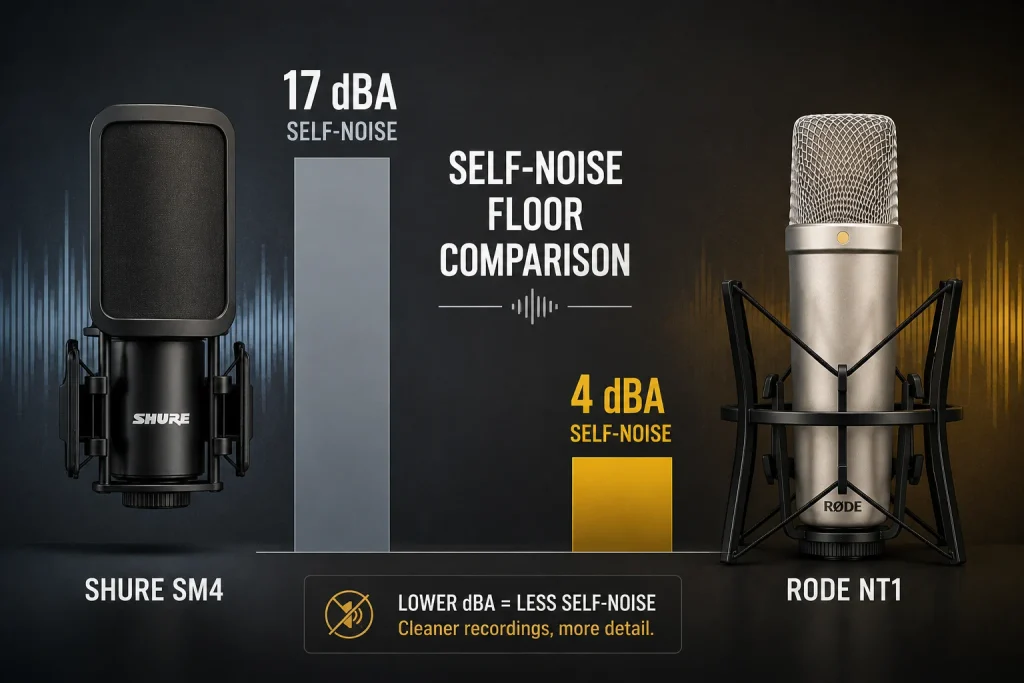
1. Self-Noise Floor and Circuit Quietness
The most dramatic technical divergence between these two microphones is their self-noise specification. The Rode NT1 is rated at 4 dBA equivalent noise level, making it one of the quietest studio condenser microphones ever manufactured. This negligible noise floor allows sound engineers to apply heavy vocal compression, aggressive limiting, and high-frequency shelf boosts in post-production without raising audible hiss.
In contrast, the Shure SM4 is rated at 17 dBA self-noise. While 17 dBA is completely acceptable for modern pop vocals, spoken podcasts, voiceover at standard conversational volumes, and loud instruments, it is audible during quiet classical guitar passages, delicate foley work, or whispered audiobooks when gain is pushed aggressively.
- Winner: Rode NT1 (Substantial Advantage)
2. Radio Frequency (RF) and Electronic Interference Shielding
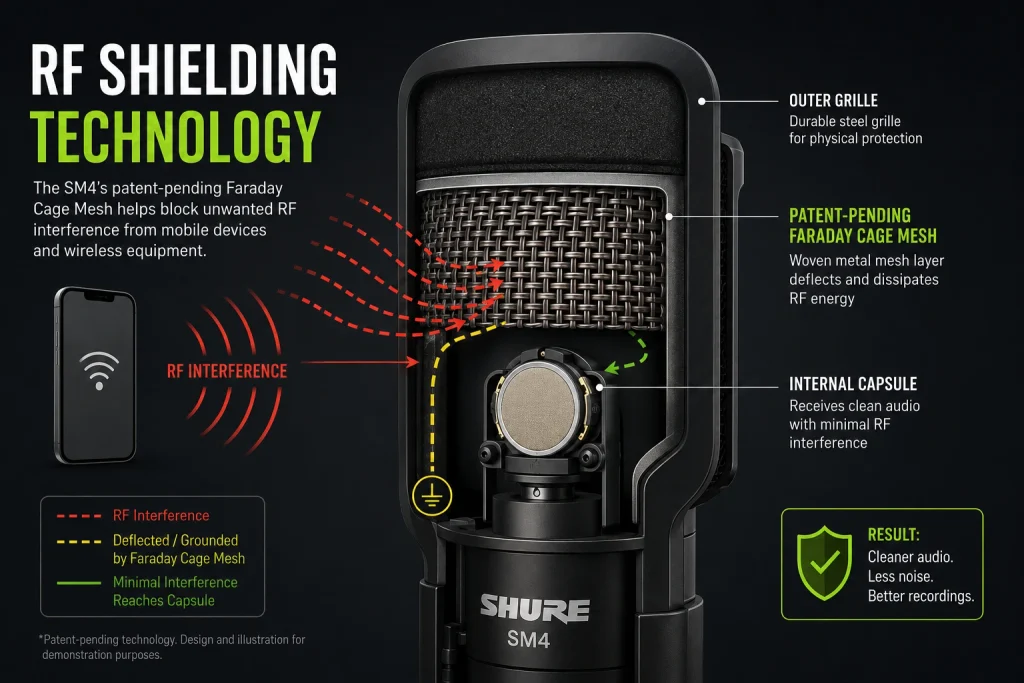
In home recording environments, microphones are frequently positioned inches away from smartphones, wireless keyboard receivers, Wi-Fi routers, and multiple computer monitors. Standard condenser capsules can pick up electromagnetic pulse bursts and cellular polling signals, resulting in rhythmic clicking or buzzing in the audio track.
Shure engineered the SM4 with a patent-pending interference shielding architecture. The capsule is enclosed inside an internal woven-mesh Faraday cage that grounds and deflects high-frequency RF signals. In independent and user testing, the SM4 exhibits complete immunity to smartphone cellular radiation even when a phone is placed directly against the microphone housing. The Rode NT1 utilizes a standard metal housing that provides good general shielding, but it lacks the specialized Faraday barrier found in the SM4.
- Winner: Shure SM4 (Clear Advantage)
3. Sound Profile, Frequency Response, and Sibilance
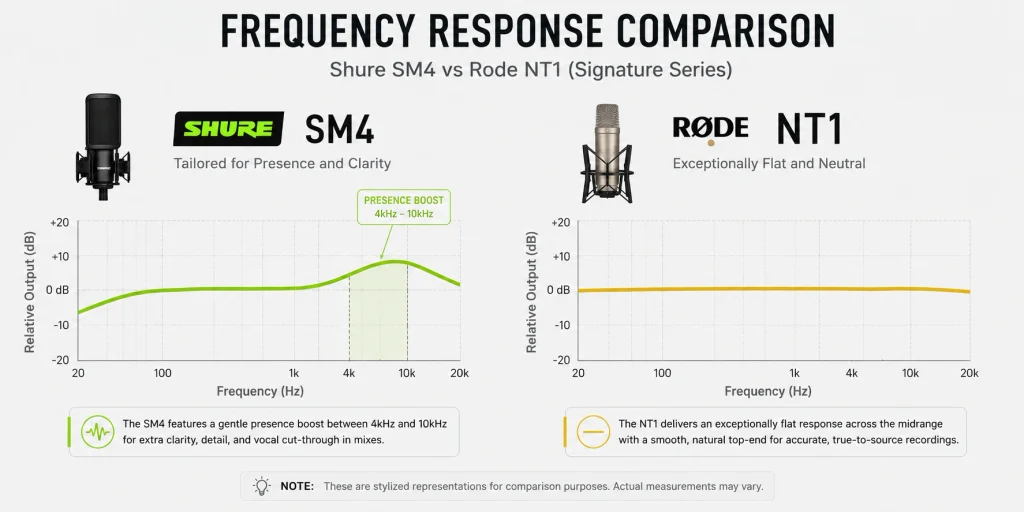
Both microphones cover the full audible spectrum from 20 Hz to 20,000 Hz, but their acoustic voicings serve different mixing workflows:
Shure SM4: Tuned for a modern mix-ready presentation. The midrange remains flat and articulate, while the upper frequencies feature a noticeable presence boost between 4 kHz and 10 kHz. This boost imparts instant vocal air and clarity, helping lead vocals cut through dense instrumental mixes with minimal equalization. However, on naturally bright or sibilant voices, it can require a dedicated de-esser.
Rode NT1: Known for its flat, neutral midrange and smooth, natural top-end extension. The NT1 reproduces audio without aggressive resonant peaks, delivering a faithful capture of the singer’s natural acoustic tone. This makes the NT1 more versatile across different voice types and stringed instruments, providing a blank canvas for equalization.
Winner: Tie / Depends on Preference (Choose Shure for modern vocal presence; choose Rode for neutral acoustic accuracy)
4. Proximity Effect and Capsule Versatility
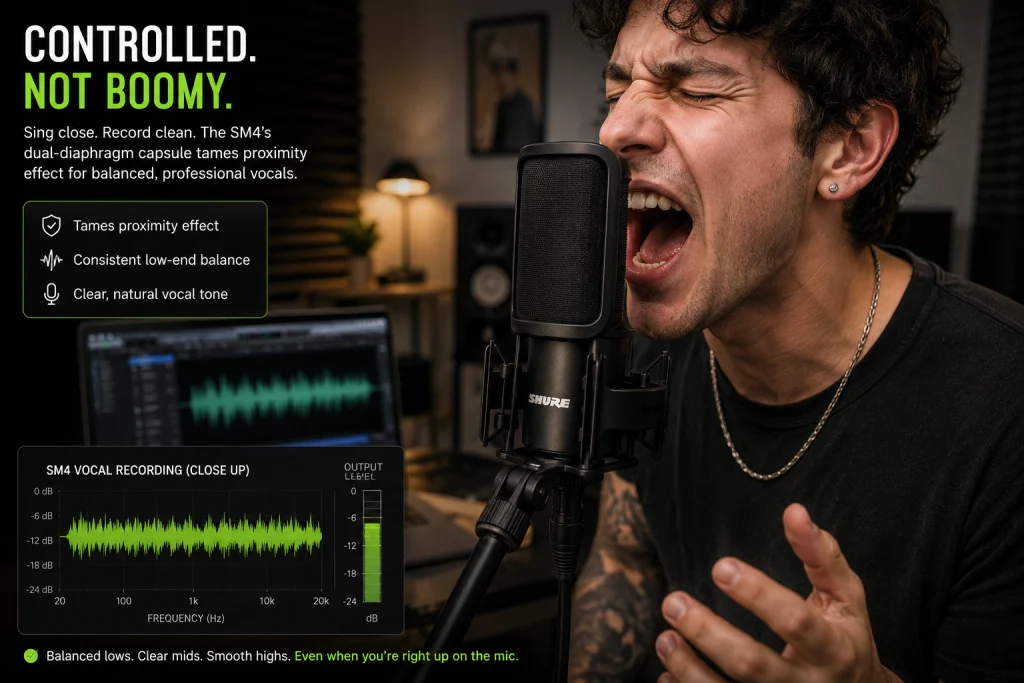
When a singer gets very close to a conventional single-diaphragm cardioid microphone (like the Rode NT1), low frequencies rise significantly due to acoustic phase differences across the diaphragm. While this proximity effect can add warmth, it can quickly muddy a vocal track if the vocalist moves erratically during tracking.
The Shure SM4 uses a 1-inch dual-diaphragm brass capsule. The secondary diaphragm helps stabilize internal acoustic pressure, significantly flattening the low-end buildup across varying working distances. This creates a larger, more forgiving sweet spot for vocalists who move while performing.
- Winner: Shure SM4 (Slight Advantage)
5. Sound Pressure Level (SPL) Handling
Dynamic range and SPL limits determine how well a condenser microphone handles loud instruments without clipping or producing total harmonic distortion (THD).
Shure SM4: Rated for a maximum SPL of 140 dB (at 1 kHz, 1% THD into a 1 kΩ load) and up to 145 dB SPL into a 2.5 kΩ load. This extreme tolerance makes the SM4 capable of close-miking snare drums, brass instruments, and high-wattage tube guitar amplifiers.
Rode NT1: Rated for a maximum SPL of 142 dB. It effortlessly handles loud vocal belts and energetic acoustic performances without distortion.
Winner: Shure SM4 (Slight Advantage into standard high-impedance preamps)
6. Included Accessories and Total Package Value
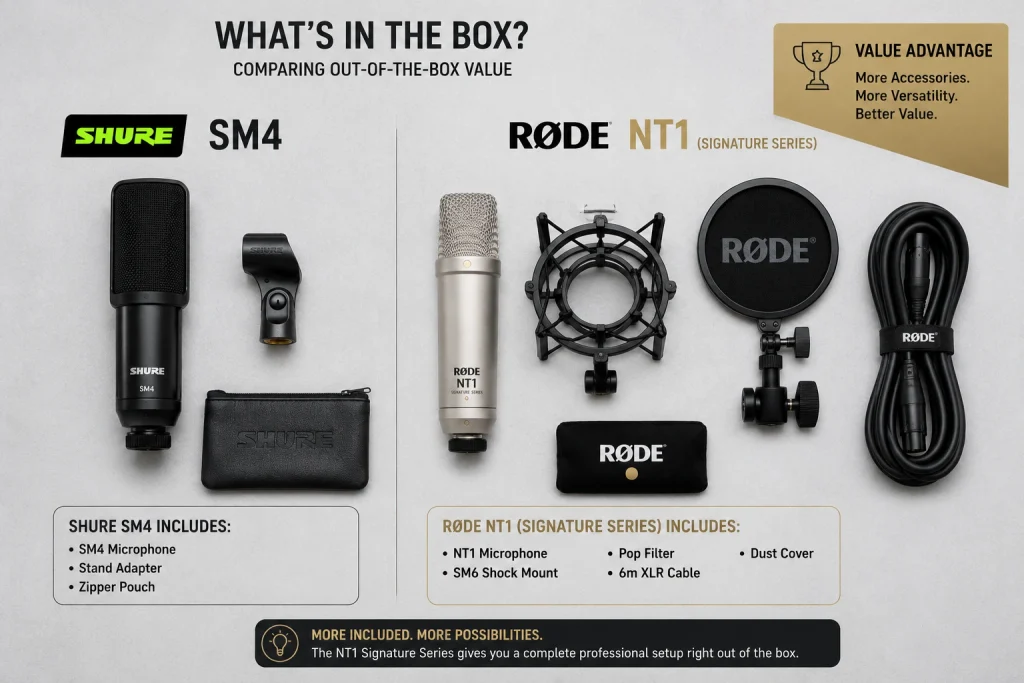
Microphone pricing must account for necessary studio mounting hardware:
Rode NT1 (Signature Series & 5th Gen): Every NT1 comes standard with Rode’s SM6 all-in-one studio shock mount, a detachable dual-axis stainless steel pop shield, a dust cover, and a high-grade 6-meter XLR cable (or USB-C cable for the 5th Gen). The package is fully ready for studio tracking immediately out of the box.
Shure SM4: The standard $199 configuration includes only the microphone, a basic swivel stand adapter, and a zippered pouch. To receive the custom elastic shock mount, magnetic clip-on pop filter, and hard case, buyers must upgrade to the Shure SM4 Home Recording Kit, which retails at an MSRP of $269.
Winner: Rode NT1 (Clear Advantage)
7. Connectivity Options and Workflow Flexibility
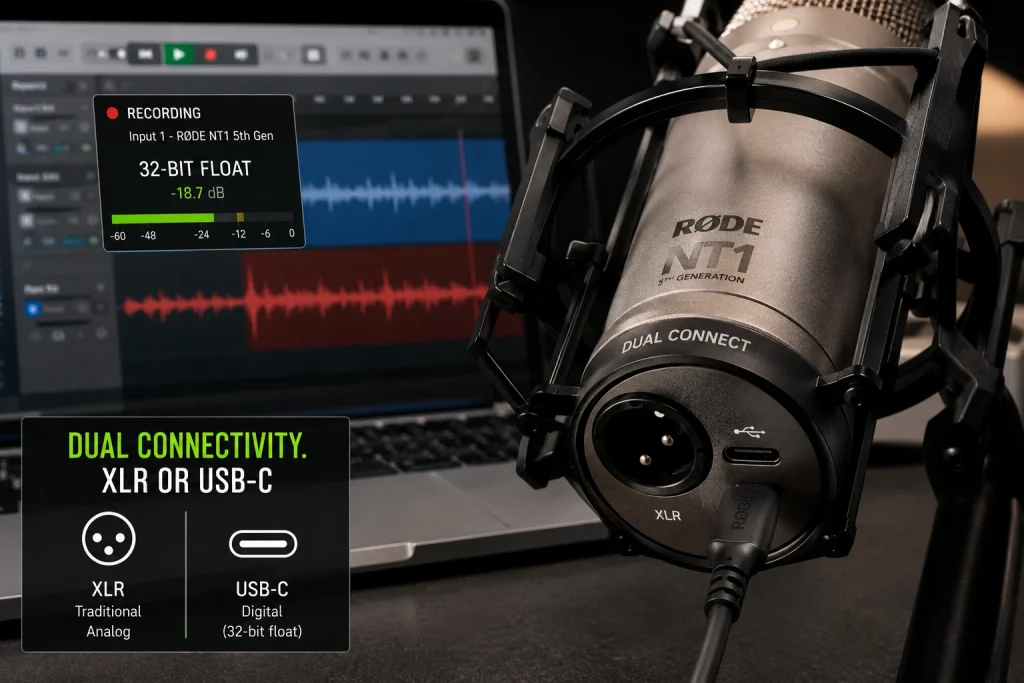
For creators who do not yet own a dedicated USB audio interface:
The Rode NT1 5th Generation features Rode’s Dual Connect output, housing both a traditional 3-pin XLR port and a digital USB-C connector inside the same base assembly. When connected via USB-C, it activates an internal 32-bit float analog-to-digital converter and onboard APHEX digital signal processing, making digital clipping impossible and eliminating the need for an external interface. The NT1 Signature Series remains purely analog XLR.
The Shure SM4 is strictly an analog XLR microphone. It requires an external audio interface or mixer supplying +48V phantom power to operate under all conditions.
Winner: Rode NT1 (5th Gen) for hybrid setups; Tie when comparing analog XLR against the NT1 Signature Series.
Evidence-Based My Take
My Take: If your home studio is located in a typical bedroom or office desk surrounded by active Wi-Fi gear, smartphones, and monitors, the Shure SM4 provides an immediate engineering benefit because its Faraday cage completely eliminates electronic RF noise. However, for acoustically isolated vocal booths, quiet audiobook narration, and acoustic guitar tracking, the Rode NT1 remains the superior acoustic tool because its 4 dBA self-noise floor is virtually silent.
Buyer-Specific Recommendations
Best for Unshielded Home & Bedroom Studios: Shure SM4
If you record at a computer desk where your phone, router, and computer tower sit within arm’s reach, the Shure SM4’s RF shielding prevents stray electronic buzzing from ruining takes.
Best for Voiceover, Narration & Audiobooks: Rode NT1
Voiceover work demands minimal circuit hiss during long pauses and quiet passages. The NT1’s 4 dBA noise floor ensures pristine, clean silence between words.
Best for Singer-Songwriters Tracking Multiple Instruments: Rode NT1
The NT1 provides a flatter, more transparent frequency response that captures acoustic guitars, vocals, and auxiliary percussion naturally without artificial midrange color.
Best for High-Energy Vocalists with Variable Mic Distance: Shure SM4
The SM4’s dual-diaphragm brass capsule maintains consistent vocal body and low-frequency balance even when an animated singer moves closer or further from the grille.
Best All-In-One Value for Beginners: Rode NT1 Signature Series
At an entry MSRP of $159 including a studio shock mount, pop filter, and XLR cable, the NT1 Signature Series delivers the lowest startup cost for a complete condenser setup.
Best for Plug-and-Play Digital Creators Without an Interface: Rode NT1 5th Gen
With onboard 32-bit float USB-C conversion, the NT1 5th Generation connects straight to your Mac or PC without requiring a separate preamp box.
Buyer Decision Matrix
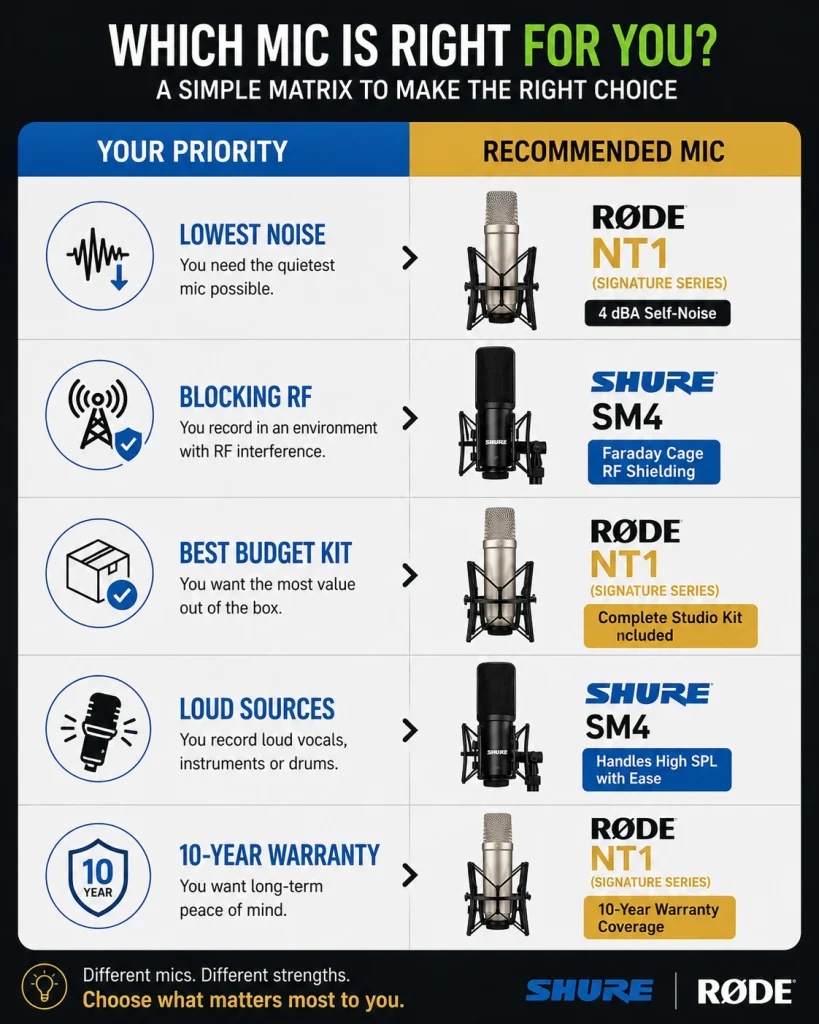
| If Your Primary Priority Is… | Recommended Microphone | Core Reason |
| Lowest Possible Noise Floor | Rode NT1 | 4 dBA self-noise eliminates audible circuit hiss |
| Blocking Smartphone & Wi-Fi Interference | Shure SM4 | Faraday cage mesh stops electronic buzzing |
| Complete Out-of-the-Box Kit on a Budget | Rode NT1 Signature | Includes shock mount, pop screen, and cable at $159 |
| Direct USB Connection Without an Interface | Rode NT1 (5th Gen) | 32-bit float USB-C connection built in |
| Tracking Loud Guitar Amps & Drums | Shure SM4 | Handles up to 145 dB SPL with dual-diaphragm stability |
| Controlled Proximity Effect on Vocals | Shure SM4 | Dual-diaphragm tames bass buildup up close |
| Long-Term Hardware Warranty | Rode NT1 | 10-year manufacturer warranty upon registration |
Alternatives to Consider
Audio-Technica AT2035: A proven studio condenser priced around $149 that includes an 80 Hz high-pass filter and a -10 dB pad switch, making it an excellent budget alternative for creators needing onboard hardware switches.
Lewitt LCT 440 PURE: Priced around $269, this Austrian-engineered microphone features a large 1-inch true condenser capsule with ultra-low 7 dBA self-noise, high 140 dB SPL handling, and an open, modern top-end sound.
Shure SM7B: The broadcast dynamic standard priced at $399. For untreated rooms with significant ambient background noise (traffic, air conditioning), this dynamic mic provides superior physical acoustic isolation compared to any condenser.
Sennheiser MK 4: A German-made true condenser microphone retailing around $299 that delivers a smooth, warm midrange and robust metal build for vocalists seeking a European studio tone.
Price and Value Analysis
Pricing for both microphones spans standard standalone options and full studio bundles:
Shure SM4:
- Launch MSRP (Mic Only, SM4-K): $199.00
- Launch MSRP (Home Recording Kit, SM4-K-KIT): $269.00
- Current Retail Price: Typically $199.00 (standalone) to $269.00 (kit) at authorized retailers.
Rode NT1 Lineup:
- Launch MSRP (NT1 Signature Series Kit): $159.00
- Launch MSRP (NT1 5th Gen Dual Connect Kit): $249.00
- Current Retail Price: Typically $159.00 for the Signature Series and $199.00 to $214.00 for the 5th Generation at major retailers.
Value Verdict:
The Rode NT1 Signature Series offers the strongest sheer price-to-performance ratio in the condenser microphone category. At $159, it provides an ultra-low 4 dBA noise floor and includes an SM6 shock mount and pop filter. To get a comparable mounting package with the Shure SM4, buyers must invest $269 for the SM4 Home Recording Kit. The SM4 justifies its higher price primarily for creators who require its specialized RF shielding and proximity-smoothing dual capsule.
Who Should Buy Which?
Buy the Shure SM4 If:
- You record in an unshielded room with smartphones, laptops, and Wi-Fi routers near your microphone stand.
- You want a vocal sound with built-in high-frequency presence that cuts through a mix quickly.
- You need a wide, forgiving sweet spot that controls proximity bass buildup when singing up close.
- You track loud sound sources like guitar cabinets, percussion, or brass instruments.
- You prefer a compact, low-profile microphone body that will not block your face on webcam streams.
Buy the Rode NT1 If:
- You require a whisper-quiet 4 dBA noise floor for voiceover, narration, ASMR, or acoustic guitar.
- You want a complete studio kit (shock mount, pop shield, cable) included in the base price.
- You want a flat, uncolored frequency response that serves as a neutral mixing canvas.
- You want the option of direct 32-bit float USB-C digital recording (via the NT1 5th Gen).
- You value a 10-year manufacturer warranty backing your studio investment.
Final Comparison Table
| Evaluation Parameter | Shure SM4 | Rode NT1 | Comparative Verdict |
| Self-Noise Level | 17 dBA | 4 dBA | Rode NT1 (Significantly quieter) |
| Capsule Type | 1-inch Dual Diaphragm (Brass) | 1-inch Single Diaphragm (Gold HF6) | Different Design Focus |
| RF Interference Shielding | Faraday Cage Mesh Built-In | Standard Housing | Shure SM4 (Superior electronic isolation) |
| Max SPL Handling | Up to 145 dB SPL | 142 dB SPL | Shure SM4 (Slight edge for loud sources) |
| Acoustic Profile | Modern, Present, Bright Air | Neutral, Transparent, Smooth | Tie (Workflow dependent) |
| Proximity Control | High (Dual-diaphragm compensation) | Standard Single-diaphragm curve | Shure SM4 (More forgiving up close) |
| Included Accessories | Basic clamp (Standard) / Kit extra | Shock mount + Pop filter + Cable | Rode NT1 (Far better base bundle) |
| Connectivity | Analog XLR Only | XLR (Signature) / XLR + USB-C (5th Gen) | Rode NT1 (Greater digital versatility) |
| Warranty | 2 Years Standard | 10 Years (With registration) | Rode NT1 (Superior coverage) |
| Overall Recommendation | Best for Desktop/RF Environments | Best for Pure Studio Tracking | Rode NT1 Overall Winner |
2026 Check: Pick by Noise Floor, Not by Newness
Measure your room before you compare microphones. Record thirty seconds of silence in your actual recording spot and listen back: fan hum, street noise, room echo, keyboard clicks. If that silence is not silent, the SM4’s dynamic design will hide more of it than the NT1 ever can, and no amount of the NT1’s detail will compensate - detail captures the noise faithfully too. If the silence genuinely is quiet, the NT1’s condenser detail becomes the advantage it is meant to be.
Do not pay for newness alone. The SM4’s newer design is a reason to consider it, not a reason to pick it over a proven condenser in a good room. Judge it on the same three questions as any mic: does your room suit it, does your chain drive it, and does your voice suit its character? The article’s own per-category winners above answer those questions better than a release date does.
The chain check still applies. The NT1 needs an interface with phantom power and a quiet gain stage to show its strengths; the SM4’s dynamic design is more forgiving of a modest chain. If you already own a good interface and a quiet room, the NT1 is the detail pick. If either is missing, the SM4 is the safer buy today - and the room and chain upgrades will matter more than either microphone choice. For the dynamic-versus-condenser question in general, see our SM7B vs NT1 5th Gen comparison.
Expert Verdict
The Rode NT1 and Shure SM4 are both high-caliber cardioid condenser microphones that cater to distinct recording challenges.
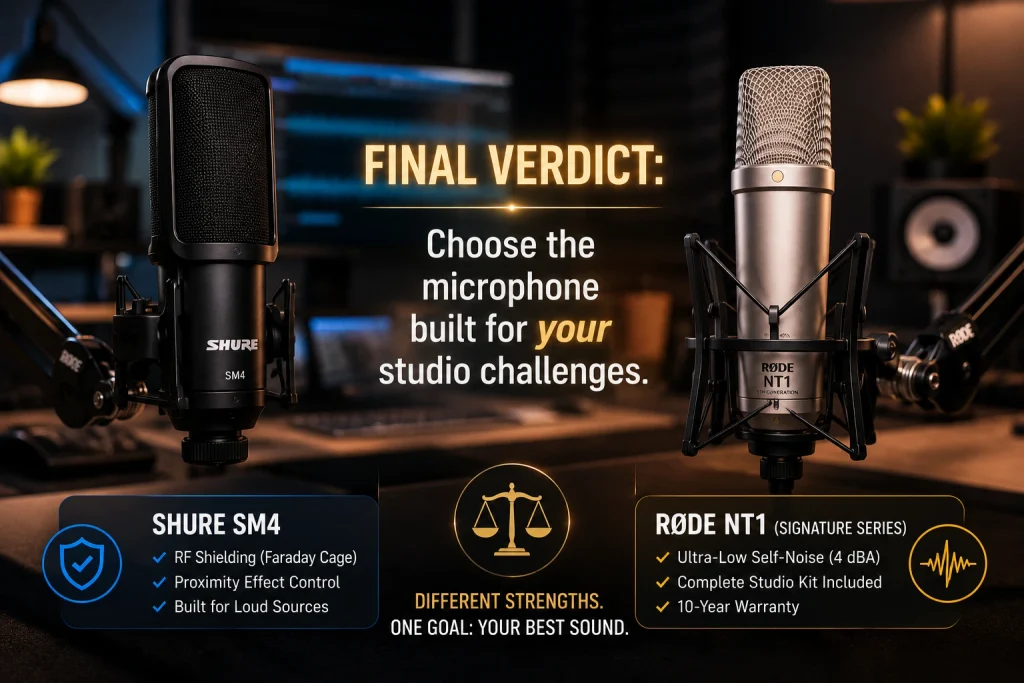
The Rode NT1 is our overall recommendation for traditional studio recording. Its class-leading 4 dBA self-noise floor, neutral acoustic balance, 10-year warranty, and standard inclusion of the SM6 shock mount make it the benchmark for voice acting, vocal tracking, and acoustic instruments under $250.
The Shure SM4 is an exceptional specialized tool engineered for the realities of modern project spaces. Its patent-pending Faraday cage mesh effectively eliminates RF noise from nearby smartphones and wireless devices, while its dual-diaphragm capsule provides consistent low-frequency control.
Choose the Shure SM4 if you record in an electrically noisy home office, want instant vocal presence, or track loud instruments close to the capsule. Choose the Rode NT1 if you want maximum detail, a silent background, and complete out-of-the-box kit value.
Ready to Choose?
Shure SM4
Best for home creators needing RF interference shielding and proximity control.
Check Current Shure SM4 Price at Authorized Retailers
Rode NT1
Best overall choice for ultra-quiet studio tracking, voiceover, and acoustic instruments.
Check Current Rode NT1 Price at Authorized Retailers
Full Technical Specifications
| Technical Specification | Shure SM4 | Rode NT1 (5th Gen / Signature) |
| Acoustic Principle | Externally biased condenser | Externally biased true condenser |
| Capsule Diameter | 1.0 inch (25.4 mm) | 1.0 inch (25.4 mm) |
| Diaphragm Configuration | Dual-diaphragm (Brass backplate) | Single-diaphragm (Gold-sputtered) |
| Directional Pattern | Cardioid | Cardioid |
| Frequency Range | 20 Hz to 20,000 Hz | 20 Hz to 20,000 Hz |
| Output Impedance | 150 Ohms | 100 Ohms |
| Sensitivity | -38 dBV/Pa (12.6 mV @ 1 kHz) | -32 dBV/Pa (25.0 mV @ 1 kHz) |
| Equivalent Noise (A-weighted) | 17 dBA | 4 dBA |
| Maximum SPL | 140 dB (1kΩ) / 145 dB (2.5kΩ) | 142 dB SPL |
| Signal-to-Noise Ratio | 77 dB (Ref. 94 dB SPL) | 90 dBA |
| Dynamic Range | 123 dB (1kΩ) / 128 dB (2.5kΩ) | 138 dB SPL |
| Power Requirements | 48V DC Phantom Power (4.8 mA) | 48V Phantom / 5V USB Bus Power |
| Output Connectors | 3-Pin XLR Male | 3-Pin XLR Male / USB-C (5th Gen) |
| Dimensions | 180 mm x 45.5 mm x 99 mm | 189 mm x 52 mm x 52 mm |
| Net Weight | 463 g (1.02 lbs) | 308 g (0.68 lbs) |
| Country of Origin | Designed in USA, Made in China | Designed and Made in Australia |
Frequently Asked Questions
Which microphone has better noise cancellation or lower background hiss?
The Rode NT1 has a significantly lower electronic self-noise floor at 4 dBA compared to the Shure SM4 at 17 dBA. This means the internal circuitry of the NT1 produces virtually no audible background hiss, making it superior for quiet audio sources. Neither microphone features active noise cancellation; both use passive cardioid directionality to reject rear sounds.
How does the Shure SM4 block smartphone interference?
The Shure SM4 uses a patent-pending Faraday cage construction beneath its grille. This woven metal mesh forms an electromagnetic barrier that grounds and blocks radio frequency (RF) energy emitted by cell phones, Wi-Fi routers, and wireless transmitters before it can reach the sensitive capsule.
Does the Shure SM4 require an audio interface?
Yes. The Shure SM4 is a standard analog XLR condenser microphone that requires +48V phantom power provided by a dedicated USB audio interface, mixer, or microphone preamp.
Can the Rode NT1 plug directly into a computer?
The Rode NT1 5th Generation can connect directly to a computer via USB-C using its onboard 32-bit float converter and digital preamp. The Rode NT1 Signature Series is analog-only and requires an XLR audio interface with +48V phantom power.
Which microphone is better for spoken word and podcasts?
If your podcast setup is on a desk surrounded by laptops, smartphones, and monitors in an untreated room, the Shure SM4 is highly effective at blocking RF noise and controlling proximity bass. If your recording room is quiet and acoustically treated, the Rode NT1 provides cleaner vocal transparency and zero circuit noise.
Is the Shure SM4 too bright for singing?
The Shure SM4 has a presence boost in the upper midrange and treble frequencies designed to make vocals sound crisp and mix-ready out of the box. On darker or warmer voices, this adds welcome clarity. On naturally bright or sibilant singers, you may need a mild de-esser or EQ cut around 6 kHz to 8 kHz.
Does the Rode NT1 come with a shock mount?
Yes. Both the Rode NT1 Signature Series and the NT1 5th Generation include the premium Rode SM6 shock mount with an integrated, detachable stainless steel pop filter and an XLR or USB cable in the box.
What is the advantage of the Shure SM4 dual-diaphragm capsule?
The dual-diaphragm brass capsule on the Shure SM4 stabilizes acoustic pressure behind the main diaphragm. This design widens the acoustic sweet spot and minimizes the excessive low-end bass buildup (proximity effect) that occurs when vocalists sing close to the microphone.
Which microphone handles loud instruments better?
Both microphones handle high sound pressure levels exceptionally well. The Shure SM4 can withstand up to 145 dB SPL (into a 2.5 kΩ load), while the Rode NT1 handles 142 dB SPL. Both can safely record loud guitar amplifiers, brass instruments, and snare drums without distortion.
What is the warranty coverage on both models?
Rode provides an industry-leading 10-year extended warranty on the NT1 upon registering the microphone on their official website. Shure provides a standard 2-year limited manufacturer warranty for the SM4.
Related reading: RØDE NT1 5th Gen vs 4th Gen