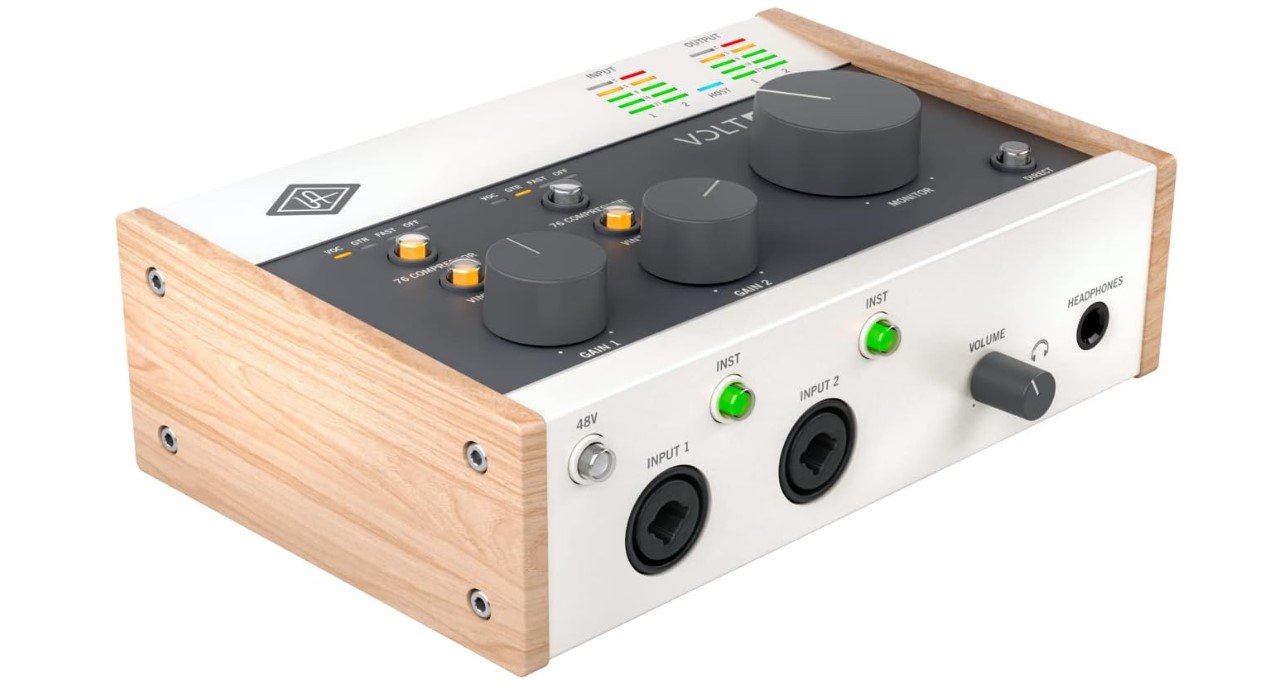
Universal Audio (UA) has long been a legendary name in high-end recording studios, famous for pristine hardware like the 1176 limiting amplifier and the premium Apollo line of audio interfaces. In this Universal Audio Volt 276 Review, we look at how UA aims to bring that classic analog flavor down to a budget-friendly price point. By packing custom analog emulation circuits directly into a desktop USB-C box, does this interface stand out in a crowded market? Let’s dive into our real-world testing to find out.
How We Tested
We put the Universal Audio Volt 276 through extensive real-world testing for three full weeks in a dedicated home studio setup.
Scenarios Tested: Tracking clean and spoken-word vocals, recording direct-input (DI) electric and bass guitars, and running long-session editing and mixing workflows.
Microphones Used: Shure SM7B (a notorious gain-hungry dynamic mic) and a Rode NT1-A condenser mic.
Monitoring Gear: Sennheiser HD 600 high-impedance headphones (300 ohms) and a pair of Kali Audio LP-6 studio monitors.
Comparative Reference: Tested side-by-side against a 4th Generation Focusrite Scarlett 2i2 and a Solid State Logic SSL 2+.
Specifications Table
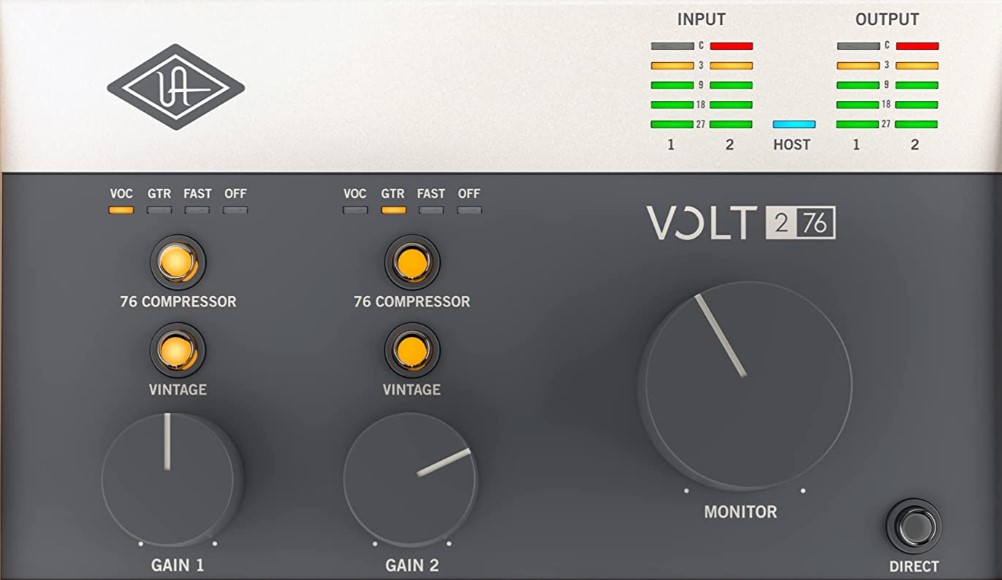
| Feature | Specification |
| I/O Configuration | 2-In / 2-Out USB 2.0 (USB-C Connection) |
| Preamp Technology | 2x Volt Preamps with Vintage Tube Emulation Mode |
| Analog Compression | Built-in 76 Compressor (VOC, GTR, FAST, OFF presets) |
| Conversion Resolution | 24-bit / 192 kHz |
| Preamplifier Gain Range | 55 dB |
| Dynamic Range | 111 dB (Inputs) / 110 dB (Outputs) |
| Headphone Output Power | 84 mW per channel into 32 ohms / 22 mW into 300 ohms |
| Additional I/O | 5-Pin DIN MIDI Input & Output |
| Power Source | USB Bus Powered or Optional 5V DC Input |
What I Like
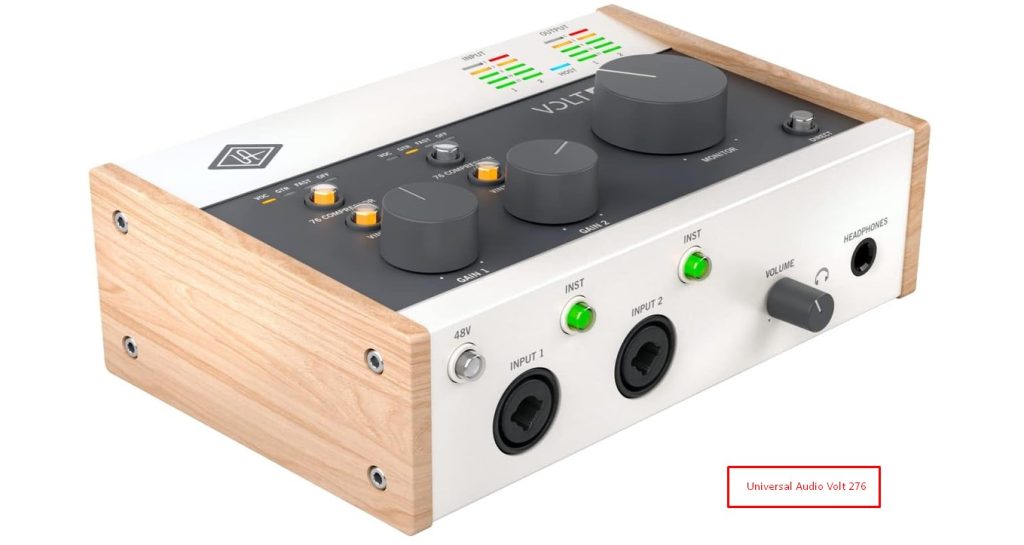
The Vintage Mic Preamp Mode: Pressing the Vintage button activates a solid-state analog emulation circuit that mimics UA’s legendary 610 tube console. It introduces a subtle, musical dip in the lower mid-range and adds pleasing harmonic excitement to vocals, instantly separating them from flat, raw digital captures.
True Analog 76 Compressor Presets: Unlike competitor emulations that rely entirely on digital software, the Volt 276 includes a genuine analog FET compressor circuit inspired by the 1176. The “VOC” (Vocal) and “GTR” (Guitar) presets work incredibly well to glue your tracking dynamics live before the signal ever hits your DAW.
Extremely Powerful Headphone Output: Many bus-powered interfaces choke when trying to feed power-hungry high-impedance headphones. The Volt 276 easily drove my 300-ohm Sennheiser HD 600s with plenty of volume headroom left on the dial.
Clear, High-Visibility Metering: The inclusion of distinct, multi-segment ladder LED meters for both the inputs and outputs on the top panel makes monitoring your gain staging an absolute breeze compared to tiny single-light halos.
What Could Be Better
All-or-Nothing Phantom Power: The +48V phantom power is controlled by a single global button on the front. If you want to use a condenser mic on Channel 1 and a delicate dynamic or ribbon mic on Channel 2, you have to be extra careful since both lines will receive live voltage.
Hiss on Aggressive Compressor Settings: While the analog compressor adds great punch, running the “FAST” preset while pushing the preamp gain past 80% introduces a noticeable, audible hiss into the track. It is best suited for cleaner inputs rather than low-output microphones that require massive gain boosts.
Awkward for Commuting Creators: The wood-paneled, wedge-shaped retro design looks gorgeous sitting flat on a desk, but it takes up a lot of vertical depth. It sits poorly in standard laptop sleeves or thin everyday backpacks compared to flatter, low-profile designs.
My Personal Experience
Design
The design of the Universal Audio Volt 276 is an absolute home run for fixed home studios. The sleek aluminum frame paired with real wood side panels gives it a beautiful, high-end retro aesthetic that immediately classes up your desk space. Having the main knobs, compressor settings, and LED meters positioned on the top face means you can easily check your status and tweak parameters from a comfortable sitting position without leaning over your gear.
Performance
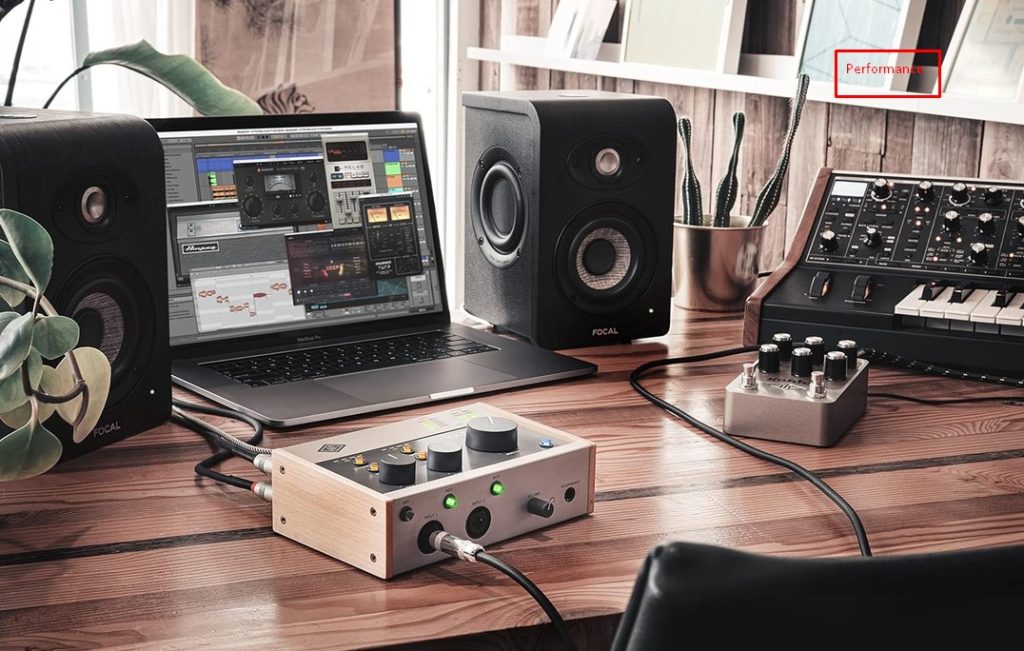
During my recording tests, the interface performed wonderfully with direct guitar tracking. Engaging the Vintage preamp combined with the “GTR” compressor preset gave my DI electric guitar a snappy, dynamic response that reacted beautifully to pick attack.
However, testing with a gain-hungry Shure SM7B revealed the unit’s boundaries. With 55 dB of available preamp gain, I had to twist the gain knob nearly all the way up to get a healthy signal level. When I layered the onboard 76 Compressor over it, the floor noise (hiss) became distinct. If you plan to record quiet voiceovers with a dynamic mic, you will likely still want an inline booster like a Cloudlifter or a FetHead.
Check Volt 276 Stock & Availability—>
An unexpected pro-level feature discovered during testing is that the monitor outputs are fully DC-coupled. This means if you are an electronic music producer, you can actually use the Volt 276 to send Control Voltage (CV) signals directly from your DAW out to modular synthesizers or Eurorack gear.

Build Quality & Comfort
The build quality feels remarkably robust. The large volume monitor knob turns with a satisfying, heavy resistance that makes minute adjustments predictable and smooth. The physical buttons lock into place with a definitive click, and the orange indicator lights let you know exactly what analog circuits are active at a single glance.
Comparison Section
To see how the Universal Audio Volt 276 shapes up against the competition, we stacked it up against two popular options: the Focusrite Scarlett 2i2 (4th Gen) and the Solid State Logic SSL 2+.
| Feature | Universal Audio Volt 276 | Focusrite Scarlett 2i2 (4th Gen) | Solid State Logic SSL 2+ |
| Price Range | ~$269 USD | ~$199 USD | ~$229 USD |
| Unique Feature | True Analog FET Compressor Circuit | Auto Gain & Safe Clip Protection | Legacy “4K” Analogue Enhancement |
| Preamp Gain | 55 dB | 69 dB | 62 dB |
| Dynamic Range | 111 dB | 120 dB | 111 dB |
| MIDI I/O | Yes (5-Pin DIN) | No | Yes (5-Pin DIN) |
Universal Audio Volt 276 vs. Focusrite Scarlett 2i2 (4th Gen)
The Scarlett 2i2 (4th Gen) offers a much cleaner, quieter preamp with a massive 69 dB of digital gain range, making it significantly better out-of-the-box for low-output dynamic mics. The Scarlett also offers smart utility tools like Auto Gain. However, the Volt 276 wins hands-down if you want vintage coloration and live analog dynamic control built straight into the hardware box without relying on software apps.
Universal Audio Volt 276 vs. Solid State Logic SSL 2+
The SSL 2+ features a pristine signal path and its famous “4K” button, which introduces a high-frequency shelf boost to bring vocals forward. While both units target analog modeling, the Volt 276 goes a step further by offering actual multi-stage dynamic compression presets rather than just an EQ/harmonic boost curve, making it a more versatile sound-shaping tool during tracking.

Pricing & Value Analysis
The Universal Audio Volt 276 sits comfortably in the premium tier of budget interfaces at around $269 USD. While it launched originally closer to $299, the recent stabilization makes it highly competitive.
The slight price premium over a baseline entry-level interface is completely justified by the inclusion of physical analog circuitry (the 76 Compressor components) and an incredibly generous, curated software bundle that includes LUNA DAW, Ableton Live Lite, and premium UAD plugins like the LA-2A and pure plate reverbs. If you are looking for a sterile, completely transparent interface, you can find cheaper options. But if your goal is to acquire character and color safely at the source, the Volt 276 offers exceptional, standalone value.
Buyer Intent Breakdown
Who Should Buy This Product
Vocalists and Songwriters: If you want your voice to sound warm, polished, and radio-ready instantly without needing to learn how to mix plugins.
Guitar and Bass Players: The Hi-Z instrument inputs matched with analog compression provide a rich, highly tactile response that feels like playing through a physical amp.
Desktop Music Producers: Creators who value dedicated MIDI I/O connectivity and beautiful desktop industrial design.
Buy Universal Audio Volt 276 on Amazon—>
Who Should Avoid This Product
- Mobile and Travel Engineers: Those who need a completely flat, slim tool to slip easily alongside a laptop into a tight travel case.
- Ultra-Transparent Audio Purists: Producers who want absolutely zero color, harmonic distortion, or altered tone added to their recordings.
Best & Worst Use Cases
- Best Use Case: Set up on a home studio desk for tracking podcasts, vocal covers, or livestreaming content where instant compression preserves perfect levels in real time.
- Worst Use Case: Trying to record field audio outside using an iPad and two mixed mic types (like a dynamic and a condenser mic together) due to the unified, un-switchable global phantom power limitations.
My Final Thoughts
Universal Audio successfully democratized their classic sound engine with the Volt 276. It strikes a wonderful balance between professional character adjustments and plug-and-play simplicity. While it has minor workflow quirks like the lack of individual channel phantom power controls and a slightly elevated noise floor when stacking high gain with aggressive compression presets the sonic advantages it brings to a home studio environment are massive.
FAQ
Does the Universal Audio Volt 276 require an external power supply?
No. The Universal Audio Volt 276 is completely USB bus-powered when connected to a standard Mac or PC. However, it does feature an optional 5V DC barrel input socket to provide stable secondary power if you are linking it to a mobile device like an iPad.
Can the Volt 276 run UAD DSP plugins internally like Apollo interfaces?
No, the Volt 276 does not feature onboard DSP chips to run proprietary UAD ecosystem plugins. It operates as a standard, class-compliant USB interface, and the included premium UAD plugins run natively using your computer’s computer CPU processing power instead.
What is the difference between the Volt 2 and the Volt 276?
The standard Volt 2 features a basic plastic housing with simple preamps. The upgraded Volt 276 introduces an all-metal build with retro wooden sides, top-mounted multi-segment LED meter ladders, and a built-in analog 76 FET compressor circuit with dedicated hardware preset toggles.
Is the compressor on the Volt 276 digital or analog?
The 76 Compressor built into the Universal Audio Volt 276 is a genuine, custom-designed analog circuit inspired by the classic hardware 1176 Limiting Amplifier. It processes your incoming vocal or instrument signals entirely in the analog domain before conversion.
Final Verdict
If you want a sterile, mathematically perfect layout, go grab a Focusrite. But if you want your home studio tracks to carry true musical weight, harmonic texture, and classic studio color right from the very first drop, the Universal Audio Volt 276 is one of the most satisfying desktop investments you can make.