
Audio-Technica AT2020 and the AKG P120 are two of the most widely used entry-level XLR cardioid condenser microphones on the market. Both sit in the sub-$100 studio category, both require 48V phantom power via an audio interface, and both target home studio producers, vocalists, podcasters, and streamers.
Updated October 2026: Both microphones here are XLR condensers, so the honest comparison is not mic price versus mic price - it is total setup cost versus total setup cost. Neither works without an audio interface with phantom power, an XLR cable, and a stand, and that chain costs the same whichever of the two you pick. This update adds the disclosure this article was missing, fixes the article’s heading structure so its sections are real H2s, and adds a setup-first verdict below.
Disclosure: This article contains affiliate links. If you buy through them, HeadphoneEcho may earn a small commission at no extra cost to you. Recommendations are based on research and published specifications, not on commissions.
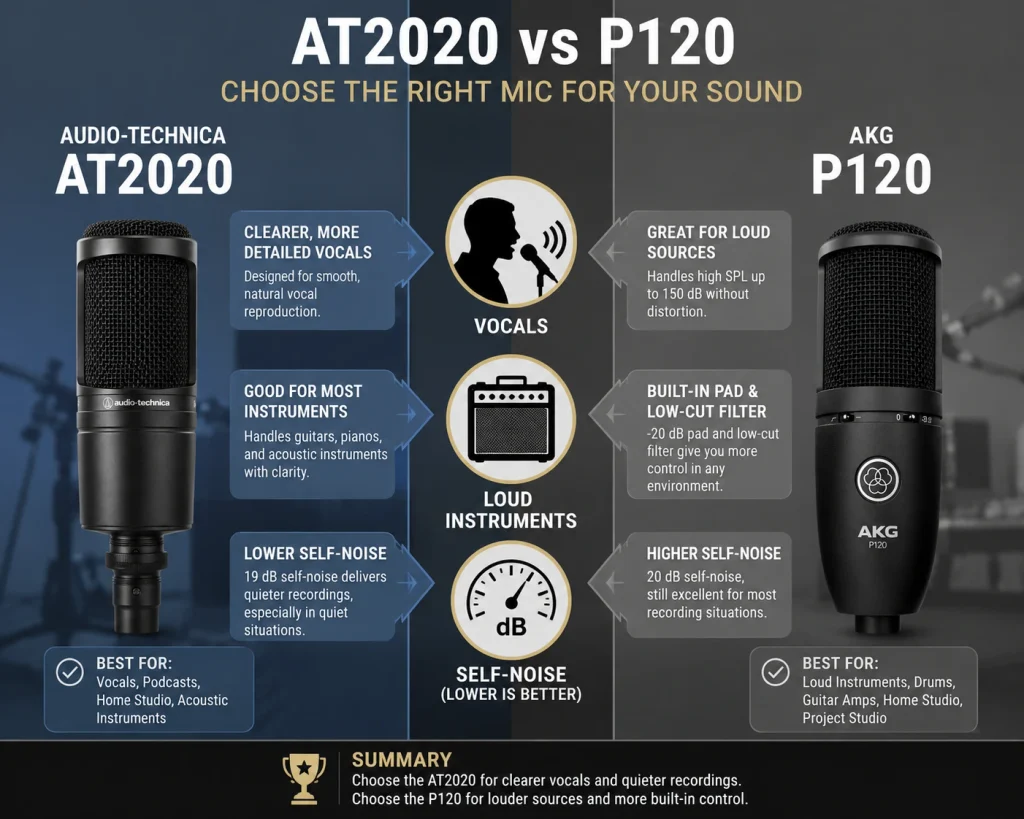
The biggest functional difference lies in hardware versatility and acoustic tuning. The AKG P120 features an onboard -20 dB attenuation pad and a 300 Hz bass-cut filter, making it adaptable to loud instruments and boomy rooms. The Audio-Technica AT2020 omits all onboard switches in favor of a fixed acoustic profile that delivers a smoother, more neutral midrange presence that excels on human speech and vocal tracking.
Winner by Category
| Category | Winner | Key Advantage |
| Vocal Tone & Speech | Audio-Technica AT2020 | Smoother midrange tuning with less aggressive upper-mid bite |
| Hardware Features | AKG P120 | Onboard -20 dB pad and 300 Hz bass-cut filter |
| High SPL Handling | AKG P120 | Handles up to 150 dB SPL with the -20 dB pad active |
| Self-Noise (Equivalent Noise) | AKG P120 | Slight technical edge at 19 dBA versus 20 dBA |
| Podcasting & Streaming | Audio-Technica AT2020 | Flattering vocal profile requiring minimal equalization |
| Acoustic Guitar Recording | Audio-Technica AT2020 | Balanced string definition and linear low-end capture |
| Loud Instruments (Drums/Amps) | AKG P120 | Attenuation pad prevents preamp clipping on loud sources |
| Build Quality & Weight | AKG P120 | Heavier all-metal chassis at 455 grams |
| Included Accessories | Audio-Technica AT2020 | Includes stand mount, 5/8-inch to 3/8-inch adapter, and zip pouch |
| Overall Value | Tie | Depends on whether you prioritize vocal tuning or hardware switches |
Key Specifications
| Specification | Audio-Technica AT2020 | AKG P120 |
| Transducer Type | Fixed-charge back plate condenser | Back-electret condenser |
| Polar Pattern | Cardioid | Cardioid |
| Diaphragm Diameter | 16 mm (0.63 in) | 16.9 mm (0.66 in) |
| Frequency Response | 20 Hz to 20,000 Hz | 20 Hz to 20,000 Hz |
| Sensitivity | -37 dBV/Pa (14.1 mV) | -32.5 dBV/Pa (24 mV) |
| Self-Noise (Equivalent SPL) | 20 dB SPL | 19 dB SPL (A-weighted) |
| Signal-to-Noise Ratio | 74 dB at 1 kHz / 1 Pa | 75 dB at 1 kHz / 1 Pa (A-weighted) |
| Max SPL (0.5% – 1% THD) | 144 dB SPL | 130 dB SPL (150 dB with -20 dB pad) |
| Onboard Switches | None | -20 dB pad, 300 Hz low-cut filter |
| Output Impedance | 100 Ohms | 200 Ohms |
| Power Requirement | 48V DC Phantom Power (2 mA) | 48V DC Phantom Power (3 mA) |
| Body Weight | 345 g (12.1 oz) | 455 g (16.0 oz) |
| Launch MSRP | $99 | $99 – $119 |
Hardware Design & Onboard Controls
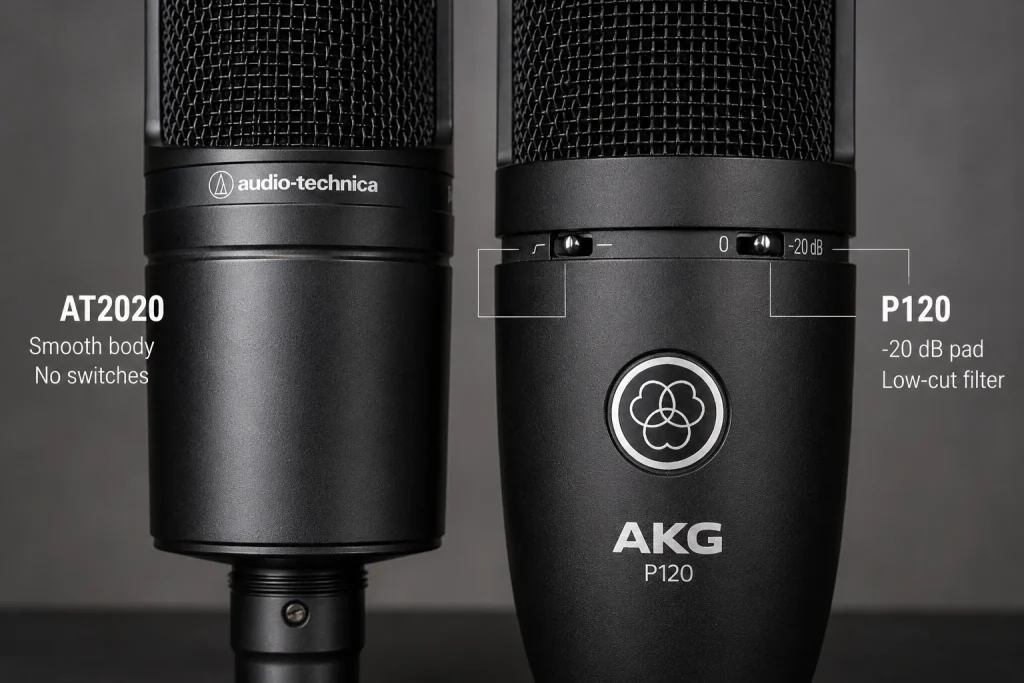
Physical design and onboard versatility mark the clearest structural distinction between these two microphones. Both units utilize side-address form factors housed in rugged metal chassis with standard 3-pin XLR output connectors at the base.
The Audio-Technica AT2020 features a streamlined, cylindrical design weighing 345 grams. Its matte-black body contains zero switches or dials. Every adjustment to gain staging, frequency response, or low-frequency roll-off must occur at your audio interface or inside your digital audio workstation (DAW).
The AKG P120 features a slightly wider, heavier housing at 455 grams. On the rear of the microphone body, AKG integrates two physical toggle switches:
-20 dB Preattenuation Pad: Reduces incoming signal level before the internal electronics, raising maximum SPL capability from 130 dB up to 150 dB.
Low-Cut / Bass-Cut Filter (300 Hz at 6 dB/octave): Rolls off low frequencies to mitigate mechanical rumble, footfall vibrations, and excessive proximity effect.
How We Evaluated
This comparison synthesizes official manufacturer technical specifications, third-party acoustic measurements, published frequency response curves, and verified expert evaluations. We analyzed performance across spoken word intelligibility, singing vocals, acoustic instrument tracking, high-volume source management, self-noise impact, and chassis durability.
Limitations: Room acoustics, background ambient noise, audio interface preamp quality, vocal technique, pop filter placement, and microphone positioning significantly influence real-world recording results.
Audio-Technica AT2020 Review
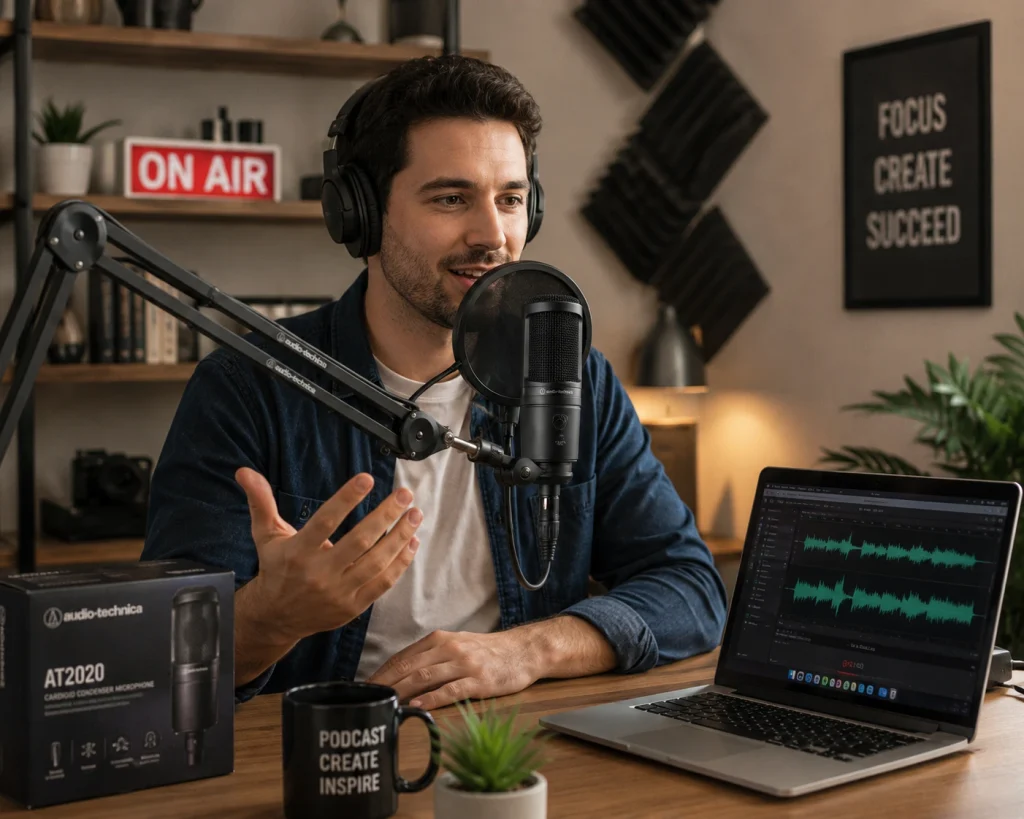
The Audio-Technica AT2020 is widely regarded as an industry benchmark for affordable studio condenser microphones. Designed with a custom-engineered 16 mm low-mass diaphragm, the AT2020 provides clean transient response and an articulate frequency curve that flatters vocal capture.
What I Like
- Natural, articulate vocal presentation requiring little corrective equalization.
- Well-controlled cardioid polar pattern that rejects unwanted rear room reflections.
- Robust 144 dB SPL rating handles aggressive vocalists and acoustic sources with low distortion.
- Compact 345-gram footprint mounts securely on budget boom arms without drooping.
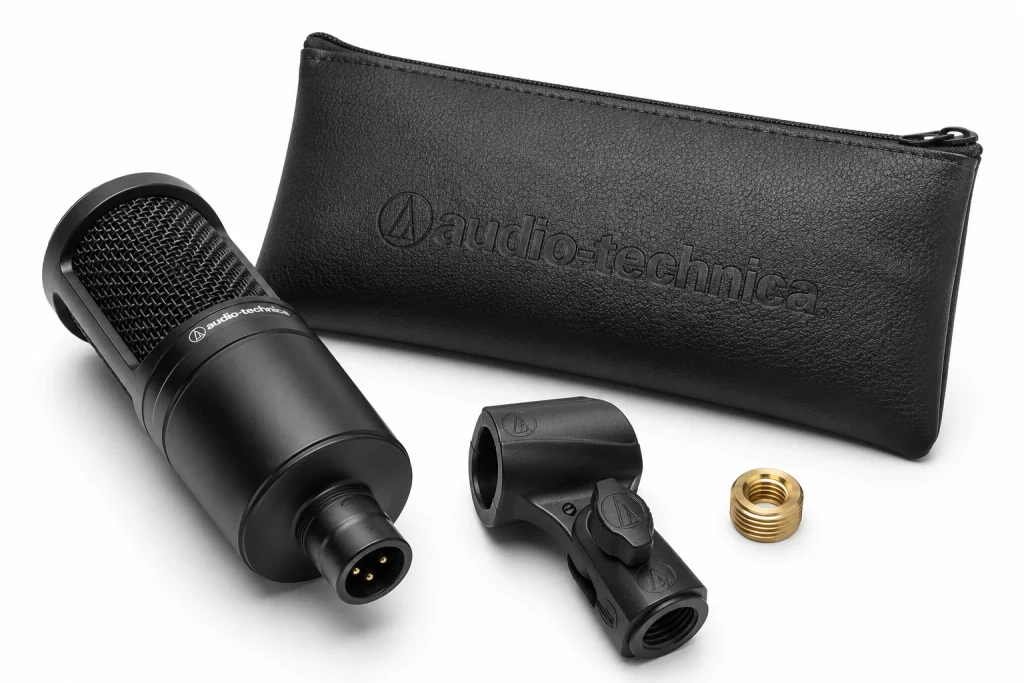
- Included pivoting stand mount and protective storage pouch in the retail package.
- Dependable long-term build quality backed by Audio-Technica manufacturing standards.
What Could Be Better
- Lacks onboard hardware switches for attenuation or high-pass filtering.
- Self-noise of 20 dB SPL is slightly high for recording extremely quiet instruments or whispered dialogue.
- Sensitive to plosive pops without an external mesh or foam pop filter.
- Sensitive to desk thumps when using the standard hard-mount collar rather than a spider shock mount.
Pros & Cons
| Pros | Cons |
| Smooth, radio-ready vocal clarity | No onboard low-cut filter or pad switch |
| 144 dB SPL limit handles loud vocalists easily | 20 dBA self-noise audible on very quiet sources |
| Lightweight design works with any boom arm | Requires dedicated shock mount to eliminate desk rumbles |
| Excellent off-axis sound isolation | High-frequency rise can accent sibilance in bright rooms |
Best For: Solo content creators, podcasters, voiceover talents, and vocalists who prioritize articulate speech and vocal warmth in controlled or semi-treated spaces.
Recommendation: If your primary workflow centers on spoken word, streaming, or lead vocal tracks, the AT2020 offers the more predictable, flattering frequency profile in the sub-$100 category.
Check Audio-Technica AT2020 Price on Amazon →
AKG P120 Review
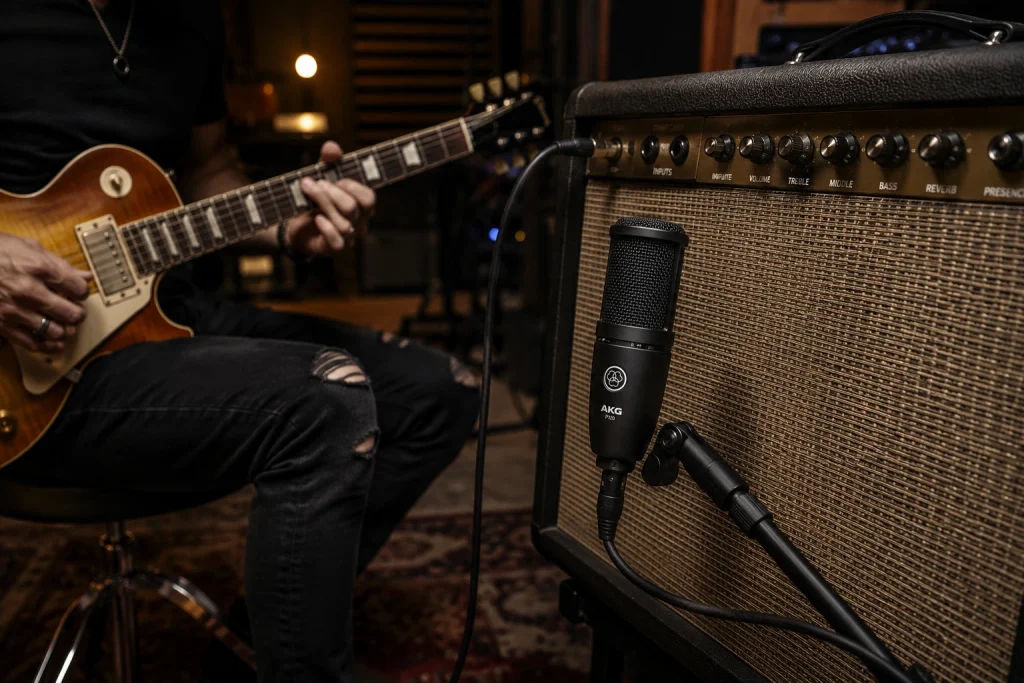
The AKG P120 (part of AKG’s Project Studio Line) is an all-metal, general-purpose condenser microphone engineered for utility and high dynamic range. Built around a 0.66-inch (16.9 mm) diaphragm, the P120 brings classic AKG clarity alongside dedicated hardware switches designed to manage demanding recording scenarios.
What I Like
- Onboard -20 dB preattenuation pad expands SPL tolerance up to an impressive 150 dB.
- Switchable 300 Hz low-cut filter effectively eliminates room rumble and mechanical floor noise.
- Heavy-duty all-metal die-cast chassis built for rigorous studio handling.
- Measured self-noise of 19 dB SPL is respectable for an entry-level studio condenser.
- Crisp upper-register frequency extension brings brightness to dull instruments.
- Exceptional capability when placed in front of electric guitar cabinets and percussion.
What Could Be Better
- The 300 Hz filter slope is steep and can thin out deeper vocal fundamentals if left on continuously.
- High frequencies can sound slightly brittle on already-bright vocalists.
- Heavier body (455 g) requires a sturdy desk arm to prevent slipping.
- Does not include a zippered carrying pouch in standard packaging.
Pros & Cons
| Pros | Cons |
| Onboard -20 dB pad and 300 Hz low-cut filter | Top-end response can lean sharp or sibilant |
| Massive 150 dB maximum SPL handling | 300 Hz filter cuts higher into the midrange than standard 80 Hz filters |
| Rugged die-cast metal body | Heavy construction demands tighter boom arm tension |
| 19 dBA self-noise slightly outpaces competitors | No protective storage pouch included |
Best For: Multi-instrumentalist project studios, drum overheads, guitar amplifier miking, and creators recording in boomy acoustic spaces needing immediate low-end roll-off.
Recommendation: Choose the AKG P120 if you require an adaptable studio utility mic that can pivot from quiet acoustic tracking to recording blaring guitar amps without overloading your audio interface preamps.
Check AKG P120 Price on Amazon →
Head-to-Head Comparison
Sound Signature and Frequency Response
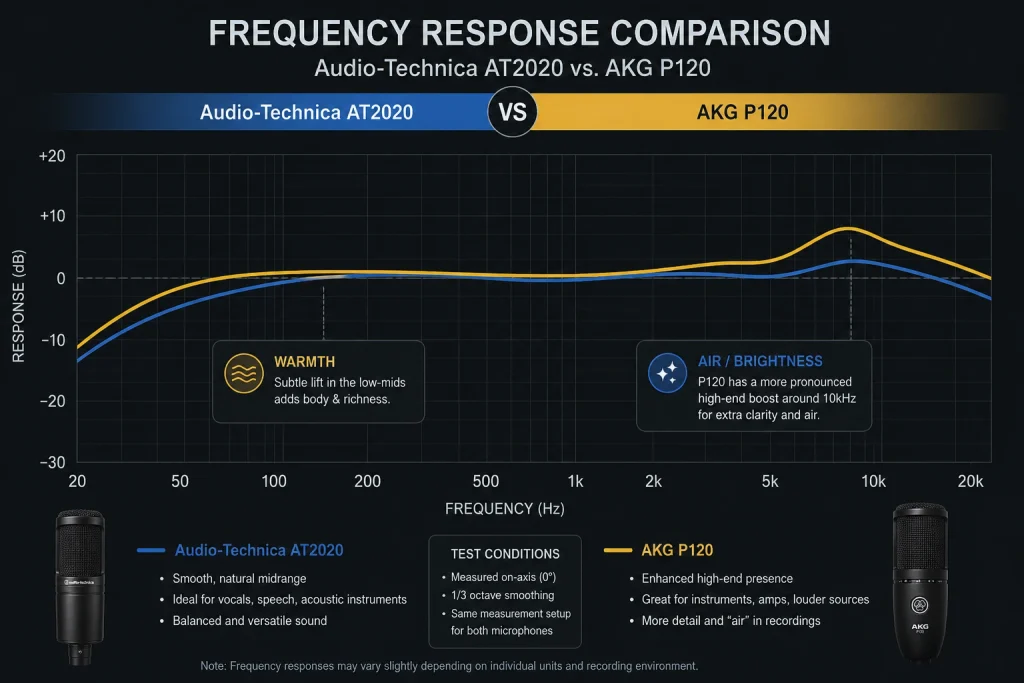
Both microphones operate across the standard 20 Hz to 20,000 Hz frequency range, but their acoustic voicing differs in critical regions.
The Audio-Technica AT2020 maintains a relatively flat response through the lower-mid and midrange frequencies, followed by a gentle, gradual lift between 5 kHz and 10 kHz. This tuning lends warmth and intelligibility to human voices without sounding overly harsh or shrill.
The AKG P120 produces a slightly more pronounced high-end sheen with an emphasis around 10 kHz to 12 kHz. This brightness helps acoustic instruments cut through a dense mix, but it can emphasize vocal sibilance (“s” and “t” sounds) if the vocalist has a naturally piercing tone.
Winner: Audio-Technica AT2020 (for natural vocal response)
Hardware Filters and Pad Switches
The hardware comparison is a straightforward victory for the AKG P120.
The AT2020 has no physical switches. If you experience low-frequency HVAC rumble or desk vibration, you must apply a high-pass filter in your software or DAW.
The AKG P120 features two switches on the chassis:
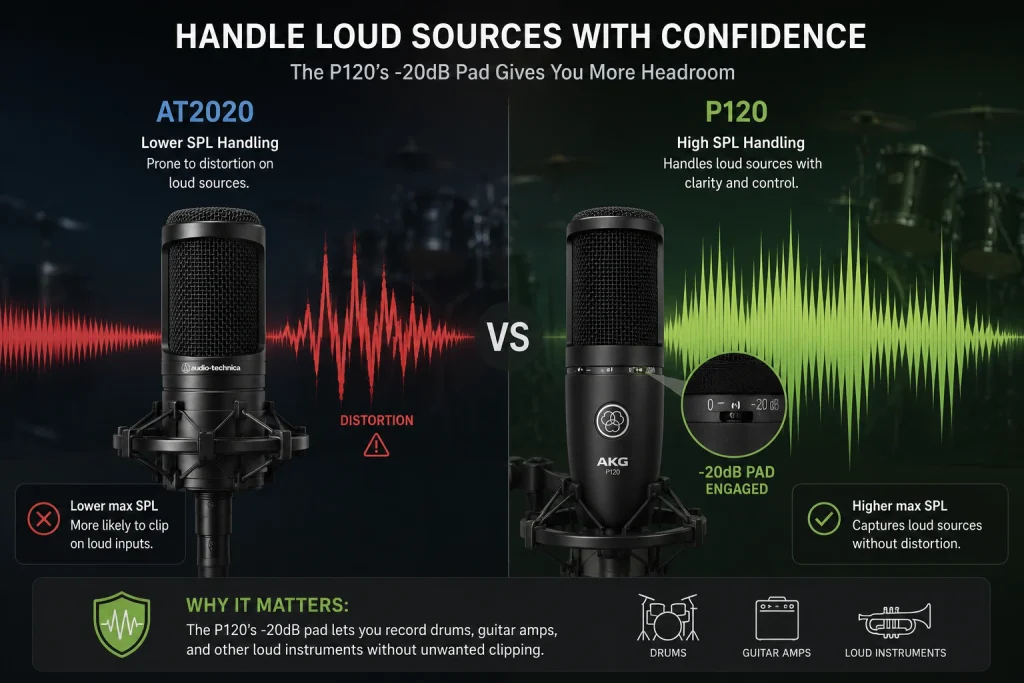
The -20 dB Pad: Drops incoming gain to prevent analog clipping at the capsule stage when tracking loud snares, brass, or amplifiers.
The 300 Hz High-Pass Filter: Cuts low rumble. Note that 300 Hz is relatively high compared to standard 80 Hz studio filters, so engaging it will noticeably reduce vocal chest resonance while cleaning up muddy low frequencies.
Winner: AKG P120
High SPL Handling and Dynamic Range
Maximum Sound Pressure Level (SPL) defines how much acoustic volume a microphone can capture before total harmonic distortion occurs.
The Audio-Technica AT2020 delivers a fixed maximum SPL rating of 144 dB SPL (at 1 kHz, 1% THD). This is exceptionally high for a condenser microphone and more than sufficient for screamed vocals, loud acoustic guitars, and horns.
The AKG P120 is rated at 130 dB SPL in standard mode. However, when you engage the onboard -20 dB pad, its ceiling extends to 150 dB SPL (at 0.5% THD). This extra headroom makes the P120 virtually immune to capsule distortion, even when placed inches away from aggressive drum kits or cranked tube amplifiers.
Winner: AKG P120
Self-Noise and Sensitivity
Self-noise (equivalent noise level) represents the ambient hiss generated by the microphone’s internal electronics.
The AKG P120 is rated at 19 dB SPL (A-weighted) with a sensitivity of 24 mV/Pa (-32.5 dBV).
The Audio-Technica AT2020 is rated at 20 dB SPL with a sensitivity of 14.1 mV/Pa (-37 dBV).
The P120 has slightly higher sensitivity, meaning it requires marginally less preamp gain on your interface to reach equivalent recording levels. The 1 dBA difference in self-noise is negligible in typical home studios where ambient room noise (computer fans, air conditioning) far exceeds 20 dBA.
Winner: Tie (AKG P120 holds a minor numerical advantage)
Spoken Word, Voiceover, and Streaming
When recording speech for YouTube videos, podcasts, Twitch streams, or audiobooks, midrange clarity is essential.
The AT2020 is a favorite among content creators because its acoustic tuning produces natural vocal weight and smooth presence without requiring extensive post-processing. The AKG P120 performs capably, but its brighter top-end can accentuate mouth clicks and room reflections in untreated recording spaces.
Winner: Audio-Technica AT2020
Acoustic Instrument Recording
For recording acoustic steel-string guitars, mandolins, and hand percussion, both microphones offer strengths:
The AT2020 provides a balanced body-to-string ratio that captures full-bodied acoustic strums accurately.
The AKG P120 provides extra sparkle and crisp transient attack on fingerpicked instruments and acoustic rhythm tracks.
Winner: Tie (Depends on preference for acoustic warmth vs top-end sparkle)
Build Quality, Mounting, and In-Box Accessories
Both microphones utilize heavy metal bodies designed for years of studio operation.
The AKG P120 is heavier (455 g vs 345 g), featuring a rugged die-cast zinc chassis and a reinforced wire-mesh grille. However, the AT2020 includes a more complete accessory kit: a dedicated pivoting stand mount with a 5/8-inch-27 to 3/8-inch-16 threaded adapter, plus a soft zippered storage pouch. The P120 includes a stand adapter but omits a storage bag.
Winner: Audio-Technica AT2020 (for included accessories)
Evidence-Based “My Take”
My Take: For the vast majority of solo creators, podcasters, and home vocalists, the Audio-Technica AT2020 is the superior purchase. Its frequency curve is tuned to deliver an immediate, balanced vocal tone that sits comfortably in a mix without harsh sibilance. However, if your setup involves recording high-volume electric guitar amps, drums, or tracking in an untreated space plagued by low-end rumble, the AKG P120’s physical -20 dB pad and low-cut switch offer practical hardware utility that the AT2020 simply cannot match without software intervention.
Buyer-Specific Recommendations
- Best for Spoken Word and Podcasting: Audio-Technica AT2020. Its smooth midrange reproduction ensures voices sound natural and authoritative.
- Best for Singing Vocals: Audio-Technica AT2020. Offers a forgiving high-frequency curve that prevents harshness on belt notes and sibilant consonants.
- Best for Loud Instrument Recording (Amps, Drums): AKG P120. The -20 dB preattenuation pad raises SPL tolerance to 150 dB, preventing input clipping.
- Best for Boomy or Untreated Rooms: AKG P120. The onboard 300 Hz low-cut filter strips away muddy room resonance and HVAC hum at the source.
- Best for Lightweight Boom Arms: Audio-Technica AT2020. At 345 grams, it places significantly less mechanical strain on budget articulated arms than the 455-gram P120.
- Best Overall Value for Multi-Instrument Studios: AKG P120. Dedicated physical switches provide maximum flexibility across multiple recording tasks.
Buyer Decision Matrix
| If You Care Most About… | Buy | Why |
| Natural Vocal & Speech Tone | Audio-Technica AT2020 | Flattering midrange and balanced 5-10 kHz presence |
| Hardware Attenuation (-20 dB Pad) | AKG P120 | Handles up to 150 dB SPL without capsule overload |
| Onboard Bass Roll-Off | AKG P120 | Integrated 300 Hz switch cuts rumble immediately |
| Podcast & Streaming Simplicity | Audio-Technica AT2020 | Clean sound right out of the box with minimal EQ |
| Guitar Amps & Loud Percussion | AKG P120 | Superior dynamic ceiling under extreme volume |
| Lighter Microphone Weight | Audio-Technica AT2020 | 345 g chassis won’t sag on budget desk mounts |
| Complete Package (Mount + Pouch) | Audio-Technica AT2020 | Includes stand adapter and zippered storage pouch |
Alternative Competitors to Consider
- Audio-Technica AT2035: The direct step-up to the AT2020. It incorporates a larger diaphragm capsule, an 80 Hz high-pass filter, a -10 dB pad, lower self-noise (12 dBA), and an included spider shock mount for approximately $149.
- Rode NT1 Signature Edition: A premium step up in the $159 range offering ultra-low self-noise (4 dBA) and an exceptionally smooth, detailed frequency response for dedicated studio vocal tracking.
- PreSonus PX-1: A direct sub-$100 competitor featuring a true 25 mm large-diaphragm capsule with warm low-end response, competing closely with the AT2020 for voiceover use.
- Shure SM58 / MV7X: If your room is completely untreated and suffers from loud reflections, traffic noise, or keyboard clicks, dynamic microphones like the SM58 or MV7X will reject background noise far more effectively than any sensitive condenser mic.
Price and Value
Both microphones regularly retail around the $99 mark. At this price point:
- The Audio-Technica AT2020 delivers superior vocal tuning and accessory value (stand adapter + travel pouch).
- The AKG P120 delivers superior hardware utility via dual physical switches and 150 dB SPL handling.
Neither microphone holds an unfair price advantage over the other. The better value is determined entirely by whether your recording workflow prioritizes vocal reproduction or multi-instrument versatility.
Who Should Buy Which?
Buy the Audio-Technica AT2020 if you:
- Record spoken word, podcasts, Twitch streams, or YouTube commentary.
- Want a natural vocal sound profile that requires minimal equalization.
- Use a lightweight boom arm or scissor stand that struggles with heavy mics.
- Already handle equalization, high-pass filtering, and gain staging in software or on your interface.
Buy the AKG P120 if you:
- Record loud sound sources such as electric guitar cabinets, snares, or brass.
- Need an onboard physical low-cut filter to tame floor vibrations or room boom.
- Prefer a brighter acoustic top end for acoustic guitar or percussion articulation.
- Want a heavier, ultra-rugged die-cast metal chassis.
Final Comparison Table
| Feature / Category | Audio-Technica AT2020 | AKG P120 | Category Winner |
| Vocal Naturalness | Warm, smooth presence | Bright, articulate high-end | Audio-Technica AT2020 |
| Hardware Controls | None | -20 dB Pad, 300 Hz Bass-Cut | AKG P120 |
| Max SPL | 144 dB SPL | 150 dB SPL (with pad) | AKG P120 |
| Self-Noise | 20 dB SPL | 19 dB SPL (A-weighted) | AKG P120 (Slight) |
| Sensitivity | 14.1 mV/Pa | 24.0 mV/Pa | AKG P120 |
| Speech / Streaming | Radio-ready midrange | Clear, can emphasize clicks | Audio-Technica AT2020 |
| Acoustic Instruments | Balanced and full | Crisp and bright | Tie |
| Loud Amps / Drums | Good up to 144 dB | Excellent up to 150 dB | AKG P120 |
| Accessories | Mount + adapter + pouch | Stand adapter only | Audio-Technica AT2020 |
| Overall Recommendation | Best for Vocals & Speech | Best for Utility & Instruments | Audience Dependent |
2026 Check: Compare the Whole Setup, Not Just the Two Mics
Budget for the same chain either way. Both mics need phantom power from an interface, an XLR cable, and a stand or arm. If you already own that chain, the price difference between the two microphones is the whole decision. If you do not, the interface is the bigger purchase - and it matters more to your final sound than which of these two budget condensers sits on the stand.
Let the room break the tie. In an untreated room, the differences between two entry-level condensers are small next to what the room itself adds: echo, computer fan noise, and reflections reach both mics equally. Treat the recording spot first - closer mic distance, a quieter corner, soft surfaces - and either mic will sound better than the “winner” recorded in a bare, echoey room.
Pick by job, not by brand loyalty. Use the article’s own Winner by Category and Buyer Decision Matrix sections above for the per-use call, and check the individual reviews for the full picture: the AT2020 review and the P120 review.
Expert Verdict
The Audio-Technica AT2020 and AKG P120 represent two distinct design philosophies in the budget studio microphone market.
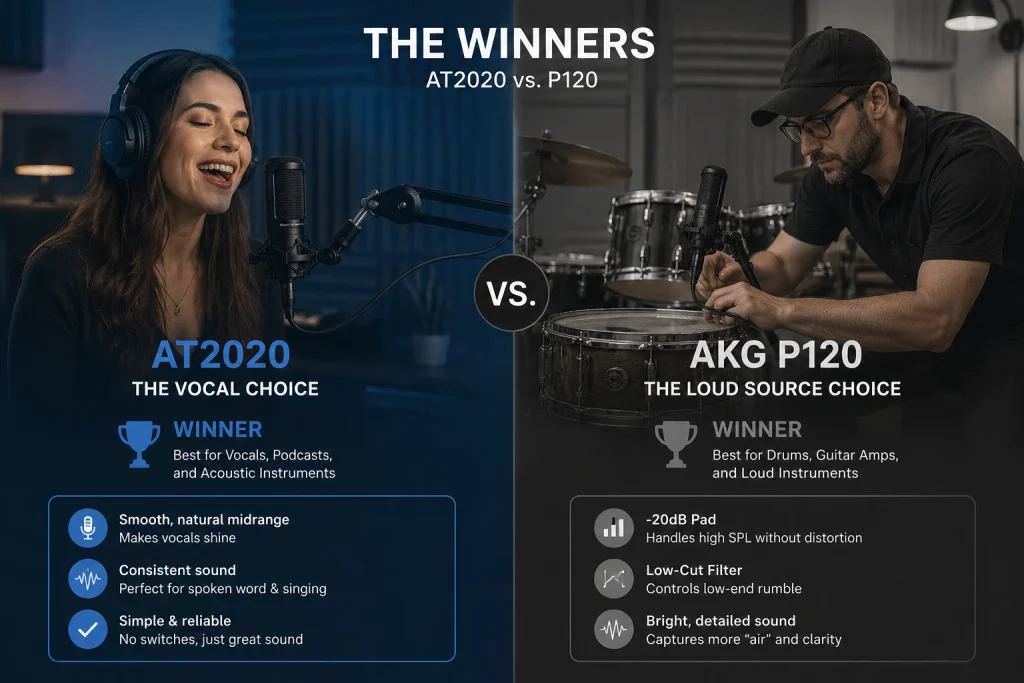
The Audio-Technica AT2020 wins as the premier vocal, streaming, and podcasting microphone. Its 16 mm diaphragm delivers an articulate, balanced frequency profile with smooth midrange clarity that flatters speech and singing vocals without inducing harsh sibilance. Its primary limitation is the lack of physical onboard switches, requiring software equalization for high-pass filtering.
The AKG P120 wins as the most versatile studio utility microphone. Equipped with an onboard -20 dB pad and a 300 Hz bass-cut filter, it manages high-volume instruments up to 150 dB SPL and eliminates mechanical low-end rumble right at the microphone body.
Choose the Audio-Technica AT2020 if your primary goal is vocal tracking, voiceover, podcasting, or streaming.
Choose the AKG P120 if you record loud instruments, guitar cabinets, and drums, or need hardware low-cut filtering in an untreated room.
Ready to Choose Your Microphone?
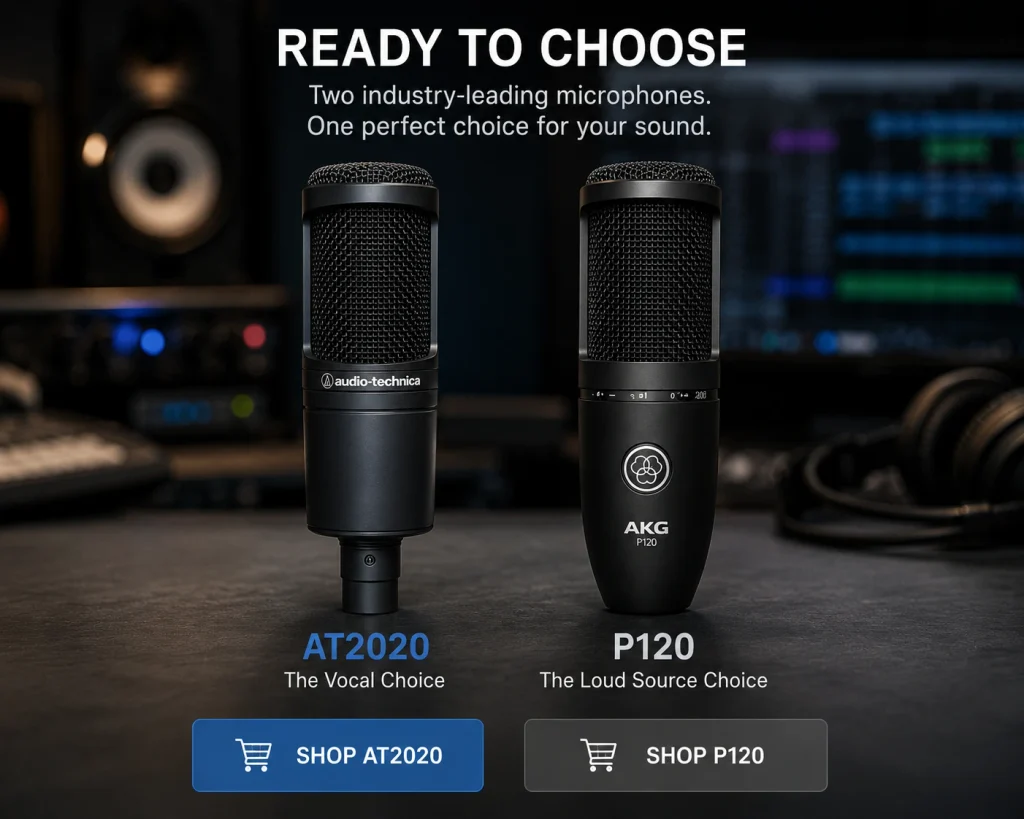
View Current Offers for Audio-Technica AT2020 →
View Current Offers for AKG P120 →
Full Technical Specifications
| Parameter | Audio-Technica AT2020 | AKG P120 |
| Microphone Type | Side-address studio condenser | Side-address project studio condenser |
| Polar Pattern | Cardioid | Cardioid |
| Diaphragm Size | 16 mm (0.63 in) | 16.9 mm (0.66 in) |
| Frequency Bandwidth | 20 Hz – 20,000 Hz | 20 Hz – 20,000 Hz |
| Sensitivity | -37 dB (14.1 mV) re 1V at 1 Pa | 24 mV/Pa (-32.5 dBV) |
| Equivalent Noise Level (Self-Noise) | 20 dB SPL | 19 dB-A |
| Signal-to-Noise Ratio | 74 dB, 1 kHz at 1 Pa | 75 dB-A, 1 kHz at 1 Pa |
| Maximum Input Sound Level | 144 dB SPL, 1 kHz at 1% T.H.D. | 130 dB SPL (0.5% THD) / 150 dB SPL with pad |
| Preattenuation Pad | None | -20 dB switchable |
| Bass-Cut Filter | None | 300 Hz, 6 dB/octave switchable |
| Electrical Impedance | 100 Ohms | <= 200 Ohms |
| Recommended Load Impedance | >= 1,000 Ohms | >= 1,000 Ohms |
| Phantom Power Requirements | 48V DC, 2 mA typical | 48V DC (+/- 4V), 3 mA |
| Output Connector | Integral 3-pin XLR Male | Balanced 3-pin XLR Male |
| Dimensions (Length x Diameter) | 162.0 mm x 52.0 mm (6.38 x 2.05 in) | 165.0 mm x 54.0 mm (6.50 x 2.13 in) |
| Net Weight | 345 g (12.1 oz) | 455 g (16.0 oz) |
| Included Accessories | Stand mount (5/8″-27), 3/8″-16 adapter, pouch | Stand adapter (5/8″-27 / 3/8″-16) |
Frequently Asked Questions
Which microphone sounds better for vocals, the AT2020 or AKG P120?
The Audio-Technica AT2020 generally sounds smoother on both male and female vocals. It features a warm, articulate midrange with a controlled high-end boost between 5 kHz and 10 kHz. The AKG P120 has a brighter top end that can sound airy on some singers, but can also accentuate harsh sibilance or mouth clicks.
Do the Audio-Technica AT2020 and AKG P120 need phantom power?
Yes. Both microphones are true condenser models that require +48V phantom power delivered through a standard 3-pin XLR cable from an audio interface, mixer, or standalone preamp. Neither microphone will produce sound if plugged directly into a computer using a simple 3.5mm adapter.
What is the benefit of the AKG P120’s -20 dB pad switch?
The -20 dB pad switch reduces the sensitivity of the microphone capsule before the internal preamplifier stage. This allows the P120 to record exceptionally loud sound sources (such as snare drums, brass instruments, and guitar amplifier speakers) up to 150 dB SPL without distorting the audio signal.
What does the 300 Hz low-cut filter do on the AKG P120?
The 300 Hz filter rolls off low frequencies at a slope of 6 dB per octave. This feature eliminates sub-bass floor rumbles, HVAC air conditioning hum, and excessive proximity effect (boomy bass when speaking close to the mic) directly at the hardware stage.
Does the Audio-Technica AT2020 have any onboard switches?
No. The AT2020 features a fixed acoustic design with no physical pads or filter switches on its body. Any gain attenuation or frequency filtering must be applied through your audio interface hardware or digital audio software.
Can I use either microphone for podcasting and streaming?
Yes. Both microphones are popular for content creation, but the AT2020 is widely favored by streamers and podcasters because its balanced vocal curve provides broadcast-ready speech with minimal equalization. Because both are sensitive condenser mics, they perform best in quiet, treated rooms.
Which microphone has lower self-noise?
The AKG P120 is rated at 19 dB-A self-noise, while the Audio-Technica AT2020 is rated at 20 dB SPL. In practical home studio conditions, this 1 dB difference is imperceptible, as background room noise typically masks such low noise floors.
Are these microphones USB or XLR?
Both the AT2020 and AKG P120 discussed here are balanced XLR microphones. Note that Audio-Technica produces a separate model named the AT2020USB-X, but the standard AT2020 requires an XLR audio interface.
Which microphone handles acoustic guitar better?
Both microphones perform well on acoustic guitar. The AT2020 provides a full-bodied, natural acoustic balance, while the AKG P120 provides extra high-frequency sparkle and string definition.
What accessories are included with each microphone?
The Audio-Technica AT2020 includes a pivoting threaded stand mount, a 5/8-inch to 3/8-inch thread adapter, and a zippered storage pouch. The AKG P120 includes a threaded stand adapter but does not include a protective pouch.
Do I need a shock mount for these microphones?
Yes, a dedicated spider shock mount is highly recommended for both microphones. Because condenser capsules are sensitive to mechanical vibrations, hard stand mounts can transfer desk bumps, typing vibrations, and footfalls directly into your audio track.
Can the AT2020 or AKG P120 work in an untreated room?
Both microphones can work in an untreated room if positioned close to the speaker (within 4 to 8 inches) using proper gain staging and a pop filter. However, because condenser capsules capture subtle high-frequency details, they will pick up more room echo than dynamic microphones like the Shure SM58 or MV7X.
Related reading: AKG P220 vs P420